
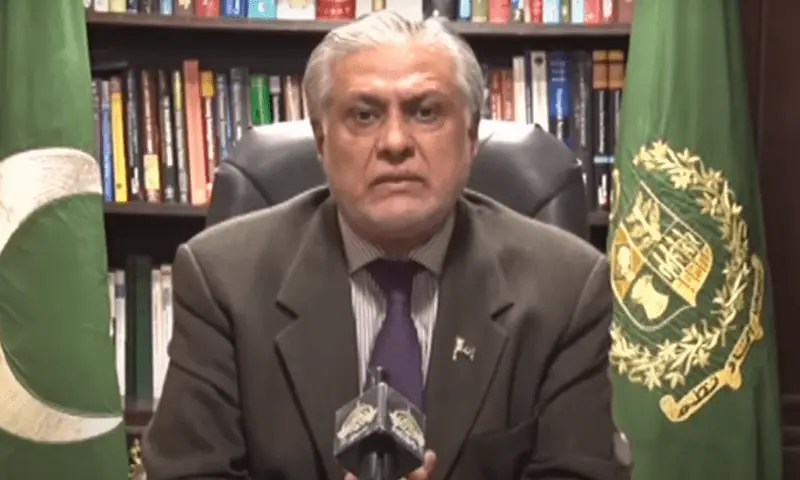
ISLAMABAD, DEC 19 /DNA/: Deputy Prime Minister and Foreign Minister Ishaq Dar said on Friday that India has consistently attempted to undermine the Indus Waters Treaty in a systemic manner.
He made the remarks while addressing the media in Islamabad, a day after the Foreign Office said it had sought a clarification from India via a letter over a sudden variation in the Chenab River’s flow.
At the beginning of his briefing, Dar said he wished to draw attention to a situation that threatened peace and stability in South Asia.
“We witnessed in April this year India’s unilateral abeyance of the Indus Waters Treaty … But what we are witnessing now is material breaches by India that strike at the heart of the Indus Waters Treaty with escalating consequences both for regional stability and sanctity of international law,” he said.
“We have observed unusual, abrupt variations in the flow of the Chenab River twice this year,” he said, adding that these were observed from April 30 to May 21 and Dec 7 to Dec 15.
“These variations in water flow are of extreme concern to Pakistan as they point to the unilateral release of water by India into the Chenab River. India has released this water without any prior notification or any data or information sharing with Pakistan as required under the treaty,” he said.
“India’s manipulation of water has prompted our Indus water commissioner to write a letter to his indian counterpart seeking clarification on the matter as provided in the Indus Waters Treaty,” he said.
He further said that India’s most recent action “clearly exemplifies the weaponisation of water to which Pakistan has been consistently drawing attention of the international community”.
“India’s manipulation of water at a critical time of our agricultural cycle directly threatens the life and livelihood as well as the food and economic security of our citizens,” he said.
Dar said that Pakistan expected India to respond to the queries raised by the country’s Indus water commissioner, refrain from any unilateral manipulation of river flows, and fulfil all its obligations in letter and spirit under the Indus Waters Treaty provisions.
“Recent violations of the treaty by India are just one example. India has consistently attempted to undermine the treaty in a systemic manner,” he said.
The deputy prime minister said that India‘s construction of hydropower projects such as Kishenganga and Ratle involved design features that violated the treaty’s technical specifications.
“India continues to build illegal dams in sheer disregard of the treaty obligations to impose fait accompli. With the building of dams, Indian capacity to store and manipulate water is also increasing which endangers Pakistan’s security, economy, and the livelihood of 240 million people,” he said.
Dar said India had halted sharing information, hydrological data, and joint oversight required by the treaty, which had exposed Pakistan to floods and droughts.
“Such illegal and irresponsible indian conduct has all the potential to trigger a humanitarian crisis in Pakistan,“ he asserted, adding that ongoing water manipulation by India violated international and humanitarian law.
“If India is allowed to violate the treaty and obligations under the treaty with impunity, we are setting a very dangerous precedent,“ he said. Dar further said that India was also subverting the treaty’s despute resolution mechanism by refusing to participate in the Permanent Court of Arbitration (PCA) and neutral expert proceedings.
“India is pursuing a deliberate strategy to sabotage a well-established arbitration process under the treaty provisions. Pakistan would like to reiterate that Indus Waters Treaty is a binding legal instrument that has made an invaluable contribution to the peace and stability of South Asia,” he said.
He said that violating the treaty threatened the inviolability of international treaties and also posed serious threats to regional peace and security. He noted that PCA had recently reaffirmed the continued validity of the treaty and its dispute resolution mechanisms.
“These rulings leave no ambiguity that the Indus Waters Treaty is alive and its provisions remain binding on the parties,” he said.