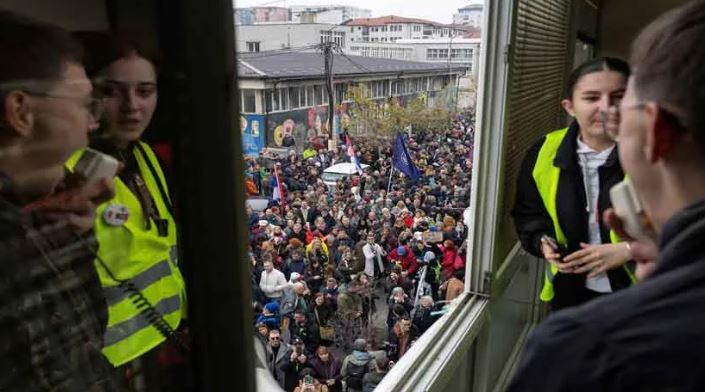
Several thousand activists from across Serbia joined student protests in the country’s southwest on Sunday, rallying against what they describe as government pressure on state universities.
The demonstration, part of a wider movement confronting political interference in higher education, was the first of its kind in Novi Pazar, a town with a majority Bosniak Muslim population.
It is among many protests organised after the collapse of a railway station roof last year in the northern city of Novi Sad, which killed 16 people.
Students from Novi Pazar have become famous countrywide after walking for days to join mass protests in Novi Sad to mark the first anniversary of the roof collapse on November 1.
Now they say the university administration has revoked regular student status for those absent due to protests and dismissed dozens of lecturers.
“I came here to express support to Novi Pazar students,” said Momcilo Zelenbaba, who travelled from the town of Jagodina 190 km (120 miles) north of Novi Pazar. “I came because 200 students lost their status and 30 professors lost their jobs.”
Protesters are demanding the resignation of the university’s managing board and the election of a new rector.
“We are here today to send a message to Serbia that we fight for an interim management and the survival of our university,” said Dzenana Ahmetovic, a protester. “This concerns all of us, not only Novi Pazar.”
Throughout the day-long protest, participants observed a moment of silence for the victims of the roof collapse. They waved flags representing their towns and universities, whistled, and chanted their signature slogan: “Pump up!”
The protest movement – led by students, academics, and opposition figures – accuses Serbian President Aleksandar Vucic and his populist nationalist party of fostering corruption, poor public services, nepotism, and restrictions on media freedom. Vucic and his party deny the allegations.
Novi Pazar is Serbia’s youngest town demographically, with 60% of its majority Muslim population under the age of 30. Despite its distinct ethnic make-up, no clashes with Orthodox Serb neighbours have been reported since the breakup of Yugoslavia more than three decades ago.