ISLAMABAD, DEC 24 /DNA/ – The Pakistan Institute of Development Economics (PIDE) convened a policy seminar to examine Pakistan’s transition to a Student Learning Outcomes (SLO) based curriculum and assessment system, with a particular focus on how national policy frameworks are being implemented in classrooms across Khyber Pakhtunkhwa (KP) and Islamabad Capital Territory (ICT). The seminar explored why outcome-based reforms, despite being fully operational in examinations, continue to face significant challenges at the teaching and learning level.
The seminar was moderated by Dr. Faheem Jehangir, Dean (Policy), PIDE/PD, and RASTA, who steered the discussion toward the broader policy relevance of education reforms and their implications for human capital development and long-term economic outcomes.
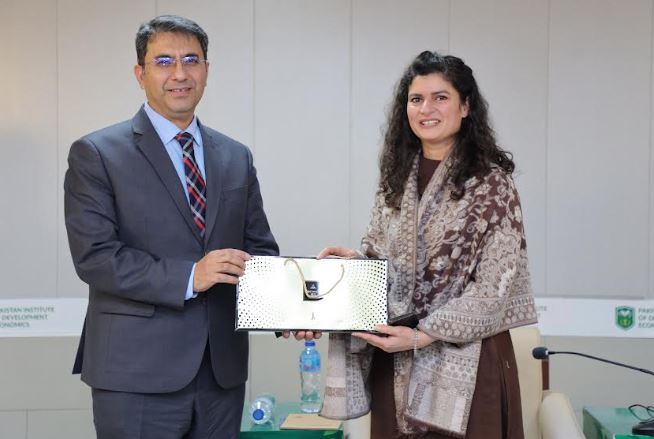
The keynote address was delivered by Dr. Aliya Khalid, Senior Departmental Lecturer at the Department of Education, University of Oxford, and Principal Investigator of a multi-year research project on SLO implementation in Pakistan. Drawing on international literature and Pakistan-specific evidence, Dr. Khalid explained that SLO-based reforms are part of a global movement aimed at shifting education systems away from rote memorization toward conceptual understanding, skills development, and application of knowledge. However, she cautioned that such reforms only succeed when curriculum, pedagogy, assessment, and teacher support are coherently aligned.
Tracing Pakistan’s reform trajectory, she outlined how SLOs were first introduced through the National Curriculum 2006 and mandated in textbooks under the National Education Policy 2009, followed by provincial ownership after the 18th Constitutional Amendment. She noted that Khyber Pakhtunkhwa emerged early as a reform leader, redesigning teacher training around outcome-based pedagogy, while later unification under the Single National Curriculum extended SLOs nationwide. The most consequential shift, she argued, occurred between 2023 and 2025, when federal and provincial examination boards moved decisively toward fully SLO-based, textbook-independent assessments.
Presenting preliminary findings from extensive fieldwork, she highlighted a persistent policy-to-practice gap. While examinations have rapidly transitioned to concept-based testing, many teachers particularly in resource-constrained schools continue to struggle with teaching without prescriptive textbooks and with limited training in formative assessment. This misalignment has contributed to sharp declines in pass rates at Grades 9 and 10 in several government schools, raising concerns about student overload, equity, and long-term participation in education, especially among vulnerable groups.
The research adopts a systems-thinking approach, combining policy analysis, curriculum and examination review, and in-depth interviews with teachers, head teachers, and education experts. The findings suggest that late-stage enforcement of SLOs at high-stakes examination levels has exposed cumulative learning gaps from earlier grades, rather than sudden failures at the secondary level. Dr. Khalid emphasized that sustainable reform requires earlier introduction of outcome-based learning, realistic curriculum depth, continuous teacher support, and feedback mechanisms that reflect classroom realities.
Adding to the discussion, Dr. Nadeem Javaid, Vice Chancellor PIDE, stressed that education reforms must be firmly rooted in Pakistan’s contextual realities rather than relying on imported frameworks. He noted that teaching culture, parental expectations, language policy, and entrenched power dynamics significantly influence classroom practices, often shaping how reforms are absorbed or resisted. Drawing on international examples, he observed that high-performing education systems are guided by clearly defined national objectives for basic education, while Pakistan continues to lack clarity on what its system ultimately seeks to produce. Referring to global evidence on the future of work, he emphasized the growing importance of creativity and critical thinking in the age of digitization and artificial intelligence, urging policymakers to align curriculum reforms with future workforce needs rather than narrow content coverage. He also cautioned against simplistic public–private comparisons, arguing that governance, accountability, and trust in public education institutions are central to improving learning outcomes.
The seminar also underscored the project’s strong policy engagement component. Beyond academic outputs, the research team has actively worked with education departments, contributed to public discourse through national newspapers, and supported the development of practical teacher training resources. As part of this engagement, structured SLO training modules for Grades 9 and 10 teachers are being integrated into provincial learning management systems, combining short instructional videos, assessments, and certification to strengthen classroom implementation.
The discussion was led by Dr. Ahsan Ul Haq Satti, Associate Professor and Director of the Center for Economic Modeling and Data Analytics (CEMDA) at PIDE, who commended the study for shifting the reform debate from policy intent to policy experience. He noted that SLOs are now fully embedded in board examinations, making it imperative to identify the most binding constraints in pedagogy, sequencing, and institutional support. Dr. Satti emphasized that many implementation challenges reflect system-level pressures such as overloaded syllabi and high-stakes exams rather than teacher resistance.
The seminar concluded with an engaged question-and-answer session, reflecting broad agreement that while SLO-based education is demanding and complex, it remains central to improving learning quality, equity, and workforce readiness in Pakistan. Participants stressed the need for evidence-informed sequencing, sustained teacher development, and realistic expectations to ensure that outcome-based reforms translate into meaningful learning gains rather than unintended exclusion.