
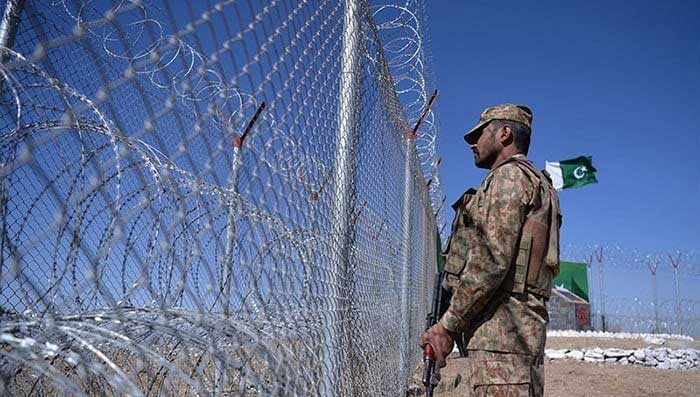
RAWALPINDI, JAN 1 /DNA/: Pakistan’s firm stance against cross-border terrorism is proving to be fruitful as Islamabad’s decision to shut its border with neighbouring Afghanistan has resulted in notable drop in terrorist attacks.
The closure of Pakistan-Afghanistan border in October has seen almost 17% drop in terrorist attacks in December 2025 and a 9% decline in November, according to a Centre for Research and Security Studies (CRSS) annual security report.
It further points out a decline in terrorist violence-linked fatalities among civilians and security officials in the last quarter of 2025, by nearly 4% and 19% each in November and December, respectively.
Pakistan had closed the Torkham and Chaman borders with Afghanistan on October 12 after the Afghan Taliban, in association with their affiliated militants, attacked multiple Pakistan Armed Forces posts along the border.
The border clashes between forces from the two countries began on the night between October 11 and 12 after the Afghan Taliban and militants launched unprovoked attacks against Pakistan’s border posts.
The resulting clashes led to the killing of over 200 Taliban and affiliated militants, while 23 Pakistani soldiers were martyred defending the motherland.
Islamabad also conducted “precision strikes” deep inside Afghanistan, targeting terrorists in Kandahar province and Kabul. A temporary 48-hour ceasefire was announced on October 15 at Afghanistan’s request.
The two sides eventually reached an official ceasefire agreement on October 19 in Qatar in talks mediated by Doha and Turkiye.
Most violent year a decade
However, the CRSS report highlights that the 2025 witnessed a 34% surge in overall violence making it the most violent year for the country in a decade where it has “suffered a sustained escalation in violence for five consecutive years since 2021, coinciding with the Taliban’s return to power in Afghanistan; with almost 38% in 2021, over 15% in 2022, 56% in 2023, nearly 67% in 2024, and 34% in 2025”.
The year witnessed 3,417 violence-linked fatalities and 2134 injuries among civilians, security personnel, and outlaws resulted from 1,272 incidents of violence; terrorist attacks and counter-terrorism operations.
This reflects a sharp increase in terrorism and counterterrorism-linked violence where 2,555 fatalities were recorded in 2024.
KP, Balochistan account for over 96% of deaths
Khyber Pakhtunkhwa, which has faced the brunt of terrorist attacks, experienced the most significant surge where the “fatalities rose from 1620 in 2024 to 2331 in 2025, an absolute increase of 711 deaths, accounting for over 82% of the net national rise and marking almost a 44% year-on-year surge in violence in the province”.
The CRSS report further termed Balochistan as witnessing an upward trend, with fatalities increasing from 787 to 956; an additional 169 deaths, which are nearly 22% higher than the 2024 stats.
Together, both KP and Balochistan accounted for over 96% of all fatalities and almost 93% of violent incidents recorded during the entire 2025.
KP was the worst-hit region, suffering over 68% (2331) of the total violence-linked fatalities, and around 63% (795) of the incidents of violence, followed by Balochistan, accounting for 28% (956) of the fatalities and over 30% (386) of the incidents of violence.
However, Punjab and Sindh on the other hand, witnessed relatively lower levels of violence. Punjab, recorded 25 incidents of violence resulting in 40 fatalities and 24 injuries, representing just 1.15% of total casualties in 2025. Sindh reported 51 incidents causing 56 fatalities and 40 injuries; 1.73% of the total.
Separately, Azad Jammu and Kashmir (AJK) recorded 15 fatalities in 2025 compared to zero violence in 2024.
Gilgit Baltistan (GB) remained the least affected region, despite witnessing a four-fold increase from one to four fatalities.
The decline in fatalities were 26 to 15 in Islamabad Capital Territory, 66 to 40 in Punjab, whereas Sindh reported a slight increase in deaths from 55 to 56.
Deadliest year for outlaws
Furthermore, the outgoing year turned out to be the deadliest year for outlaws in a decade as well. They accounted for the majority of fatalities recorded this year — surpassing the fatal losses suffered by the civilians and security officials combined.
With about 2,060 deaths as a result of at least 392 security operations, the outlaws accounted for over 60% of the fatalities recorded this year, surpassing the combined fatal losses among the civilians and security officials i.e., 1,357 fatalities (40% of total) suffered in around 880 terrorist attacks.
Nevertheless, the toll of injuries remained higher among civilians and security officials, suffering over 93% of all injuries recorded, compared to 7% among outlaws.
The majority of the injuries were sustained by the civilians (1187 – 56%), followed by security officials (793 – 37%), and outlaws (7% – 154).
Still, the fatalities among civilians and security officials reduced in 2025 by over 24% and 5%, respectively, compared to 2024.