• Education milestone: Literacy reaches 63% from 60% nationwide
• Out-of-School Children decreased from 30%to 28%
• Household Internet Access increased from 34% to 70%
• Individuals using the internet increased from 17% to 57%
• Full Immunization (Record Based) coverage increased from 68% to 73%
• Use of Clean Fuels increased from 35% to 38%.
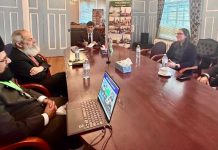
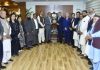
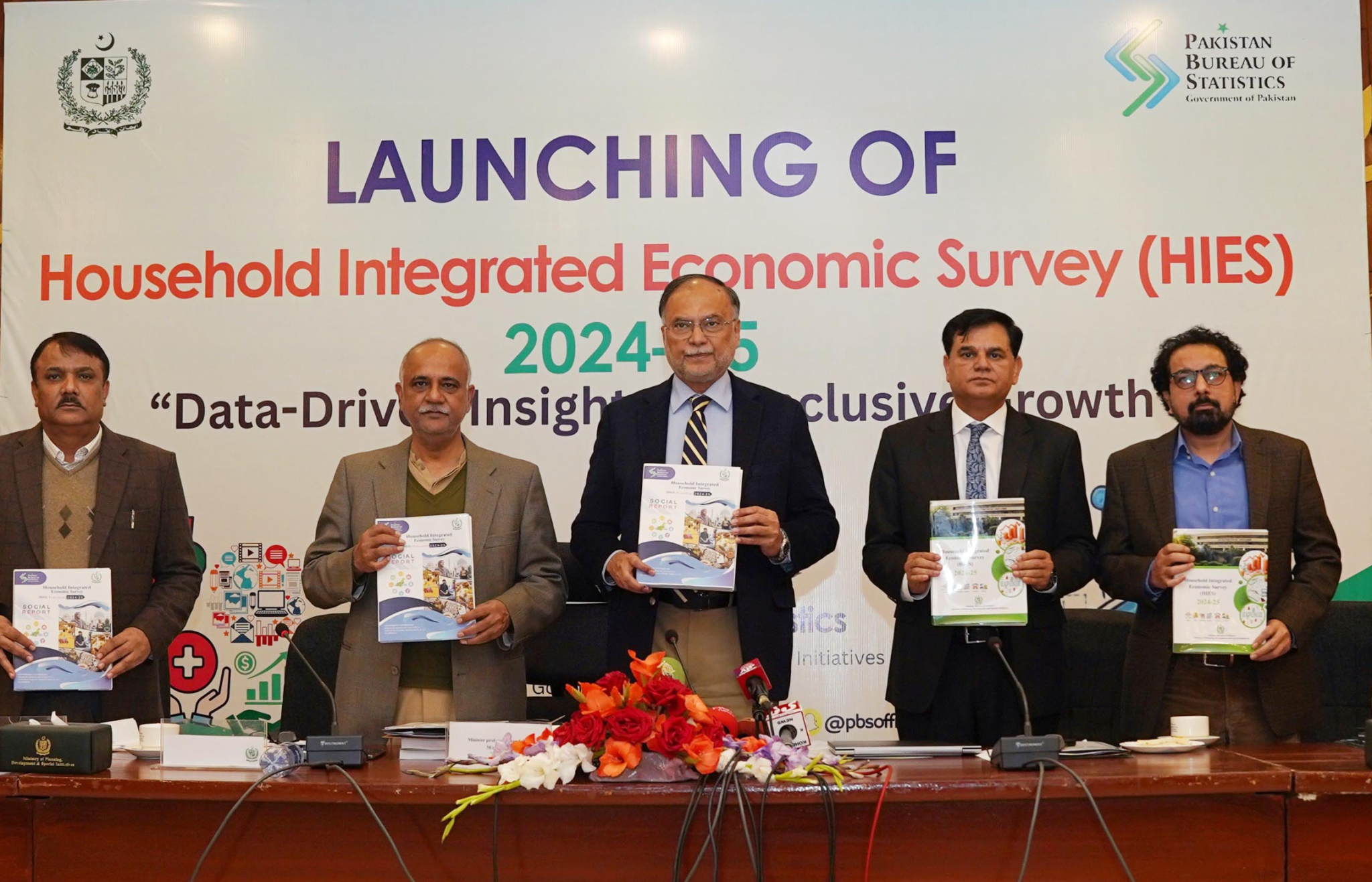
Islamabad: Jan 1 /DNA/: Ahsan Iqbal, Federal Minister for Planning Development & Special Initiatives officially launched the Household Integrated Economic Survey (HIES) 2024–25. The launching ceremony was held on 1st January 2026 at the Ministry of Planning, Development & Special Initiatives. The event was hosted by the Chief Statistician, Dr. Naeem uz Zafar (SI), Muhammad Sarwar Gondal (SI), Member (SS/RM) ,Ms. Rabia Awan DDG (PSLM/PCS), and was attended by key stakeholders, members of the Technical Committee, and senior officers from the Ministry of Planning and the Pakistan Bureau of Statistics.
Pakistan Bureau of Statistics (PBS) has successfully completed and released the results of the Household Integrated Economic Survey (HIES) 2024–25, marking a major milestone in Pakistan’s national data ecosystem. Endorsed by the Technical Committee, the survey provides comprehensive insights to review the social and economic conditions of the country and serves as a key tool for evidence-based planning and policymaking.
Federal Minister for Planning, Development and Special Initiatives Ahsan Iqbal on Thursday formally launched the Household Integrated Economic Survey (HIES) 2024–25, conducted by the Pakistan Bureau of Statistics (PBS), terming it a major milestone towards data-driven governance and evidence-based policymaking.
Addressing the launch ceremony, the Minister said that the Ministry of Planning and PBS have successfully been transformed into modern, data-driven institutions, which is a highly encouraging development. He noted that the Planning Ministry is systematically clearing long-standing institutional backlogs and strengthening its analytical capacity.
Ahsan Iqbal highlighted that Pakistan’s first-ever digital population census was a major national achievement, followed by the Digital Agriculture Census and the Economic Survey of Pakistan, all of which were conducted successfully. He said the Household Integrated Survey will now enable researchers to conduct more meaningful analysis, while providing valuable insights to the business community for better decision-making and improved productivity.
Referring to the economic challenges of the past, the Minister said that Pakistan’s economy suffered its first major shock in 2018, which disrupted the growth momentum of previous years. He added that the survey clearly reflects that economic growth was halted at that point and the economy was pushed onto a downward trajectory. He further stated that poor planning in 2022 caused irreparable damage to the economy.
He noted that after the COVID-19 pandemic, the world entered a global crisis, which also impacted Pakistan, particularly the middle class, as reflected in the Economic Survey findings. However, he emphasized that the period of crisis has ended and Pakistan is now firmly moving towards economic recovery.
The Minister expressed optimism that Pakistan would achieve around 4 percent GDP growth during the current fiscal year. He said the government is pursuing a cautious and responsible economic policy, with a clear focus on ensuring sustainable and consistent growth in the coming years.
Ahsan Iqbal stressed that economic growth must be built on strong fundamentals and capacity development. He pointed out that the survey shows several positive economic and social indicators, reflecting gradual improvement. He said Pakistan must urgently address its education emergency, aiming to raise the education participation rate to 90 percent.
He underscored that addressing the literacy crisis on an emergency basis is essential, noting that no country can truly develop without near-universal literacy, while Pakistan still has approximately 25 million out-of-school children.
The Minister said that by implementing the “5Es Framework” of URAAN Pakistan, the country can successfully achieve its economic and social development goals. He emphasized that political stability and policy continuity are essential for sustained progress.
Referring to national unity, Ahsan Iqbal said that following the success of “Marka-e-Haq”, the entire nation must now contribute to “Marka-e-Taraqqi” (the battle for development). He called for collective national effort to transform Pakistan into a one-trillion-dollar economy by 2035 through sustained hard work.
He said the Household Integrated Economic Survey serves as both a call for reflection and a call to action, urging Pakistan to accelerate its development pace to compete globally.
The Minister regretted that Pakistan’s national discourse remains overly political and urged the media to initiate informed debates based on the findings of the survey. He emphasized that government accountability should not revolve around political meetings, but rather on tangible outcomes, such as efforts to reduce stunting, enroll out-of-school children, and improve healthcare services.
“Given the speed at which the world is progressing, Pakistan must rapidly improve its economic and social indicators. There is only one way forward — an economic long march to secure a prosperous future for Pakistan,” the Minister concluded.
Household Integrated Economic Survey (HIES) has been monitoring socio-economic indicators at the national and provincial levels since 1963. The last survey was conducted in 2018-19, providing detailed data on income and consumption patterns. HIES also supports tracking progress on the Sustainable Development Goals (SDGs), covering 31 out of 62 indicators, reported by PBS.
HIES 2024–25 is the First-Ever Fully Digital HIES conducted after Digital Population and Housing Census 2023. Field operation of the survey was completed in June 2025 by conducting on quarterly basis, covering 32,000 households across Pakistan, representative at the provincial and national level. A fully integrated Enterprise Resource Planning (ERP) system was used for data collection, task management and real-time monitoring.
During the event, Deputy Director General Ms. Rabia Awan presented the key results and major highlights of the survey. Major highlights are:
• Household Mobile or Smartphone Facility has increased to 96%.
• Household Internet Access increased from 34% to 70%
• Individuals using the internet increased from 17% to 57%
• Gender Parity at primary level has increased from 92% to 96%.
• Neo-Natal Mortality Rate has decreased from 41 to 35 per thousand live births.
• Infant Mortality Rate has decreased from 60 to 47 per thousand live births.
• Total Fertility Rate has decreased from 3.7 to 3.6 children per women.
• Use of clean fuels—such as natural gas, LPG, biogas, solar energy, and electricity for clean heating, lighting, and cooking—increased to 38%.
• Household incomes and consumption have increased. Major part of the household consumption goes to Food (37%), housing &fuel (26%) followed by restaurants and hotels (6.63%), clothing and footwear (6.28%) and transport (6.21%) at national level.
At the conclusion of event, PBS highlighted that HIES 2024–25 reflects significant progress in education, health, digital access and household income. The survey provides a solid evidence base for data-driven policies, guiding inclusive and effective development interventions. These results underscore Pakistan’s commitment to improving living standards and promoting equitable growth across the country.