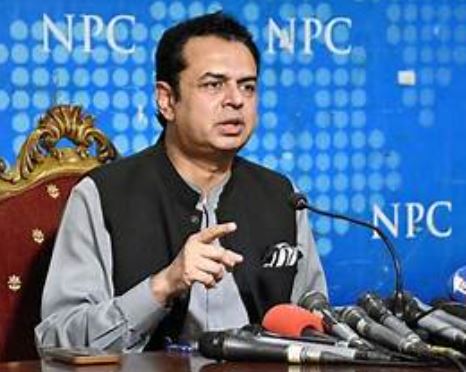
ISLAMABAD, 13 JAN (DNA) — Minister of State for Interior Talal Chaudhry on Tuesday informed the National Assembly that only the allergy-causing paper mulberry trees had been removed in Islamabad, saying that the capital is now “greener than before” and that 60,000 additional trees would be planted by the end of March.
Responding to a calling attention notice moved by MNA Muhammad Riaz Fatyana regarding wanton tree cutting in Islamabad, Talal Chaudhry said the issue had been widely debated on social and electronic media, but facts established that only specific categories of trees were removed — primarily paper mulberry, long identified as a source of severe allergies and health issues.
Talal Chaudhry explained that tree removal in Islamabad generally occurred under three circumstances: development activities executed under the city’s original master plan where brown-area sectors remained unbuilt, infrastructure requirements such as new roads, underpasses and overhead structures, and removal of hazardous species, especially paper mulberry.
He noted that areas publicly perceived as green were, in fact, brown-area zones in the original master plan. Citing the example of Embassy Road’s expansion in 2016–17, he said trees planted temporarily on unbuilt road space were later removed and replaced with four times more trees once the road was constructed in accordance with the plan.
The minister emphasised that no infrastructure project undertaken during the past eighteen months had removed trees without due process. He said every project went through mandatory public hearings, Environmental Protection Agency (EPA) review, certification, and mapping through SPARCO imagery and NDVI (Normalized Difference Vegetation Index), an internationally recognised method for assessing green cover.
He said over 40,000 mature trees — 8 to 10 feet tall — had already been planted, and 60,000 more would be planted by March. Talal Chaudhry added that the paper mulberry issue had been under review for years, beginning with Islamabad High Court orders in 2009, followed by an environmental committee in 2010, a public hearing in 2023, and a Supreme Court decision in 2024.
He said 2,915 trees were removed only after complete surveying, tagging and expert review. Committees appointed by the Supreme Court confirmed that only paper mulberry trees had been removed and no healthy indigenous species were affected.
He said SPARCO imagery, Google Maps data and NDVI analysis showed that Islamabad’s greenery had increased between 2023 and 2025, contradicting claims that green cover was diminishing. He invited parliamentarians and journalists for an on-ground technical briefing to verify the data.
He underlined that removing paper mulberry did not generate revenue — rather, resources were spent to uproot it fully to prevent regrowth. He said Islamabad was now safer, more modern and greener than before, and urged that criticism based on misinformation should not overshadow factual environmental improvements.— DNA