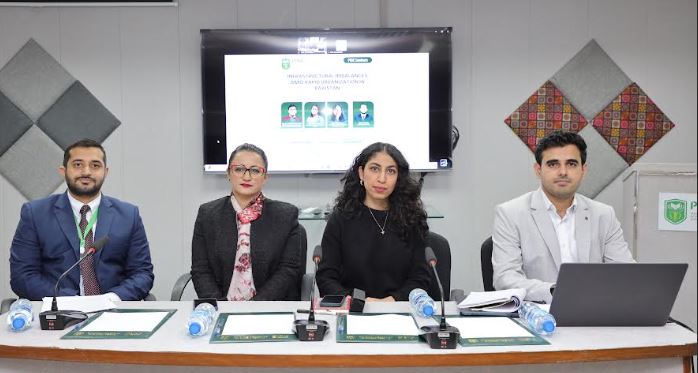
ISLAMABAD, JAN 14 /DNA/ – The Pakistan Institute of Development Economics (PIDE) hosted a timely and insightful seminar titled “Infrastructural Imbalances Amid Rapid Urbanization in Pakistan” today, bringing together leading experts to discuss the challenges and opportunities posed by rapid urban growth in Pakistan.
The seminar, held at A.R. Kemal Hall, explored the complex interplay between urbanization, infrastructure development, and governance, with a particular focus on how the growing urban population is outpacing the expansion of vital services and infrastructure.
Dr. M. Shafaat Nawaz, RASTA Fellow and Fulbright PhD from the University of Illinois Chicago, opened the discussion with a thought-provoking presentation that reframed Pakistan’s urbanization narrative.
Dr. Nawaz challenged the conventional perception that Pakistan’s urbanization is a gradual process, suggesting that the nation may already be highly urbanized, with 88% of the population living in urbanized areas, according to a recent study by the World Bank.
He highlighted the mismatch between the urban reality and the official urbanization statistics, which suggest only 39% of the population is urban. This discrepancy has led to significant infrastructural imbalances, exacerbating issues such as housing shortages, water scarcity, traffic congestion, and waste accumulation.
Ms. Fauzia Rizwan, Director of The Urban Solutions Pvt Ltd, and Ms. Risham Amjad, Consultant at the Asian Development Bank, further elaborated on these challenges, emphasizing the need for a unified approach to urban planning that addresses not only the physical infrastructure but also social infrastructure, such as healthcare and education.
Key discussions revolved around Pakistan’s secondary cities, which are often overlooked despite their increasing urbanization. These cities, which host a large portion of the country’s urban population, have received less policy attention compared to megacities like Karachi and Lahore.
The panelists called for a redefinition of urban areas to align with the actual realities on the ground, noting that such reclassification could significantly boost local government revenues through property taxes, thus enabling better infrastructure and services for these rapidly growing areas.
Another pressing issue discussed was the country’s critical shortage of housing units, with an estimated 9 million housing units needed. The shortage is not just about the number of units but also about affordability and accessibility, particularly for vulnerable populations.
Over 50% of urban residents are living in informal settlements or below-standard housing conditions, a stark reminder of the urban-rural divide that still exists in Pakistan.
The seminar also highlighted the role of municipal governments, which are critically underfunded and unable to meet the growing demand for urban services.
The lack of adequate water supply, waste management, and sewage systems was identified as a major impediment to the quality of life in urban areas, contributing to public health crises such as air pollution, which is responsible for over 200,000 premature deaths annually in Pakistan.
Mr. Bilal Aftab, Staff Economist at PIDE, moderated the session and concluded with a call for integrated policy reforms. He stressed the importance of aligning fiscal resources with urban realities, ensuring that infrastructure investments are not just concentrated in megacities but also spread across secondary and smaller cities, where the need for development is equally urgent.
The seminar concluded with an interactive Q&A session, where participants discussed potential solutions to these infrastructural challenges, including the need for stronger urban governance, redefined urban boundaries, and a more balanced approach to development across Pakistan’s cities.
PIDE remains committed to fostering meaningful dialogues on urban development and will continue to lead discussions on policy-relevant issues affecting Pakistan’s cities.