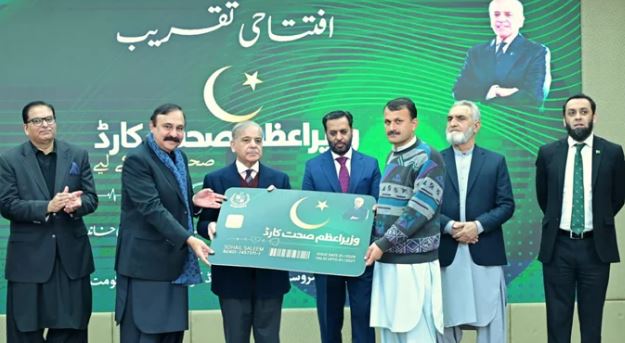
ISLAMABAD, JAN 16 – Prime Minister Shehbaz Sharif on Friday revived and extended the Health Card programme to Islamabad, Azad Jammu and Kashmir (AJK) and Gilgit-Baltistan (GB), reaffirming the federal government’s commitment to providing quality healthcare as a fundamental right for every citizen, regardless of social or economic status.
Addressing the ceremony, the premier said the initiative marked another major step towards delivering healthcare facilities at people’s doorsteps.
Recalling the launch of the scheme in 2016 under the leadership of former prime minister Nawaz Sharif, he said the programme was later expanded rapidly across provinces. He stressed that nothing was more valuable in life than health.
“If there is health, there is education; if there is health, there is dignified employment; if there is health, there is progress in every field of life,” he remarked.
PM Shehbaz said while affluent segments of society could afford expensive treatment anywhere in the world, the real test of the state lay in protecting the poor, widows, orphans and daily wage earners who struggled to make ends meet.
“If a labourer falls ill and leaves this world without treatment, his children are left in permanent darkness. Healthcare is the right of every Pakistani — whether a prime minister or a street vendor,” he said.
Congratulating Federal Health Minister Mustafa Kamal, the secretary health and their entire team, the prime minister urged transparent implementation through third-party monitoring to ensure treatment was provided at the right facilities and with appropriate standards.
He expressed confidence that honest execution of the programme would not only serve the people but also bring reward in this world and the hereafter.
Expressing hope for swift and effective implementation, the prime minister said the programme would be personally monitored through visits and inspections in collaboration with Islamabad’s health leadership, parliamentarians, the chief minister of Gilgit-Baltistan and the premier of AJK.
Responding to a demand to extend the programme to Sindh, he termed the proposal valid and assured that he would personally take up the matter with the chief minister of Sindh.
He noted that the programme was progressing rapidly in Punjab, with billions of rupees being spent on healthcare, and congratulated the Punjab government on its efforts. He added that while other provinces had their own health initiatives, efforts would be made to ensure similar facilities nationwide.
Earlier, Mustafa Kamal said the revived programme would provide free, cashless healthcare to nearly 10 million residents of Islamabad Capital Territory, Azad Jammu and Kashmir and Gilgit-Baltistan.
He said the programme ensured citizens could receive treatment without worrying about affordability during moments of pain and distress.
Sharing operational details, Kamal said around 70 hospitals were being empanelled under the Prime Minister’s Health Card across Islamabad, AJK and Gilgit-Baltistan, including 20 additional hospitals in Islamabad alone.
He added that cardholders from these regions living in Karachi would also be able to access treatment at 16 designated hospitals in the city.
He noted that Sindh remained the only province where the Prime Minister’s Health Card was not yet operational, while Punjab, Khyber Pakhtunkhwa, Balochistan and the federal territories were already covered.
Referring to earlier proposals, he said a plan covering 10 rural and urban districts of Sindh at an estimated cost of Rs24 billion had been prepared.
“If funding is provided for just two years, the programme can become self-sustaining from the third year onward,” he said, expressing hope that healthcare deprivation in Sindh could also be addressed.