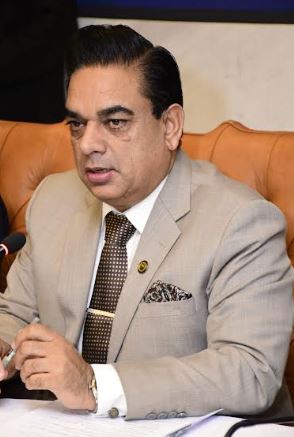
ISLAMABAD, JAN 25 /DNA/ – President of the Islamabad Chamber of Commerce and Industry (ICCI), Sardar Tahir Mehmood, has appreciated the Prime Minister Shehbaz Sharif’s visionary leadership and efforts for economic stabilization under the national vision of “Uraan Pakistan by emphasizing that revitalization of the Real Estate Sector must be treated as a national economic priority. In a letter forwarded to the Prime Minister he urged urgent and concrete measures to recognize the Real Estate Sector as an industry, stating that a vibrant, well-regulated real estate market is essential for strengthening the economy, attracting investment, and achieving sustainable growth.
He noted that structural challenges continue to impede business activity, particularly due to the high cost of doing business. Excessive taxation, elevated KIBOR rates, and rising energy costs have placed significant pressure on investment-driven sectors. In this context, he said the Real Estate Sector, one of the country’s largest employment generators—is facing serious operational and regulatory constraints.
Sardar Tahir Mehmood expressed concern that overlapping jurisdictions of multiple government departments have resulted in procedural delays, uncertainty, and compliance burdens, eroding investor confidence and prompting capital outflows to more facilitative regional markets.
Highlighting the sector’s broader economic impact, the ICCI President said the Real Estate Sector has a strong multiplier effect, supporting nearly 100 to 150 allied industries, including cement, steel, construction materials, transport, financial services, architecture, engineering, and skilled labor. He emphasized that global experience demonstrates how a well-regulated real estate sector acts as a backbone for economic growth in both developed and emerging economies.
To ensure sustainable development, he proposed organizing an annual National Real Estate Conference under the Prime Minister’s patronage to institutionalize policy dialogue, enhance stakeholder coordination, and promote consistent and informed decision-making.
He stressed that Pakistan’s export challenge at this juncture cannot be addressed through fragmented policy notifications, but requires a fundamental reset of the export facilitation system that places trade growth above revenue-driven enforcement. He underscored that exports, being zero-rated by nature, must operate within a framework defined by speed, certainty, and transparency, backed by post-clearance audits and intelligent, risk-based controls. Advocating the declaration of a National Export Emergency, he maintained that such a step would enhance—rather than dilute—compliance by introducing time-bound processes and digital oversight, ultimately boosting foreign exchange inflows, strengthening Pakistan’s standing as a dependable global supplier, and restoring the confidence of exporters essential for sustained economic revival.
He also highlighted the concerns of Overseas Pakistanis, noting that regulatory ambiguities, inconsistent taxation, and limited facilitation have undermined their confidence. He stressed the need for clear, predictable, and investor-friendly policies to safeguard overseas investments and attract foreign direct investment.
Calling for rationalization of taxes, the ICCI President said that multiple and complex levies have significantly increased business costs. A simplified and transparent tax regime, he added, would encourage investment, promote documentation, and broaden the revenue base.
He further urged the government to ensure affordable energy tariffs and reduce the KIBOR rate to ease financing constraints and stimulate investment.
In conclusion, Sardar Tahir Mehmood expressed confidence that timely policy intervention under the Prime Minister’s leadership would reinforce investor confidence, generate employment, and support Pakistan’s path toward sustainable economic growth.