Yossi Mekelberg
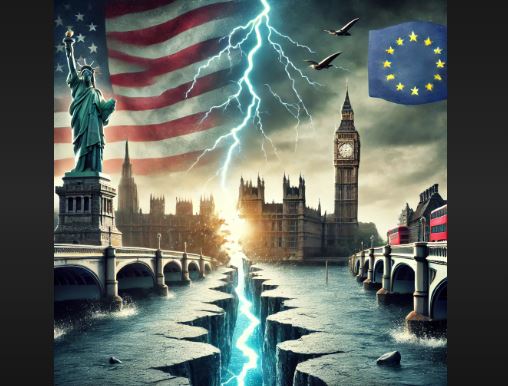
A rift between the US and Europe is quickly brewing. However, neither side can afford it or will benefit from it. Worse, this long-standing alliance now faces its severest test yet, which is bound to remain for the next three years. It is already leaving deep scars.
The security and prosperity of what is known as the West depend on close transatlantic relationships. When this alliance weakens, it only serves those the US and Europe perceive as their main rivals: China and Russia. One would not be surprised if the leaderships in Beijing and Moscow were rubbing their hands with glee at every spat between the Trump administration and America’s NATO allies.
The American administration’s insistence on acquiring Greenland has proven to be, for the EU, the UK and Canada, the final straw. For them, this was a red line they could not afford to let Washington cross without mounting a challenge, as they did.
The strategic importance of Greenland — the world’s largest island — is indisputable and it will only increase because of the unfortunate impact of climate change. Its strategic position between the US and Russia makes it a front-line area of growing importance as the ice sheets melt.
Global warming is causing Greenland’s ice sheet and the rest of the Arctic’s sea ice to melt, opening new sea routes that will serve as an alternative to traditional, costly navigation through the Suez and Panama canals. Add to this Greenland’s rich mineral and hydrocarbon deposits and the attraction of this massive island, despite its harsh weather, lack of infrastructure and remoteness, is turning it into the US’ latest frontier.
The administration’s insistence on acquiring Greenland has proven to be, for the EU, the UK and Canada, the final straw
Alas, the way President Donald Trump is going about it alienates his country’s closest allies and does so needlessly. The idea of the American frontier underpins the country’s historical westward expansion, with European settlers moving from the original settlements along the Atlantic Coast toward the Pacific Coast. This was a combination of ideology and utilitarianism, eventually resulting, for instance, in the purchase of Alaska in 1867 for the modest sum of $7.2 million (about $150 million today).
Acquiring territories reflected the “manifest destiny” notion, coined by John L. O’Sullivan in 1845, that America had a special destiny to stretch across the continent. However, it was another US president, Woodrow Wilson, with his notable 14 points during the First World War, who made his country the champion of the right to self-determination — a position that now seems reversed by the current US administration.
Greenland, in Trump’s thinking, epitomizes this. And it is no longer a fight between the so-called new world and the old world of colonial Europe, but a confrontation that undermines the closest of allies, which share similar security concerns and, at least until recently, similar values and respect for the norms of a rules-based world order.
Before Trump’s arrival at the World Economic Forum in Davos, the fear was that the issue of Greenland was going to cause irreparable damage to the US’ relationship with most of the other members of NATO, which believed that Trump would not climb down from his demand for American sovereignty over the island.
The day before Trump addressed the forum, Canadian Prime Minister Mark Carney urged his fellow “middle powers” to form new alliances, accusing the great powers of abandoning the post-Second World War system of freer trade and international norms, which required an adequate response. “We understand that this rupture calls for more than adaptation,” he said, as “the old order is not coming back. We should not mourn it. Nostalgia is not a strategy. But from the fracture, we can build something better, stronger and more just.”
The response from Europe was very similar, rejecting any attempts to intimidate Denmark, the sovereign power in Greenland, or the 57,000 Greenlanders to hand the island to the US.
Trump might not have given up on his aspirations to own Greenland, but he took notice of his allies’ firm position, making a very public commitment that he would not order a military operation to achieve this objective. Later, he announced that he and NATO had agreed a compromise with which both sides were happy, though they are yet to share it with the rest of us. To ease tensions with European allies, he also withdrew the threat of additional tariffs on them for their resistance to the US annexing Greenland.
To be sure, it is almost impossible to know whether Trump just enjoys pushing the envelope, and with it testing both the zones of possible agreement and the patience of his interlocutors, or if there is a serious and definite plan. In the case of Greenland, while there is curiosity about the agreement reached, a deal could have been achieved without straining America’s relations with its close allies.
Trump might not have given up on his aspirations to own Greenland, but he took notice of his allies’ firm position
Greenland, by virtue of being part of the Kingdom of Denmark, is protected by NATO, under Article 5 of its charter, from any hostile foreign forces. And if the US or any other member believes there is an imminent threat, they could work together to fortify the defenses of the island, on and offshore, to avert such a hostile development.
Moreover, the US already has more than 100 military personnel permanently stationed at its Pituffik base at the northwestern tip of the territory, operating under a 1951 agreement with Denmark. This agreement does not limit the number of troops the US is allowed to station there. This could serve as a basis for negotiations on an increased American presence without claiming sovereignty over land that is, anyway, public.
This base, in coordination with Denmark and other NATO allies, or even additional bases, could be accorded long leases that guarantee an almost permanent American presence without violating the sovereignty of another country or deciding the future of the Greenlanders, which must be done by them alone.
One complication with Trump’s announcement is that neither the US nor NATO has legal standing in Danish territory and their leaders have not been mandated to negotiate on Denmark’s behalf. Yet, reaching an amicable agreement with Denmark on the future security of Greenland, in the spirit of the NATO family, could create goodwill for the territory’s commercial development, particularly regarding its natural resources.
Significantly, Europe has drawn a line in the sand, which seems to have been understood in Washington: deliberations, negotiations and compromises are possible, but attempts to force an entire continent that wields its own levers of power to concede territory are mutually harmful and will be strongly rejected.