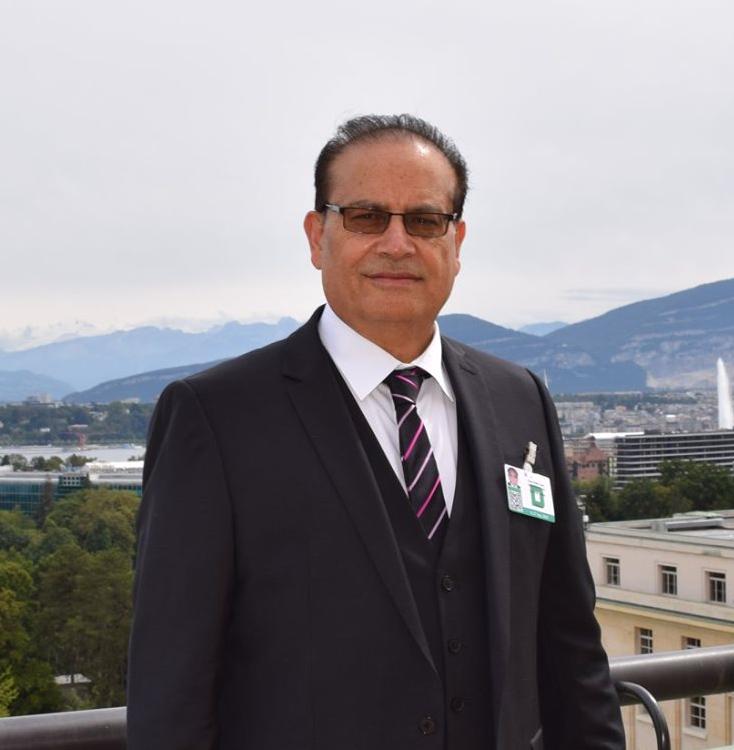
Qamar Bashir
February 6, 2026 has the feel of a turning point — not because the United States and Iran suddenly became friends, but because two sworn rivals chose diplomacy at the very moment when the logic of escalation was gaining speed. In Muscat, Oman, with anxiety rising across capitals from Tel Aviv to Beijing, the world watched an extraordinary scene: U.S. and Iranian delegations meeting under Omani mediation to test whether a negotiated path still exists before the region is pushed into another cycle of strikes, retaliation, and economic shock.
Iran’s Foreign Minister Abbas Araqchi came out of the talks calling them a “good start,” and — crucially — confirming that the process will continue after consultations in both capitals. Oman’s foreign minister, Badr al-Busaidi, described the discussions as “very serious” and stressed that outcomes would be weighed carefully in Tehran and Washington before the next steps are set. That language matters. It signals that neither side wanted a theatrical meeting designed to fail; both treated it as a controlled opening whose survival depends on disciplined messaging and political authorization at home.
Araqchi’s public framing was unusually calm for this relationship. He insisted that “any dialogue requires refraining from threats and pressure” and drew a sharp boundary around the agenda: Iran will discuss its nuclear issue — and nothing else — with the United States. That insistence is not a negotiating flourish; it is Iran’s strategic doctrine in diplomatic form. Tehran wants a narrow, technical bargain that can translate into sanctions relief, without turning the table into a referendum on Iran’s missiles, its regional posture, or its internal politics.
Washington, by contrast, has signaled a broader ambition. Publicly, U.S. officials have voiced interest in a framework that reaches beyond the nuclear file to Iran’s ballistic missiles, support for armed groups in the region, and internal governance and human-rights issues. But the early reporting around Muscat suggests the first round did not become a missile negotiation. A diplomat briefed on Iran’s account of the talks said Tehran insisted on its “right to enrich uranium,” and that missile capabilities were not raised during the discussions themselves — a telling sign that the meeting’s primary purpose was to prevent collapse at the starting line.
This is where the real contest lies: enrichment versus zero-enrichment. For Washington, domestic enrichment is treated as a red line because enrichment can be a pathway — depending on level, stockpile, and monitoring — toward weapons capability. For Tehran, enrichment is framed as sovereign entitlement under international norms, coupled with repeated claims that it does not seek a bomb. The Muscat channel appears to be searching for a formula that neither humiliates Iran nor leaves the United States politically exposed: limits on enrichment “level and purity,” more intrusive oversight, or even alternative arrangements such as a regional consortium were discussed as possibilities in the reporting. In exchange, Iran’s demands were described as immediate and effective sanctions relief — especially in banking and oil — and a reduction in U.S. military pressure near Iran.
Yet, even as delegates spoke in Muscat, pressure politics continued in Washington. President Donald Trump signed an order tied to tariffs on countries that trade with Iran — described in reporting as a mechanism that could raise import costs by as much as 25% for countries purchasing Iranian goods, aimed at discouraging third-country trade ties with Iran in energy, metals, and petrochemicals. Some coverage emphasized that the order sets a process and authority rather than flipping an immediate universal switch — but either way, the message was unmistakable: diplomacy is being run alongside economic coercion, not instead of it.
The same dual-track approach showed up in sanctions. Reporting described new U.S. measures targeting Iranian petroleum-related networks, including entities and vessels linked to oil and petrochemical trade. That timing is not accidental; it is intended to signal negotiating leverage. But it also carries risk: Tehran can interpret such actions as proof that Washington negotiates with one hand while tightening the noose with the other — precisely the behavior Araqchi warned against when he demanded talks without “threats and pressure.”
Against this backdrop, the strategic psychology is as important as the technical details. Both sides now appear to recognize that war is not a clean option. The United States holds greater conventional military power and unmatched financial leverage. Iran, however, has built a layered deterrent: missile capability, regional influence, and the ability to impose costs in a conflict that would not remain limited or predictable. The development leading up to the talks underscored the scale and seriousness of Iran’s missile capability, tested during the June 2025 conflict, and the broader atmosphere of tension as talks were set.
Then there is the world’s most sensitive nerve: the Strait of Hormuz. Any confrontation that threatens energy shipping through that chokepoint would ricochet immediately through global markets. It would not be “a regional war”; it would become a global inflation event. China’s energy security, South Asia’s import bill, Europe’s fragile price stability — all become collateral. This is why even states that distrust Tehran fear a breakdown. The Muscat talks were not just about uranium; they were about preventing a chain reaction in trade, energy, and geopolitics.
The symbolism around the meeting also tells you how close the temperature is to boiling. Hours before talks, Iranian state media highlighted deployment of the Khorramshahr-4 ballistic missile at an underground Revolutionary Guard “missile city” — a calculated signal of readiness and deterrence, designed to shape the psychology of negotiation: talk if you want, but do not assume coercion will be cost-free.
This is why the “good start” language matters more than it seems. U.S.–Iran diplomacy often collapses not because the issues are unsolvable in principle, but because the political ecosystem around the talks punishes concession and rewards confrontation. In that environment, secrecy and restraint are not suspicious — they are essential. Oman’s emphasis that results must be considered carefully in both capitals is, in effect, an admission that the next phase will be decided not only by diplomats but by the domestic politics of power on both sides.
Your central argument stands: the implications radiate outward — to Israel’s security calculations, to Gulf state stability, to Pakistan and Afghanistan’s strategic environment, and to China’s energy-risk horizon. The Muscat channel is a narrow door. If it widens, a framework could emerge that limits nuclear escalation risk and reduces market fear, even if it leaves missiles and regional alliances unresolved. If it slams shut, the region returns to the most dangerous pattern: sanctions, deployments, threats, miscalculation — and the constant possibility that one strike produces an uncontrollable reply.
For now, the most important fact is simple: the talks did not collapse on day one. In a relationship where collapse is often the default expectation, that alone is the first measurable achievement — and possibly the only thing standing between the region and a new inferno.
Qamar Bashir
Press Secretary to the President (Rtd)
Former Press Minister, Embassy of Pakistan to France
Former Press Attaché to Malaysia
Former MD, SRBC | Macomb, Michigan