
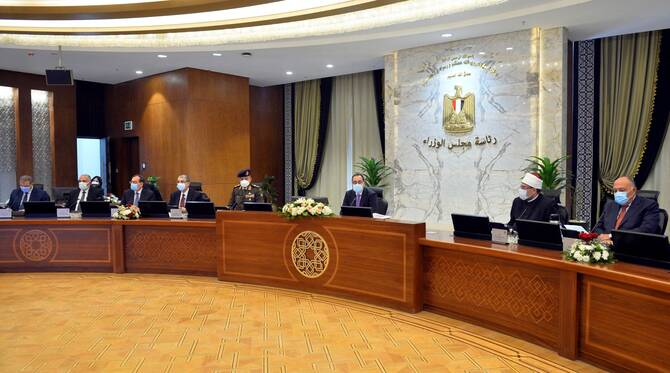
CAIRO, Feb 13 (MENA/APP/DNA):Prime Minister Mostafa Madbouly said the recent cabinet reshuffle was guided by President Abdel Fattah El Sisi’s mandate to the government, emphasizing that Egypt continues to face significant regional and international challenges as part of an interconnected global landscape.
Speaking at a press conference following the first meeting of the newly formed cabinet in the New Capital, Madbouly outlined four main pillars guiding the government’s work: safeguarding national security and maintaining a balanced foreign policy; advancing economic development; boosting production while strengthening energy and food security; and building human capacity.
He detailed several presidential directives, including sustaining comprehensive economic growth, increasing employment, reducing public debt, curbing inflation and maintaining its downward trend, and attracting more investments.
The president also instructed the government to accelerate the implementation of the State Ownership Policy Document, expand private sector engagement, and continue the public offerings program, the prime minister said.
Madbouly stressed the importance of improving education—particularly higher education in modern sciences and technology—and prioritizing healthcare by speeding up the rollout of the universal health insurance system nationwide.
He also highlighted the Decent Life Presidential Initiative to develop villages, highlighting directives for merging its phases to accelerate completion.
The prime minister underscored the need for strong coordination within the economic ministerial group to ensure policy harmony and achieve higher growth rates.
He also called for closer cooperation with the parliament and emphasized transparent communication with the public through responsible national media to counter misinformation.
Addressing structural changes, Madbouly explained that a deputy prime minister for economic affairs has been appointed to oversee the reform of 59 state-owned economic authorities, manage state-owned companies, update the State Ownership Policy Document, and supervise the public business sector during a transitional phase.
He clarified that the abolition of the Ministry of Public Business Sector does not signal liquidation of state companies but rather aims to improve governance and maximize returns from state assets.
Finally, he said merging the environment and local development ministries will enhance coordination, ensure faster implementation of environmental policies, and better integrate environmental considerations into local development projects.












:Prime Minister Mostafa Madbouly said the recent cabinet reshuffle was guided by President Abdel Fattah El Sisi’)