First-Ever National Parliamentary Dialogue Calls for Coordinated Action Against Terrorism
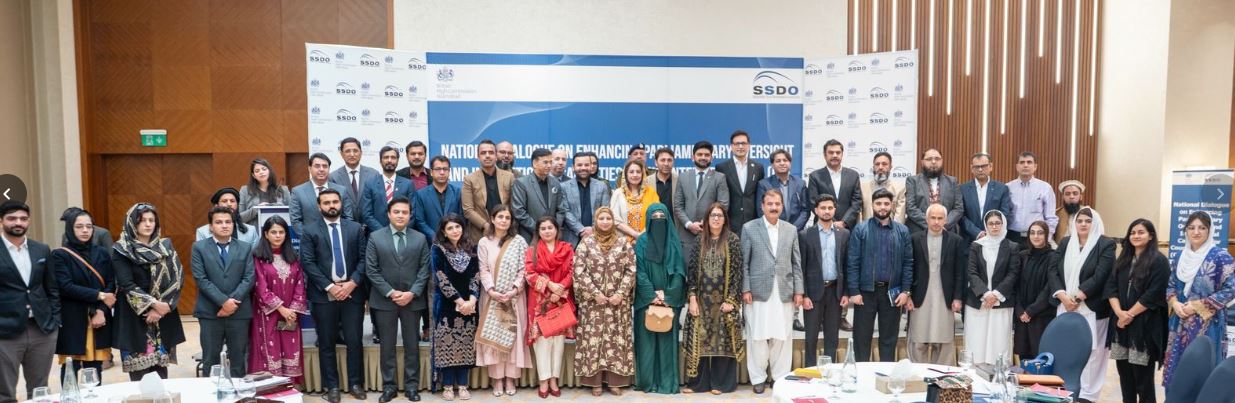
Islamabad: /DNA/- Pakistan on Thursday concluded its first-ever National Parliamentary Dialogue on Enhancing Parliamentary Engagement and Institutional Capacities for Counter Terrorism (CT), Countering Terrorist Financing (CFT), and Countering Violent Extremism (CVE), with participants calling for sustained and coordinated action by federal and provincial governments and legislatures.
The two-day dialogue, held in Islamabad, culminated in the unanimous adoption of a comprehensive resolution aimed at strengthening parliamentary oversight, institutionalised inter-agency coordination, and long-term investment in legal and operational capacities to address evolving security challenges.
The landmark dialogue, jointly organised by the Sustainable Social Development Organization (SSDO) and the British High Commission, brought together parliamentarians, government officials, law enforcement representatives, academia and civil society actors on a single platform to collectively assess emerging security challenges and propose actionable policy responses.
Delegates unanimously adopted a resolution calling for the establishment of dedicated parliamentary committees on Counter Terrorism (CT), Countering Terrorist Financing (CFT), and Countering Violent Extremism (CVE) marking a significant shift toward institutionalised democratic oversight and engagement.
Speakers at the inaugural session reaffirmed Pakistan’s resolve to combat terrorism in all its forms and manifestations, while underscoring the importance of democratic oversight, whole-of-government approach, and community engagement in consolidating hard-won security gains.
Khyber Pakhtunkhwa Governor Faisal Karim Kundi, addressing the opening session, emphasised the need for unity and collective responsibility.
“Terrorism remains a shared national challenge. Unity between federal and provincial governments is not optional it is essential,” he stated.
“Parliament must lead and engage the communities in our fight against terrorism.”
National Coordinator of the National Counter Terrorism Authority (NACTA), Jawad Ahmed Dogar, noted that while Pakistan has developed a robust legal and operational framework, emerging and increasingly complex threats require closer inter-agency cooperation and enhanced institutional capacities.
Representing the British High Commission, Alasdair Grant, Counsellor for Security and Justice, acknowledged Pakistan’s significant progress in counterterrorism and countering terrorist financing efforts, and reaffirmed the United Kingdom’s continued support.
“The UK remains committed to strengthening Pakistan’s counterterrorism framework through cooperation, capacity building, and institutional partnerships,” he said.
SSDO Executive Director Syed Kausar Abbas highlighted the importance of bridging the gap between policy formulation and implementation.
“Collective action involving parliament, state institutions, and civil society is not merely desirable it is indispensable,” he remarked.
“Strengthened parliamentary engagement and institutional coordination are key to effectively countering terrorism, terrorist financing, and violent extremism.”
Panel discussions during the dialogue focused on strengthening parliamentary oversight and engagement mechanisms. Participants observed that although legislative frameworks exist, parliamentary committees at both federal and provincial levels require enhanced technical support, regular access to security briefings, and clearly defined mandates to ensure effective scrutiny of CT, CFT, and CVE policies and budgets.
Speakers stressed that oversight mechanisms must be institutionalised rather than dependent on individual leadership or informal practices. The parliamentarians and other stakeholders needs to support the law enforcement agencies to create out reach and awareness among the local communities to ensure the effective community engagement and community intelligence.
The dialogue concluded with the adoption of a seven-point resolution calling for:
• Establishment of dedicated parliamentary committees on CT, CFT, and CVE
• Institutionalised inter-agency coordination frameworks
• Updating legal frameworks and fast-track prosecutorial efforts while ensuring fair trial
• Sustained investment in capacity building through training and resource allocation
• Constituency level engagement through parliamentarians to engage the local stakeholders and communities
The resolution further urged tighter regulation of digital and informal financial channels, improved federal–provincial policy harmonisation, mainstreaming of CVE and prevention strategies into national and provincial development and security plans, and enhanced transparency through periodic public reporting and constructive engagement with civil society and media.
Participants called upon parliamentarians to formally transmit the resolution to the federal and provincial governments, Parliament, and provincial assemblies for consideration and follow-up.
At the concluding session, Barrister Aqeel Malik, Minister of State for Law and Justice, praised SSDO and the British High Commission for convening key stakeholders on a common platform.
“This dialogue marks a transformative step toward inclusive, constitutionally grounded action against terrorism,” he stated.
“The government remains committed to coordinated and democratic approaches to ensure peace, stability, and the rule of law.”