
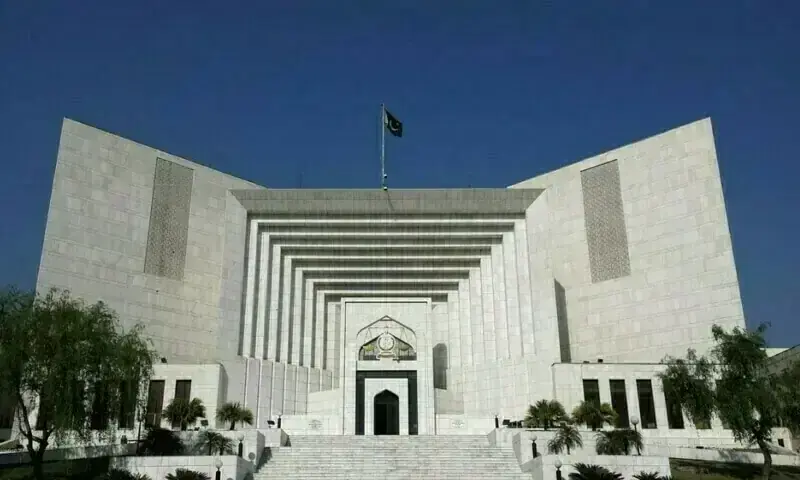
ISLAMABAD, FEB 21 /DNA/: The Supreme Court on Friday rejected a delayed plea filed by the federal government against a Federal Service Tribunal (FST) order, observing that the government was like any other litigant and required to follow the law and respect it with institutional seriousness.
A two-judge SC bench headed by Justice Ayesha A. Malik took up an appeal filed by the finance ministry challenging the FST’s June 26, 2025 order along with an application seeking condonation of a 20-day delay in filing the petition.
Authored by Justice Malik, the four-page judgement described the 20-day delay as inexcusable and criticised the state’s casual approach towards statutory timelines.
The state enforces the law against citizens and expects compliance within prescribed timelines; therefore, it must also hold itself to the same standard, she emphasised.
Observes state is just like any other litigant and must comply with statutory timelines
Through the application, the finance ministry sought condonation of delay, explaining that the case was under process with the deputy secretary (Litigation-II) and awaiting approval from a CPLA committee, which could not be convened due to an insufficient number of cases for deliberation.
It further explained that once the caseload increased and approval was obtained, the draft was sent to the Law and Justice Division for vetting. The division suggested changes, and by the time the final draft was prepared, the limitation period had expired.
Justice Malik observed that if the state were permitted to disregard statutory timeframes on account of its internal inefficiencies, it would create an imbalance in the administration of justice and undermine the constitutional guarantee of equality before the law.
When the state fails to comply with these timelines and seeks indulgence for administrative delay, it transfers the consequences of its disorganisation onto the court and the opposing party, which is often in a weaker position, the judgement emphasised. It added that good governance requires institutional functioning through clear responsibility, internal discipline and adherence to the law.
If compliance depends on convenience rather than structured systems, delays become routine and accountability diminishes. The courts cannot condone such delays without weakening the expectation that the state must maintain efficient systems capable of meeting its legal obligations. Enforcement of timelines and internal procedures strengthens institutional discipline and reinforces public confidence, the judgement observed.
Such delay is inexcusable, particularly when no effort has been made to reform or improve the procedure causing the delay, the verdict noted, adding that the state must organise itself to function in a timely manner and meet legal deadlines rather than seeking indulgence for its own inefficiencies.
The judgement observed that enforcement of timelines and internal procedures strengthens institutional discipline and reinforces public confidence that the law applies equally to all under Article 25 of the Constitution.
In this context, the prescribed timeline under the SC rules is 60 days. When a statutory timeframe is set, it is meant to ensure diligence and prevent disputes from remaining indefinitely pending.
If internal file movement, committee scheduling constraints or staff shortages are accepted as sufficient cause, the statutory framework would become flexible at the convenience of the litigant, defeating the very purpose of limitation, which is to ensure certainty and predictability in the administration of justice. The court emphasised that limitation is not merely a technical requirement but carries substantive importance.
Every litigant, including the petitioner, is required to adhere to the prescribed timelines, failing which the remedy stands extinguished unless sufficient cause is shown.
“We find that the explanation provided in the application for condonation of delay is insufficient and reflects a very casual approach towards the prescribed limitation,” the judgement observed.
Consequently, the application for condonation of delay was dismissed and, as a result, the petition itself was dismissed as time-barred.