
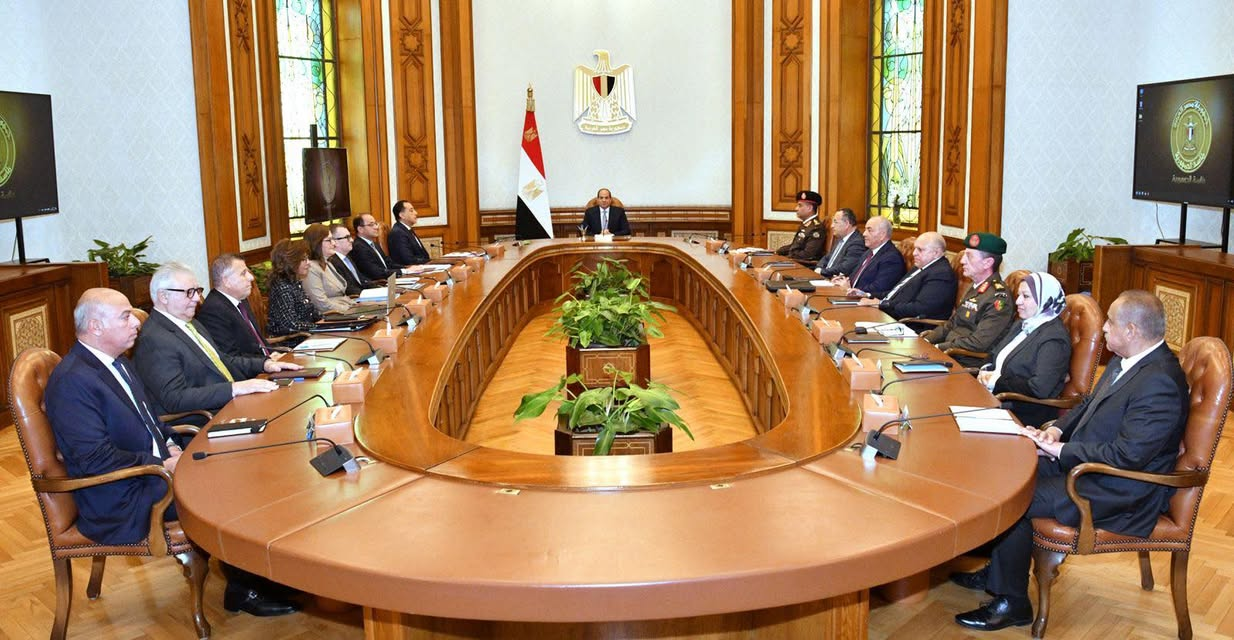
CAIRO, FEB 26 (MENA/APP/DNA):President Abdel Fattah El Sisi stressed the importance of investing in human capital through training, knowledge transfer, and skills development as key drivers of improving institutional performance and enhancing the ability to implement public policies efficiently and flexibly.
In this regard, President Sisi underscored the necessity for the National Training Academy (NTA) to select its trainees and participants based on objective criteria without any favoritism.
He emphasized that the academy should offer strong preparation and qualification programs aligned with the state’s priorities and development plans, implement rigorous assessment systems that ensure genuine evaluation free from favoritism, rely on digitalization and Artificial intelligence (AI), fully execute its strategies and plans, and establish regional and international strategic partnerships with reputable institutions that share common goals to exchange expertise and resources, thereby achieving distinguished results in a shorter time.
The president’s remarks came during a meeting with the Board of Trustees of the National Training Academy, in presence of Prime Minister Mostafa Madbouly, Minister of Defense and Military Production Ashraf Salem Zaher, Solafa el Goueli, Executive Director of the Academy and Mohamed Salah el Turki, Director of the Egyptian Military Academy.
Presidential Spokesman Mohamed el Shennawy reviewed the proposed strategic plan of the National Training Academy as well as its vision and mission, including developing human capital and building leaders capable of driving institutional and societal transformation, thereby enhancing Egypt’s regional and international standing.
The Academy also aims to effectively contribute to qualifying and developing the administrative apparatus and preparing competent national cadres, leading positive change in societal issues, and promoting the values of leadership, innovation, and institutional integration, in a way that strengthens Egypt’s soft power and leadership regionally and internationally.
Shennawy added that Goueli reviewed the Academy’s strategic objectives, which include preparing qualified cadres capable of developing the state’s administrative apparatus, contributing to building national and developmental awareness to positively impact Egyptian society, positioning the Academy as a regional hub for training, and serving as a soft power tool that supports Egypt’s standing regionally and internationally.
In this context, the meeting also reviewed the executive status of the strategy and ways to further develop the Academy to ensure the sustainability of its training impact and maximize the benefit from its accumulated expertise.
The executive director affirmed that the Academy relies on the latest training and capacity-building methodologies in line with the Egyptian state’s directions across various sectors, through integrated training and presidential programs that enhance leadership and technical skills—particularly for youth—and promote modern management concepts.












:President Abdel Fattah El Sisi stressed the importance of investing in human capital through training, knowledge)