Israel and the United States have launched a “pre-emptive attack” against Iran, pushing the Middle East into a renewed military confrontation and further dimming hopes for a diplomatic solution to Tehran’s long-running dispute with the West.
What we know so far:
- Israel launched a pre-emptive attack on Iran
- US strikes on Iran reportedly underway, according to a US official
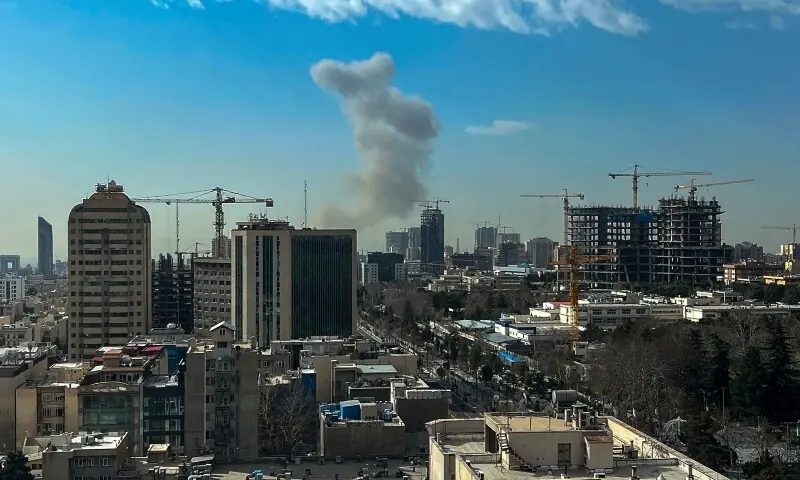
- Explosions and smoke observed in Tehran, suggesting a missile attack
- Iran’s Supreme Leader Khamenei moved to a secure location for safety
“The State of Israel launched a pre-emptive attack against Iran to remove threats to the State of Israel,” Defence Minister Israel Katz said.
Katz has “declared a special and immediate state of emergency throughout the country”, read a statement from his ministry.
The New York Times, citing a US official, reported that US strikes on Iran were underway as well. A US official told Reuters that US strikes were being carried out by air and sea.
An Israeli defence official also told Reuters that the operation was being carried out in coordination with the US.
The attack, coming after Israel and Iran engaged in a 12-day air war in June, follows repeated US-Israeli warnings that they would strike again if Iran pressed ahead with its nuclear and ballistic missile programmes.
An Israeli defence official said the operation had been planned for months in coordination with Washington, and that the launch date was decided weeks ago.
Explosions were heard in Tehran, Iranian media reported.
Two loud blasts were heard in Tehran by AFP journalists, and two plumes of thick smoke were seen over the centre and east of the Iranian capital.
“The type of explosions suggests that this is a missile attack,” the Fars news agency reported, without immediately providing further details.
Meanwhile, an official confirmed to Reuters that Iran’s Supreme Leader Khamenei was not in Tehran and had been transferred to a secure location.
Following the attack, Israel closed its airspace to civilian flights, their defence ministry said.
Iran has also closed its airspace following multiple explosions, Civil Aviation Organisation spokesperson Majid Akhavan told state media IRNA.
Akhavan said that the airspace will be closed for six hours.
Iraq’s transport ministry said it closed the national airspace after Israel attacked Iran, Reuters quoted the state news agency as saying.
Pakistan issues travel advisory
In the wake of the attack, the Foreign Office (FO) issued a travel advisory for Pakistani nationals in Iran, urging them to “avoid all non-mandatory travel” to the country for their safety and security.
FO stated, “Pakistani nationals currently residing in Iran must exercise caution, remain vigilant, minimise non-essential travel, and stay in regular contact with the Pakistani Missions.”
The contact details are provided below:
Embassy of Pakistan in Iran
Tehran
+98-21-66-9413-88/89/90/91 (landline)
+98-21-66-9448-88/90 (landline)
+98 990 6824496 (mobile)
Zahidan:
+98 54 33 22 3389 (landline)
+98 90 46 145412 (mobile)
Mashhad:
+98 910 762 5302 (mobile)
+98 937 180 7175 (mobile)
+98 902 709 3994 (mobile)
Renewed talks
The US and Iran renewed negotiations in February in a bid to resolve the decades-long dispute through diplomacy and avert the threat of a military confrontation that could destabilise the region.
Israel, however, insisted that any US deal with Iran must include the dismantling of Tehran’s nuclear infrastructure, not just stopping the enrichment process, and lobbied Washington to include restrictions on Iran’s missile programme in the talks.
Iran said it was prepared to discuss curbs on its nuclear programme in exchange for lifting sanctions, but ruled out linking the issue to missiles.
Tehran also said it would defend itself against any attack.
It warned neighbouring countries hosting US troops that it would retaliate against American bases if Washington struck Iran.
In June, the US joined an Israeli military campaign against Iranian nuclear installations, in the most direct American military action ever against the Islamic Republic.
Tehran retaliated by launching missiles toward the US Al Udeid air base in Qatar, the largest in the Middle East.
Western powers have warned that Iran’s ballistic missile project threatens regional stability and could deliver nuclear weapons if developed. Tehran denies seeking atomic bombs.
This is a developing story that is being updated as the situation evolves. Initial reports in the media can sometimes be inaccurate. We will strive to ensure timeliness and accuracy by relying on credible sources, such as concerned, qualified authorities and our staff reporters.