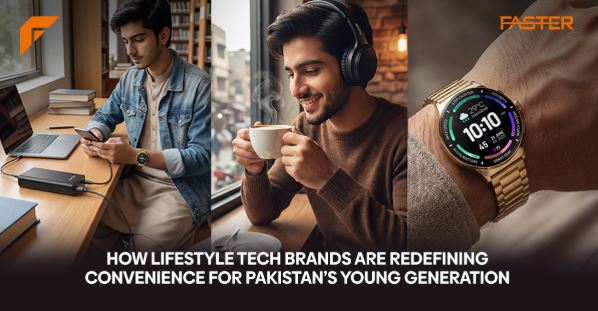
How Lifestyle Tech Brands Are Redefining Convenience for Pakistan’s Young GenerationThe young generation in Pakistan is living in a world where digital tools are not a choice but a part of life. From early morning alarms to late night scrolling, technology quietly shapes how they manage time, energy, and focus in a fast moving society.
Convenience is not simply a matter of luxury or even comfort in the modern world, but rather it is a matter of lessening friction in day-to-day life. Young users have come to expect that their devices should be adjusted to them and not that their lives should be altered according to the technology. Such a change has created an opportunity where brands such as Faster Pakistan are discussed in terms of utility in everyday life and not just image.
In Pakistan, access to smart phones among households has been at an all time high and the percentage of mobile or smart phone ownership in households has reached to approximately 96 percent. Internet access at the individual level increased 57 percent as compared to 17 percent in 2019 and household internet access doubled to 70 percent as per the last national survey (ProPakistani, 2026).
Why Convenience Has Become a Daily Requirement
The meaning of convenience has evolved alongside digital dependence. It is now linked to productivity, emotional ease, and control over time rather than just speed or appearance.
The telecom and digital consumption in Pakistan is dramatically shifting during the recent years. Mobile broadband connections now serve millions of people, almost 146 million 3G/4G mobile users were registered by mid 2025, reflecting the growing extent of high-speed access to data (Phoneworld, 2025).
With increased digital presence, young consumers evaluate technology based on its ability to help them lead personal, academic and professional lives without complicating or stressing them out.
The Real Problems Shaping Young Users’ Expectations
Convenience begins with understanding real world limitations rather than ideal conditions, especially in a diverse and developing country like Pakistan.
The most common challenges young users face today include:
- Load shedding that disrupts study and work
- Long commutes that waste productive hours
- Budget constraints due to inflation
- Limited access to premium global brands
- Managing multiple roles within one day
These realities have shifted preferences away from luxury appeal toward practical and resilient solutions.
How Daily Routines Are Quietly Being Rewritten
Technology is no longer confined to desks or bedrooms but travels with users throughout their day. This mobility has transformed how young people learn, work, and interact with the world around them.
Students now revise coursework on buses, freelancers answer international client calls from cafés, and young professionals join remote meetings from hostels and co-working spaces. This everyday mobility changes how young people define productivity and presence.
The convenience today is about possessing the tools that assure a perfect fit in the changing surroundings and evolving priorities, and not about the fixed environment and strict time schedule.
Personal Sound and the Need for Mental Space
In crowded urban landscapes, noise pollution is unavoidable. Whether it is traffic, marketplaces, or packed lecture halls, external sound becomes a constant distraction for youth trying to focus.
In such conditions, personal audio shifts from being purely entertainment to a tool for attention management. Many young users now carry compact wireless audio devices to create private focus zones during work, study, or leisure hours.
In these everyday scenarios, products like Faster Earbuds are valued not for brand prestige but because they fit seamlessly into moving routines, offering clarity and comfort that supports sustained concentration and calm during long days.
Wearables and the Rise of Self Awareness
Health awareness among Pakistani youth is steadily on the rise, yet access to formal healthcare remains uneven, especially outside major cities. Wearable devices bridge this gap by helping users track physical activity, sleep quality, and other personal wellness indicators independently.
This self monitoring which is taken regularly transforms health to more proactive habits than a reactive need and leads to long term health, without having to visit a clinic every now and then.
Many young people find gadgets such as the Faster Nerv smartwatch intuitive and unobtrusive, as they support everyday health tracking without drawing constant attention or complexity, aligning with a lifestyle that values subtle but valuable digital assistance.
Why Trust Has Become Part of Convenience
Convenience does not end at the moment of usage but extends into after sales experience and long term support. Trust has quietly become part of the convenience equation for young buyers.
Before purchasing, users now actively compare reviews, warranty terms, and service availability. They want assurance that help will exist after the transaction.
Audio as a Productivity Tool, Not a Fashion Statement
Headphones were once seen mainly as accessories, but today they function as essential productivity tools in digital learning and remote work environments. Sound clarity is now directly linked to performance.
In environments such as study halls and shared workspaces, extended usability becomes a priority that directly impacts productivity and output.
Here, comfortable and functional options like Faster Headphones are often chosen for usability over flash, reflecting how youth now evaluate tech based on daily usefulness and comfortability rather than appearance.
How Lifestyle Tech Supports Digital Careers
Pakistan has seen a significant rise in digital professions, with freelancing, content creation, and remote work becoming viable income streams for many young people. Connectivity is no longer a luxury; it is inseparable from economic opportunity and financial stability.
Reliable audio, stable connectivity, and portable power are now essential tools rather than optional accessories. Even small technical failures can mean lost opportunities.
In this context, convenience gains value not just as comfort but as a contributor to income generation and career resilience in a competitive global environment.
What Young Users Expect From Tech Brands Today
Expectations from tech brands have evolved significantly among young users, moving beyond advertising messages toward meaningful performance and transparent communication.
Today, young users commonly expect:
- Easy availability across cities
- Fair pricing without hidden compromises
- Durability for daily use
- Clear warranty and service policies
- Honest communication
Lifestyle tech brands that align with these values naturally build long term trust rather than short term attention.
Convenience Is Emotional, Not Just Functional
Beyond tangible performance, convenience now carries an emotional dimension, where technology that works reliably reduces stress and builds confidence over time. Knowing that a device will not fail during an important assignment, exam, or client call creates peace of mind.
These small but meaningful reassurances quietly improve overall life quality and psychological comfort, showing that convenience is both functional and emotional.
Lifestyle tech brands today shape emotional experiences as much as technical ones, which helps explain their growing influence in everyday life.
Visual Insight into Why Convenience Matters
Understanding long-term digital engagement patterns helps explain why lifestyle tech has become essential rather than optional for young Pakistanis. The graph below visualizes Smartphone Usage Patterns Among Pakistan’s Youth (2025–2026) that underpin everyday tech reliance.
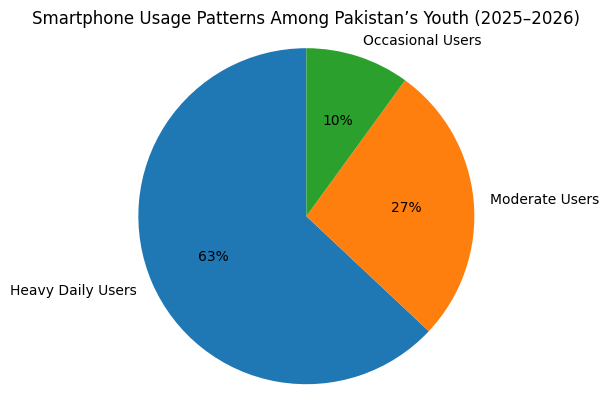
This chart highlights how deeply smartphones are embedded in the daily routines of Pakistan’s young generation. With nearly two thirds using their phones heavily every day, convenience has become a basic expectation rather than a luxury. This explains why lifestyle tech brands now design for constant mobility and ease.
Source: Dunya News (2025), Pak Observer (2025), and TechMag (2025)
The Broader Impact on Society
Easy access to digital tools extends beyond individual convenience and influences social structures as a whole. When more young people embrace digital platforms for learning, earning, and communication, the collective capacity for innovation and participation increases.
Digital inclusion enables broader access to education, financial services, and government programs, contributing to greater socioeconomic mobility and inclusion.
In this context, convenience becomes not only a personal benefit but a shared resource that supports community resilience and national progress.
The Quiet Transformation of Everyday Life
Lifestyle tech brands are not changing Pakistan loudly but steadily through routines and habits. That is what makes their impact sustainable rather than temporary.
For Pakistan’s young generation, convenience now means control over time and space, allowing them to work, learn, and relax on their own terms.
Lifestyle tech has become the invisible support behind this growing freedom.