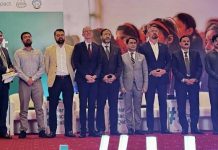
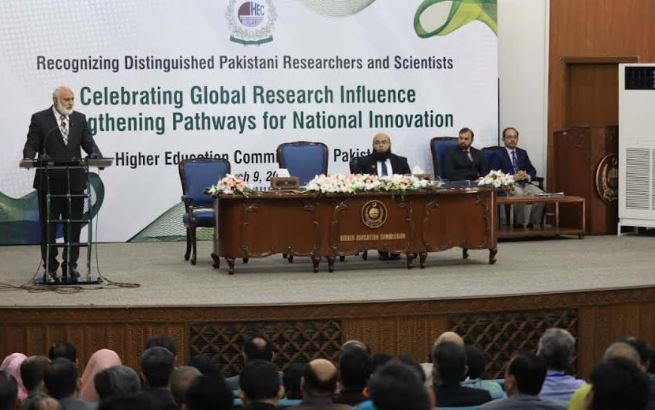
ISLAMABAD, MAR 9 /DNA/ – The Higher Education Commission (HEC) Pakistan celebrated the researchers who have made their way into the world’s top two percent scientists with a renewed commitment to fostering a culture that nurtures research activities focused on socio-economic development of the country.
Around 118 researchers – currently serving the universities in Islamabad, Rawalpindi and the vicinity – were honoured and recognised at the ceremony attended by a large number of Vice Chancellors, Deans, and faculty members. HEC has announced to hold similar events in the provinces to highlight the researchers’ achievement, followed by a research exhibition to showcase the work done by the distinguished individuals.
Chairman HEC, Dr. Niaz Ahmad Akhtar, distributed certificates to distinguished researchers during the ceremony, which was also graced by the presence of Executive Director HEC, Dr. Zia ul Haq, who himself is among the globally ranked individuals, and Advisor, HEC Research & Innovation Division, Dr. Engr. Muhammad Ali Nasir.
It is pertinent to mention here that as many as more than 1000+ Pakistani researchers have been included in the global ranking list for the year 2025 released by Stanford University, California. The list highlights the world’s top over 100,000 scientists across various disciplines based on citation impact.
Addressing the researchers, Chairman HEC Dr. Niaz Ahmad Akhtar congratulated the researchers and expressed pride in their achievement, describing them as ‘the stars of the nation’. He underlined that universities remain the primary centres for the creation and transformation of knowledge. “Universities must create and transform knowledge, inculcate skills, and produce responsible and civilized citizens for society,” he emphasised. He highlighted the vital role of teachers in national development and termed teaching as a noble profession that demands dedication and commitment to shaping future generations.
Stressing the significance of research in universities, the Chairman HEC remarked that HEC allocates substantial resources to research and will continue facilitating researchers through funding and supportive initiatives. He urged the researchers to link their research to the industrial needs and to continuously examine their work as to how it contributes to the advancement of their disciplines and to the socio-economic development of Pakistan. “A single research paper that brings real change is far more valuable than hundreds of papers without tangible impact,” Dr. Niaz underlined. He also encouraged the researchers to mentor young scholars and transfer their knowledge and experience to the next generation of researchers.
In his welcome remarks earlier, Dr. Zia ul Haq asserted that it is a significant achievement for a researcher to be part of the world’s top two percent scientists, as it reflects the dedication and hard work of Pakistani researchers. “The achievement to reach this level of global recognition is a testament to the growing research capabilities of our scholars and the supportive role played by universities and national institutions,” he acknowledged. He reiterated HEC’s commitment to facilitating researchers and promoting productive research that contributes to national progress. He also urged the recognised scientists to cascade their expertise to strengthen the country’s research community.
Speaking on this occasion, Advisor R&I Division Dr. Muhammad Ali Nasir shed light on HEC’s research and innovation portfolio and highlighted the outcomes of initiatives such as National Research Programme for Universities (NRPU), Technology Development Fund (TDF), research grants, and collaborative partnerships. He said HEC is implementing multiple competitive programmes aimed at strengthening research capacity, promoting technology transfer, and fostering national and international collaboration. He also informed the audience of HEC’s extensive research support mechanisms followed to ensure that research outcomes translate into practical solutions and innovation.
Representatives of the globally recognised scholars also expressed their views on this occasion. They stressed the importance of scientific integrity, curiosity, and collaboration. They observed that interdisciplinary cooperation and resource sharing are essential to address the challenges faced by the nation. They underscored that the Pakistani researchers possess immense potential to significantly contribute to not only the country’s uplift but also to the global scientific discourse.