
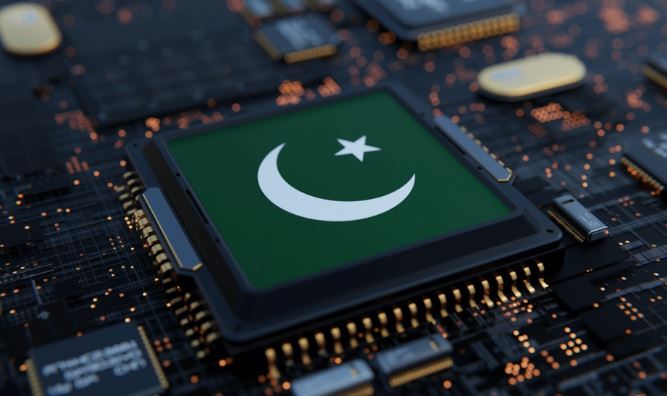
Silicon is the new oil, and Pakistan is running dry. While the 20th century was defined by the race for oil, the 21st century is being shaped by control over semiconductor supply chains. Global powers invest billions, but Pakistan remains a distant spectator despite having a young workforce with 64% of the population under 30 and abundant natural resources, including silica reserves in regions like Mianwali and Thatta with raw purity reaching up to 99.98%. Such dilemmas raise questions for the future of Pakistan, such as: Is Pakistan willing to play a constructive role in this high-stakes race for semiconductor supremacy, or will it watch its economic and geopolitical relevance disintegrate as the silicon clock ticks down?
In recent decades, with a growing demand for increased computational power globally, semiconductor technology has emerged as an important strategic asset. It also became an epicenter of geopolitical competition as a result of growing the US-China technology rivalry. In 2022, the United States committed $52.7 billion in federal funding specifically to bolster its domestic semiconductor industry through the CHIPS and Science Act. The Act supported US domestic chip manufacturing and research with an overall authorized budget of roughly $280 billion. The CHIPS Act served as America’s effort to strengthen its technological base and develop an independent supply chain, which can supersede reliance on foreign actors, especially China.
In the meantime, China is committed to advancing its policy of technological self-reliance and catching up with Taiwan. Since 2014, China has spent an estimated $150 billion upgrading its semiconductor sector. Huawei has been at the forefront of this ambition and thus is also the face of the US-China technology rivalry. Beijing also aspires to reduce its reliance on the foreign semiconductor industry and work on establishing an indigenous industry in the long term.
Other countries, like Taiwan, South Korea, and the Netherlands, have also shown their significance in this sector. Taiwan is the base for more than 60 percent of advanced chip manufacturing, South Korea dominates in developing memory chips, and the Netherlands is home to companies specializing in extreme ultraviolet lithography equipment essential for advanced chip production. In the same breath, India is also attempting to get on the bandwagon. The president of India’s Electronics and Semiconductor Association (IESA), Ashok Chandak, recently confirmed India’s intent to focus on Outsourced Semiconductor Assembly and Test (OSAT). A Gujarat based Kaynes Semicon company has invested $260 million in a factory to assemble and test semiconductor chips with the support of the Indian government to help India package technology indigenously.
In contrast to India, Pakistan lacks strategic long-term policy planning. India heavily invested in institutions like the Indian Institutes of Technology (IITs) and the Indian Institute of Science (IISc) decades ago. It progressively maintained continuity in its policies and, as a result, built reliable industry-academia linkages, which gave New Delhi an edge in the corporate world. By contrast, Pakistan has struggled less because of a lack of talent and more due to a lack of sustainability and commitment in the semiconductor domain. The lack of long-term vision has cost Pakistan its place in the modern world.
Pakistan does not need to build expensive “mega-factories” or “semiconductor fabs” to compete in the tech race. Countries like Vietnam and Malaysia have already shown a better way by focusing on specific niches like chip assembly and testing. By hosting global giants like Intel, Samsung, and Infineon, these countries prove that steady government policy and smart positioning are more important than being a manufacturing powerhouse.
Computer chips or semiconductor manufacturing is essentially achieved in three steps: designing chips, wafer fabrication in semiconductor “fabs”, and OSAT. Pakistan is currently absent from all three steps. The most daunting of all three stages is the second one, focused on wafer fabrication in semiconductor fabs, since it involves expensive machines in exclusive factories that already dominate the industry.
However, Pakistan can produce some luck in OSAT and chip designing. A strenuous collaborative effort at labs in NUST and other institutions can guide Pakistan into designing chip architecture. This process will particularly require serious revisions in the academic curriculum and reformation in vision. During the OSAT phase, large silicon sheets are sliced into tiny chips and safely packaged for use. Practically speaking, Pakistan can use this phase in its interest positively.
According to ex-Lumentum, Dr Salman Abdullah, a semiconductor device fabrication and photonics expert, Pakistan’s challenge is structural rather than intellectual. He argues that Pakistan lacks the foundational infrastructure required to establish a global semiconductor ecosystem. He mentions that although Pakistan produces approximately 25,000 engineering graduates annually, they rarely receive exposure to real chip manufacturing environments. The lack of local industry has led to a severe “brain drain,” with official figures showing that over 11,000 engineers have emigrated from Pakistan in the last two years to seek better opportunities abroad. Even if Pakistan is to only focus on the phases of chip designing and manufacturing, it will still require an academic reformation and revival at the higher education level.
Although a Pakistan National Semiconductor Plan (PNSP) has recently been compiled, it is going to take more than bureaucratic huddling to take a generational leap. The PNSP avoids calling for immediate investment in advanced wafer fabrication since it can cost tens of billions of dollars, besides demanding reliable resources. Instead, the plan focuses on fabless chip design, verification, testing, and packaging. This focus is economically critical, as Pakistan currently faces a massive financial drain due to its total reliance on foreign technology. In 2024, Pakistan’s import bill for electrical and electronic equipment reached $6.25 billion, contributing significantly to a trade deficit that exceeded $24 billion.
The emergent challenges and risks involving semiconductor manufacturing and designing call for an approach of increased focus and patience. It is essential to strengthen fabless design, verification, packaging, and seamless testing, which can generate exports, create skilled jobs, and build experience. It is also essential to establish a strategic and structured scholarship program that can enhance engagement with the Pakistani scientific diaspora and international experts. Such a collaboration will transfer expertise back. Finally, setting up centralized national research centers would allow universities and startups to share infrastructure that individual institutions cannot afford. All of this is critical to put Pakistan on the global technological landscape.
While semiconductor manufacturing is a truly global enterprise and its incessant need is attracting global interests, Pakistan remains largely absent from the industry’s manufacturing and testing supply chain. Such a lack of participation raises significant concerns regarding the nation’s industrial development, technological sovereignty, and long-term economic growth. The global semiconductor race is accelerating, and the clock is ticking for Pakistan. While the country may not become a fabrication powerhouse anytime soon, it will be in Pakistan’s interest to find a meaningful role in the semiconductor domain.
About the Authors
Osama Tahir is a software engineer and independent researcher specializing in data-intensive systems and applied artificial intelligence. He has an Engineering Doctorate (EngD) in Software Technology from Eindhoven University of Technology. He has worked at IBM, the Wikimedia Foundation, and Deakin University across research, industry, and open-source development.
Mahnoor Saleem is an Erasmus Mundus Scholar. She specializes in the politics of emerging technologies, security research, and corporate intelligence and espionage. She has a postgraduate degree in International Security, Intelligence, and Strategic Studies (IMSISS) from the University of Glasgow.
Disclaimer
The views expressed are the authors’ own and do not represent the positions of their employers or affiliated institutions.