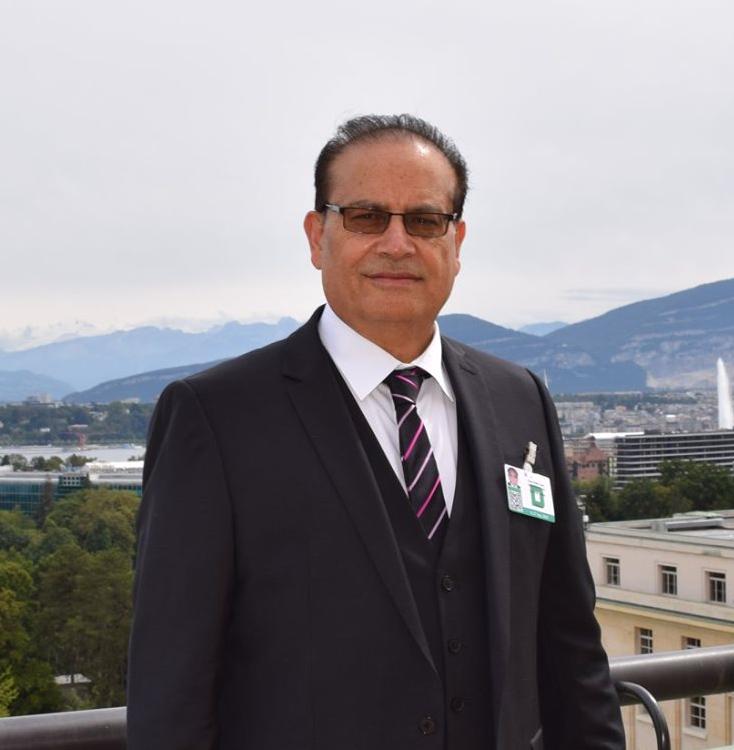
Qamar Bashir
What once appeared to be an abstract geopolitical forecast has now taken the shape of unfolding reality. In early 2024, Chinese-Canadian analyst Jiang Xueqin advanced a controversial thesis—“The Iran Trap.” His argument was dismissed by many as speculative: Donald Trump would return to power, initiate a major confrontation with Iran, and ultimately entangle the United States in a costly, unwinnable war that would weaken its global standing. Two elements of that prediction have already materialized. The third—strategic failure—is now emerging gradually, not through collapse, but through erosion.
The war, which began on February 28, 2026, quickly escalated into one of the most intense confrontations in modern Middle Eastern history. The United States, alongside Israel and supported by regional partners, launched extensive aerial and naval operations targeting Iranian military infrastructure, energy networks, and strategic facilities. Initial expectations in Washington were rooted in the belief that overwhelming force would compel Iran into submission or at least force it to negotiate from a position of weakness.
But the war did not follow that script. Iran absorbed the shock and responded with calculated resilience. It refused to surrender, refused to slow its retaliation, and instead demonstrated a sustained capacity to respond through asymmetric means. Missile strikes, drone operations, and regional disruptions transformed the battlefield into a prolonged contest of endurance. The conflict shifted from a display of technological superiority to a test of strategic patience.
For the first time in decades, Israel faced sustained retaliatory pressure that tested both its defensive systems and civilian morale. Reports of public frustration—including direct confrontations with political leaders—revealed growing discontent with a war that appeared to lack a clear exit strategy. The psychological balance of the conflict began to shift.
On March 23, 2026, President Donald Trump announced a five-day pause in planned strikes on Iranian energy infrastructure, particularly power grids. He described ongoing contacts as “very good and productive,” signaling a potential diplomatic breakthrough. However, Iranian officials quickly dismissed these claims, denying any formal or informal negotiations and labeling such statements as misleading narratives intended to influence global markets.
According to Iranian spokespersons, this announcement by the United States—framed as a diplomatic opening—was not driven by genuine intent for peace, but rather by economic pressure. They argued that rising oil prices, triggered by disruptions in the Strait of Hormuz, were causing severe strain not only on Europe but also on the United States and the global economy. In their view, Washington’s signaling of negotiations was a calculated attempt to cool oil markets and temporarily ease economic pain, rather than a reflection of substantive progress.
Iranian officials further warned that such unilateral messaging would be short-lived, and that once the immediate market reaction subsides, tensions would likely escalate again—driving oil prices upward once more. This perspective highlights a deeper layer of the conflict, where economic warfare and perception management are as critical as military operations.
At this stage, Iran’s Foreign Minister Abbas Araghchi has expressed conditional willingness to engage in negotiations, but only within a clearly defined framework. Any dialogue, he has emphasized, must focus strictly on the nuclear issue, must be fair, and must ensure a win-win outcome that preserves Iran’s sovereignty, dignity, and national integrity. Yet, notably, Iran’s official channels have not confirmed any ongoing talks, nor acknowledged any tangible progress, even as U.S. leadership continues to project optimism.
This non-committal posture is deliberate. From Tehran’s perspective, the United States has already escalated the region into chaos—damaging infrastructure, destabilizing allies, and contributing to disruptions in global energy flows. Having triggered this environment, Washington now appears eager to de-escalate. But Iran’s stance is clear: it will not allow the United States to exit the conflict without consequence, without concessions, and without accountability.
This raises a critical and uncomfortable question. If Iran’s leadership has not formally acknowledged negotiations, and if there is no official confirmation of talks, then who exactly is Washington engaging with? Reports have mentioned possible intermediaries such as Brett McGurk and other diplomatic figures, yet the absence of Iranian confirmation introduces ambiguity. While it may seem far-fetched, the possibility cannot be entirely dismissed that the United States may be interacting with non-authoritative or secondary channels, rather than the core decision-making leadership in Tehran.
Such uncertainty underscores the fragility of the diplomatic process. Meanwhile, Iran continues to assert that its nuclear program remains fully compliant with the Non-Proliferation Treaty (NPT). It has reiterated its willingness to allow inspections by the International Atomic Energy Agency (IAEA), while firmly maintaining that uranium enrichment is its sovereign right. This dual posture—cooperation without concession—has strengthened Iran’s negotiating position.
The broader geopolitical consequences are equally significant. Europe, having reduced dependence on Russian energy, is now heavily reliant on Middle Eastern supplies routed through the Strait of Hormuz. With that corridor under threat, energy prices have surged, supply chains have tightened, and political pressure has intensified across European capitals. The global economy has reacted sharply to every development—oil prices, shipping costs, and stock markets now fluctuate in direct response to battlefield events and diplomatic signals.
At its core, the conflict has exposed a fundamental imbalance—not in military strength, but in strategic approach. The United States and Israel have relied on conventional superiority—air dominance, naval strength, and precision strikes. Iran, by contrast, has leveraged asymmetric warfare, combining missile capabilities, drone networks, cyber tools, and regional influence to offset its disadvantages. Its ability to project force and sustain pressure has reshaped perceptions of power.
This is precisely the dynamic envisioned in the “Iran Trap”—a scenario in which a superpower becomes entangled in a conflict where traditional advantages fail to yield decisive outcomes.
As negotiations—acknowledged or otherwise—move closer, the balance of power has shifted. Iran now enters this phase as a confident and strengthened actor, capable of negotiating from a position of resilience. If sanctions are lifted, Iran could rapidly emerge as a revitalized economic and regional force, leveraging its energy resources and strategic geography.
Yet, the implications extend beyond Iran. History shows that unresolved conflicts often lead to new entanglements. Some analysts speculate that if this confrontation stabilizes without a clear resolution, geopolitical tensions may shift to other regions, including Cuba. While such scenarios remain hypothetical, they underscore a broader risk: the danger of moving from one strategic quagmire to another without learning from the first.
The lesson is unmistakable. Power alone does not guarantee victory. Military superiority does not ensure control. In a multipolar world defined by complexity, resilience and adaptability can challenge even the most dominant forces. The Iran conflict is no longer just a regional war—it is a defining test of global power, credibility, and strategic limits. What began as an assertion of dominance may ultimately redefine it.
Qamar Bashir
Press Secretary to the President (Rtd)
Former Press Minister, Embassy of Pakistan to France
Former Press Attaché to Malaysia
Former MD, SRBC | Macomb, Michigan