
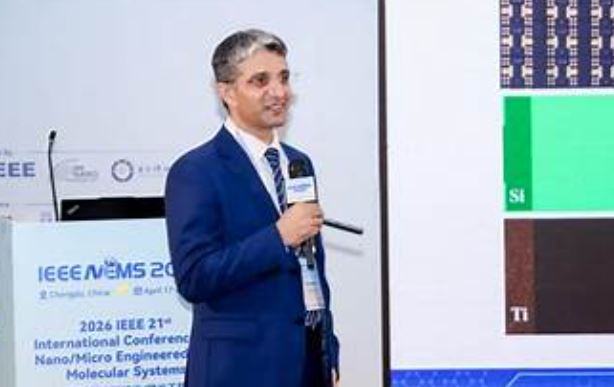
BEIJING, Apr 30: When the 2026 IEEE 21st International Conference on Nano/Micro Engineered and Molecular Systems (IEEE NEMS 2026) brought together nearly 1,000 experts from around the world in the southwestern Chinese city of Chengdu, a Pakistani scientist trained at top Chinese universities took an active part in the event.
Dr Ali Imran, Director of Research and Development at the National Nanotech Innovation Center in Guangzhou, served as a session chair for a panel on “Micro/Nanofabrication and Sensor”, which received five papers from five Chinese universities. He has chaired sessions at several international conferences in recent years, reflecting how Chinese-trained international scientists are increasingly involved in major academic events hosted by China, CEN reported.
IEEE, the Institute of Electrical and Electronics Engineers, is the world’s largest non-profit technical professional organization. The conference, held from April 17 to 21, focused on cutting-edge fields including Micro/Nano Electromechanical Systems (M/NEMS), nanotechnology and molecular systems. The event featured seven plenary sessions, 100 parallel sub-forums and three poster presentations. More than 300 invited and keynote speakers addressed the conference, which attracted nearly 1,000 experts and scholars from universities, research institutes and enterprises worldwide.
Dr. Imran spoke highly the fact that IEEE NEMS 2026 provides a valuable platform for experts, scholars, researchers and students from around the world to exchange ideas and showcase the latest research achievements, innovative concepts and applied technologies across academia and industry.
Dr. Imran received his academic training from leading Chinese institutions, including Peking University, Beijing Institute of Technology and Zhejiang University. Beyond his role at the conference, Dr Imran introduced his recent collaboration with a Chinese engineering team in the development of a new hard radiation sensing platform.
“The innovation focuses on deep-ultraviolet detection, a critical technology for applications in complex and high-risk environments,” he said. “Based on preliminary estimates, the technology could reduce production costs by up to 80 percent compared with imported deep-ultraviolet detectors.”