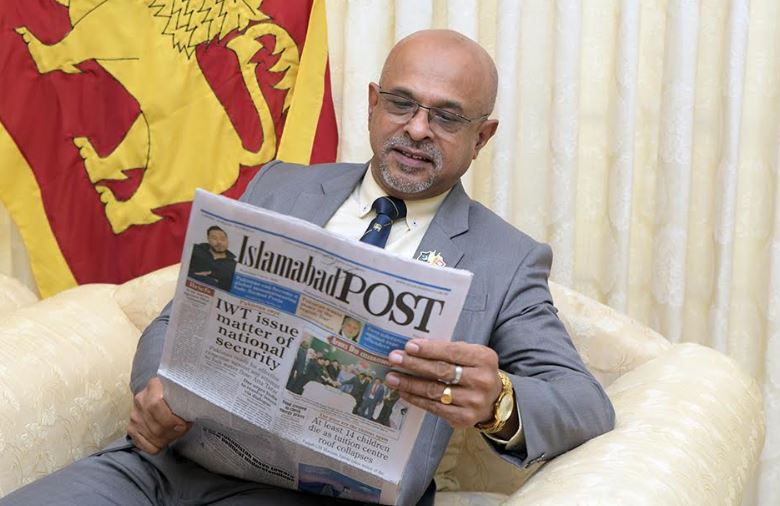
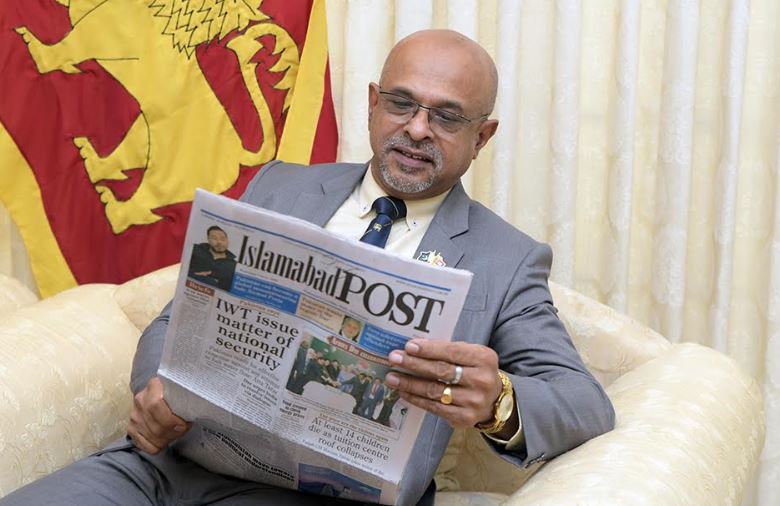
High Commissioner of Sri Lanka to Pakistan, Fred Senevirathne, speaks to Centreline, Daily Islamabad Post, and Diplomatic News Agency. In an extensive conversation, High Commissioner Fred Senevirathne highlighted the deep-rooted Pakistan–Sri Lanka ties and shared his vision for strengthening them further. Here is the text of his interview.
By Ansar Mahmood Bhatti
1: Bilateral ties: How would you describe the current state of Sri Lanka–Pakistan relations, especially in defense and strategic cooperation?
Allow me to start by expressing my sincere thanks to Centreline Magazine for granting me this platform. I am deeply honored to contribute to such an esteemed outlet and to share my views on the state of relations between our two nations, as well as the many promising prospects for future collaboration.
Pakistan and Sri Lanka share a strong, longstanding friendship rooted in mutual understanding and trust. We have always stood by each other in times of need. In recent years, however, regular consultations in key areas were disrupted by unavoidable circumstances, such as the COVID-19 pandemic, Sri Lanka’s economic crisis, and certain regional developments. As the Sri Lankan Mission, we have clearly taken note of this and are working diligently to harness the untapped potential and further strengthen our bilateral relations.
In the defence sector, we have a very close and smooth relationship. Regular Defense and Security Talks are conducted between Defence Secretaries and Service Chiefs. At any given time, approximately 100 Sri Lankan military personnel are being trained in Pakistan. Recently, one Pakistani submarine and two naval ships paid a goodwill visit to Sri Lanka, and one Sri Lankan Army contingent participated in a joint training exercise.
2: Regional security: What role can Sri Lanka and Pakistan play together in ensuring regional peace and countering terrorism?
Beyond land-based threats, both nations are critical Indian Ocean littoral states and are prone to non‑traditional security challenges such as piracy, narcotics trafficking, human smuggling, and illegal, unreported, and unregulated (IUU) fishing. Unlike traditional threats, these typically stem from non‑state actors or systemic factors and cannot be solved by any single country.
Therefore, maritime security and domain awareness represent, a key area for bilateral collaboration. Leveraging our shared strategic geography within the Indian Ocean, the establishment of a formalized intelligence‑sharing framework would facilitate a unified response to these threats.
- Trade potential: Bilateral trade volume is around $500 million. What sectors do you see as most promising for expansion under the Free Trade Agreement?
First, let me briefly explain the Free Trade Agreement (FTA). Although the Pakistan‑Sri Lanka Free Trade Agreement (PSFTA) has been in place for some time, its potential remains largely untapped. Data shows a significant disparity in utilization rates: Sri Lanka’s is around 10%, compared to Pakistan’s 35%, which has contributed to the current trade balance being in Pakistan’s favor.
Therefore, I believe a critical review and modernization of the PSFTA itself is essential to ensure it remains relevant and mutually beneficial. This review should focus on achieving balanced concessions by critically examining and potentially reducing the negative lists that currently restrict market access. It should also include the addition of country‑specific products that are in high demand.
When it comes to conventional trade, the export baskets of both countries are largely similar, offering limited scope for expansion. Nevertheless, there is room to introduce new, nation-specific products that face rising demand from the other side, this issue can be taken up during the upcoming meeting of the Economic Joint Commission. However, tourism and hospitality, agriculture and livestock, pharmaceuticals and chemicals, and textiles and apparel represent as most viable areas for economic cooperation such as joint ventures.
4: Investment opportunities: How can Sri Lanka attract Pakistani investors, and vice versa?
I would like to take this opportunity to explain in detail the key investor-friendly conditions that make Sri Lanka an advantageous destination for potential Pakistani investors.
Financial Benefits
The standard corporate income tax rate is 28%. However, a reduced rate of 14% is provided for specific sectors, as such as Small and Medium-sized Enterprises (SMEs), Export of goods and services, IT and Education, Tourism and Agriculture.
Strategic Location
As you all know, our strategic location is one of our greatest strengths. Sri Lanka is situated at the center of major maritime trade routes, connecting the Far East, Middle East, Africa, Australia, Europe, and the Americas providing easy access for global shipping. We also have two major deep-water ports with multiple container terminals, extensive berthing facilities, and a variety of modern cranes and equipment. These ports offer services for car carriers, container, break bulk, and bulk cargo. They also provide specialized services such as bunkering, ship repair, and support for the oil & gas and cruise ship sectors.
Air Connectivity
Air connectivity plays a major role in economic development and provides a significant advantage to investors. In the case of Sri Lanka, the national carrier Sri Lankan Airlines offers direct flights from various international destinations, including four weekly frequencies from Lahore and Karachi. Strong connections are also provided by numerous Middle Eastern carriers such as Emirates, Etihad Airways, Qatar Airways, Oman Air, flydubai, and Air Arabia, which offer convenient one‑stop access to Sri Lanka for travelers from Europe, North America, and beyond. A wide array of Asian airlines—including Malaysia Airlines, AirAsia, Singapore Airlines, IndiGo, Air India, and Fits Air—also fly to Sri Lanka, along with several European carriers like British Airways and Turkish Airlines.
Capable Work force
We are proud to say that we offer a highly literate and cost-effective labor pool, with significant talent in the engineering, IT, apparel, and tourism fields. We also have a strong pipeline of vocational graduates for various fields.
Internal Transportation
The country has an extensive road network and a railway system that seamlessly connects the commercial capital, Colombo, with the rest of the country.
Telecommunications
Our telecommunications infrastructure has been rapidly modernized, resulting in excellent mobile network coverage across the entire island. This robust connectivity enables advanced e-commerce and digital banking services.
Special Economic Zones
There are 12 Export Processing Zones (EPZs) operating under the Board of Investment (BOI), offering dedicated facilities and incentives for exporters such as, approval and facilitation for export and import documentation, engineering approvals such as building plans, centralized water and sewage facility, around the clock security coverage
5: Gandhara heritage: Pakistan’s Gandhara Buddhist heritage has been showcased to Sri Lankan monks. How do you see cultural diplomacy strengthening ties?
Cultural diplomacy serves as a powerful tool to strengthen the bonds between the peoples of Pakistan and Sri Lanka by fostering mutual understanding, respect, and appreciation for each other’s rich traditions and heritage. However, the majority of the Buddhist community in Sri Lanka remains unaware of the Buddhist heritage existing in the Gandhara civilization in Pakistan, and of how the Pakistani government preserves and safeguards it.
Despite this lack of awareness, Sri Lankans immensely value the Buddhist heritage of the Gandhara civilization, including all artifacts preserved at museums and the Dharmarajika Stupa. For instance, the sacred Buddha relic kept at the Taxila Museum is considered a very holy religious object.
In this context, commemorating Wesak Day at Dharmarajika Stupa and the Taxila Museum, and showcasing it to Buddhist monks and Buddhist communities from other countries, has proven to be a remarkable event. One Buddhist monk from Sri Lanka who attended was highly impressed and promised to spread the news through his sermons to the Buddhist community back home. Moreover, after seeing the ceremony on social media, a Sri Lankan Buddhist association based in Australia contacted me and expressed its willingness to visit the Gandhara civilization.
Therefore, I believe Pakistan should leverage the Gandhara region, the major pilgrimage site for Buddhists to attract travelers from Sri Lanka’s majority Buddhist population. By doing so, Pakistan can turn cultural diplomacy into a concrete driver of religious tourism and people to people ties.
6: Public diplomacy: How can media collaborations between Sri Lanka and Pakistan enhance people-to-people contact?
As earlier mentioned, Pakistan and Sri Lanka share a strong, longstanding friendship rooted in mutual understanding and trust. People to people bonding through cultural exchange, trade, education, and tourism are vital factor for any bilateral relationship. However, some sectors in both countries remain unaware of each other’s true potential.
In this technologically advanced era, media can play a huge role in enhancing awareness and strengthening these people-to-people bonds. Recognizing this, the Sri Lanka Tourism Development Bureau (SLTDB) conducted two road shows in Karachi and Lahore last year. This year, further events involving media from both countries are already planned. Very recently, the Sri Lanka Tourist Promotion Board invited ten media and tour operators from Pakistan and successfully conducted a programe.
I hope that Pakistan will also conduct a similar programe in Sri Lanka, thereby completing a reciprocal effort to deepen mutual awareness and friendship through the power of media.
7: Climate cooperation: Both countries face climate challenges. Are there joint initiatives planned in renewable energy or disaster management?
Yes, as you said, both countries are prone to climate change challenges and have very recently experienced severe disasters. As a result, there are jointly planned initiatives for disaster management. In this context, the Sri Lanka Disaster Management Centre (DMC) maintains a close relationship with Pakistan’s National Disaster Management Authority (NDMA).
Beyond this bilateral cooperation, Sri Lanka is an active member of the Asian Disaster Preparedness Centre (ADPC) and has attended all of its programs, benefiting from regional knowledge sharing and capacity building. This regional engagement complements the direct collaboration with Pakistan.
Building on these foundations, every year Sri Lanka and Pakistan conduct a virtual exercise on Anticipatory Action for floods, cyclones, and droughts. These exercises help both countries align their early warning systems and response protocols. In a significant step forward, in 2023 Sri Lanka hosted the Sustainable Anticipatory Action Programme, a regional event that strengthened cooperation on forecast‑based disaster financing and proactive response.
High‑level exchanges have further solidified this partnership. The Director General of NDMA visited Sri Lanka in 2022, and high‑level officials from the Sri Lanka Disaster Management Centre visited NDMA in 2024. These reciprocal visits have deepened mutual understanding and opened avenues for technical collaboration.
However, to further enhance Sri Lanka’s disaster management capabilities, Sri Lanka must plan to obtain assistance from Pakistan, particularly in terms of knowledge, practical experience, and specialized equipment. By leveraging Pakistan’s extensive hands‑on experience in large scale flood response, drought management, and emergency logistics, Sri Lanka can build a more resilient disaster management system ready for future climate challenge.
8: Security concerns: With terrorism and extremism still a threat, how can Colombo and Islamabad cooperate more effectively?
Terrorism and extremism directly affect any country’s political stability, economic development, and social harmony. Sri Lanka suffered heavily from both of these scourges. Two stark examples are the three decade long civil war fought against the separatist Liberation Tigers of Tamil Eelam (LTTE) and the Easter Sunday attack of 2019, in which an extremist Islamic group targeted Christian churches and leading hotels. Today, Pakistan faces a similar situation, and this threat now affects every aspect of the country.
It is important to recall that during Sri Lanka’s civil war against the LTTE, Pakistan provided crucial assistance, including training and military hardware. Sri Lankans consider this support a major contributory factor in ending the separatist war. In a spirit of reciprocity, Sri Lanka now possesses hard earned expertise in successfully concluding a separatist civil war. Therefore, Sri Lanka can share its experience to help enhance Pakistan’s own counter‑terrorism and counter‑extremism strategies. This would be a meaningful way to build on the steadfast support Pakistan provided to Sri Lanka during its own challenges, fostering a truly reciprocal security partnership.
To ensure that this partnership remains innovative and sustainable over the long term, we should also foster robust links between our defence academies and think tanks. Establishing joint research initiatives can drive progress in critical fields such as artificial intelligence and defence production. Concrete steps could include the co‑development of specific technologies, for example unmanned aerial vehicles or the modernization of naval vessels. Such cooperation would not only strengthen bilateral ties but also contribute to regional stability.
9: Anything you would like to add?
I take this opportunity to explain the current political and economic situation in Sri Lanka.
As you may be aware, our nation has endured one of the most difficult periods in its modern history, a 30-year separatist civil war that ended in 2009, the devastating Easter Sunday attacks in 2019, and a severe economic crisis between 2022 and 2023 caused by political and financial mismanagement. These events brought us to our knees and tested the strength of our people and institutions. But from this hardship, a new Sri Lanka has emerged, determined to rebuild itself as a stable, transparent, and forward-looking nation.
Following that economic crisis, a new government, the National People’s Power (NPP), came to power with a strong mandate, securing more than a two-thirds majority. I am proud to say that under the visionary leadership of President Anura Kumara Dissanayake, our country is now on a path of resilience and transformation. Today, our political environment is stable and our economy is growing. With IMF guidance, we have regained macroeconomic stability, our exchange rate is steady, our reserves are no longer at alarming levels, and our export earnings have increased over the past year. We have also seen a strong recovery in tourism, with the highest number of visitors in recent times.
This progress is backed by serious governance and anti-corruption reforms that have gained international recognition. Just three months ago, IMF Managing Director Dr. Kristalina Georgieva acknowledged our government’s efforts during her visit. Additionally, Sri Lanka has climbed 14 places in Transparency International’s 2025 Corruption Perceptions Index, now ranking 107th out of 180 countries. Given this context of stability, reform, and growth, we see great opportunities for investment, whether on your own or through joint ventures. I therefore respectfully invite the Pakistani business community to explore the growing potential of Sri Lanka as a trusted and rewarding investment destination.