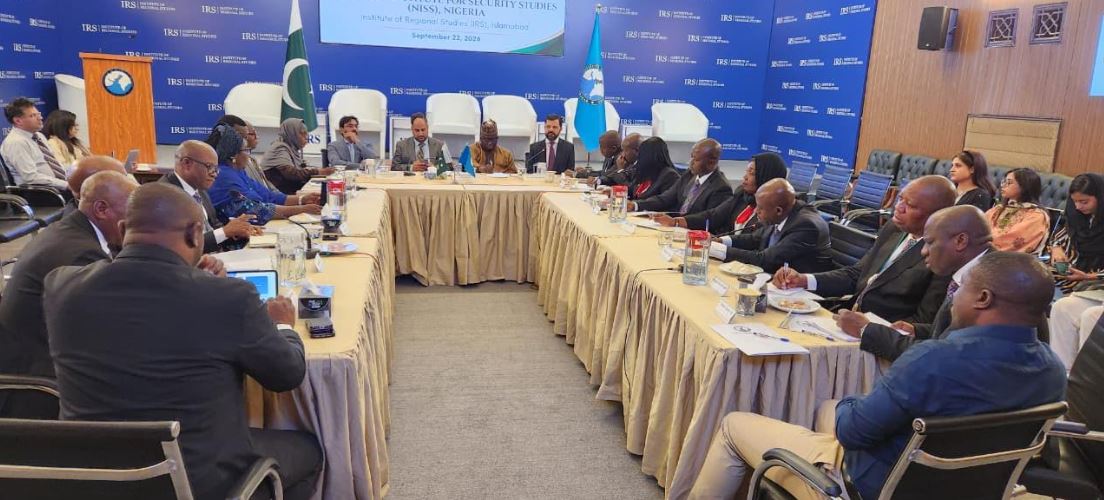
ISLAMABAD, SEP 22 /DNA/ – A high-level delegation comprising participants of a course at Nigeria’s National Institute for Security Studies (NISS) visited the Institute of Regional Studies (IRS) in Islamabad and held wide-ranging discussions with IRS researchers on shared security and regional challenges.
During the interaction, President IRS Ambassador Jauhar Saleem highlighted the socioeconomic and sociocultural similarities between Pakistan and Nigeria and discussed some of the common security challenges faced by the two countries. He also highlighted Pakistan’s concerns regarding the role of external factors, including developments involving Afghanistan and India, in its internal security challenges. Ambassador Saleem underscored the considerable potential for officials and researchers from Pakistan and Nigeria to learn from each other’s experiences and called for continued institutional collaboration between NISS and IRS.
The interactive session featured an extensive exchange of views and questions from members of the visiting delegation. The IRS research team briefed the delegation on Pakistan’s efforts to address its internal and external security challenges, while the Nigerian participants shared their experiences in dealing with the country’s own security challenges. The discussion covered terrorist narratives, socioeconomic drivers of extremism, the relationship between traditional and non-traditional security, and the impacts of climate change in South Asia and Africa, particularly Pakistan and Nigeria.
The visiting delegation included senior faculty members of NISS as well as officials from various Nigerian government institutions, including the Department of State Services, Independent Corrupt Practices and Other Related Offences Commission, Nigerian Ports Authority, Nigeria Security and Civil Defence Corps, Federal Airports Authority of Nigeria, and the Taraba State Government.
The visit provided an opportunity for both sides to exchange perspectives and explore avenues for further cooperation and knowledge-sharing between the two institutions.