DNA
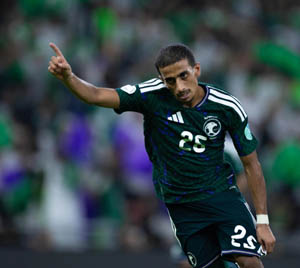
DAMMAM: On Jan. 8, 2004, Yasser Al-Qahtani netted two goals in 22 minutes to give Saudi Arabia a 2-0 victory over Yemen. That win brought Saudi Arabia its third Gulf Cup title — its last for another 22 years. And it was just 22 days after that win over Yemen that a certain Hammam Al-Hammami was born. Al-Hammami began his footballing career in the most unlikely of places for a Saudi player — not at a youth club in his birthplace of Jeddah or hometown of Najran — but in East London, at the West Ham Foundation. From there, he was selected for the Saudi Future Falcons program and signed for Czech club Slavia Prague’s under-19s before being loaned to fourth-division side Benešov. He returned to Saudi Arabia within months, joining the black and yellow of Al-Ittihad. The young winger could not break through at the Tigers and was loaned out to Al-Kholood after a debut season that saw him accumulate just 11 minutes. There, he launched his career and announced himself to his home country. But while Al-Ittihad fans awaited his return, Al-Hammami found himself surplus to requirements and moved to Al-Shabab — where he raised his stock to become a key figure in the squad. His first two seasons as a regular starter saw him rank among the top 10 in successful dribbles per 90 in the Saudi Pro League for two consecutive campaigns. But despite a 45-minute Gold Cup cameo against Haiti in the summer of 2025, Al-Hammami could not secure a place in the Green Falcons setup for the Arab Cup in December or the World Cup the following summer. With Georgios Donis deploying Mohammed Abu Al-Shamat on the right wing, Sultan Mandash’s stellar form since arriving at Al-Hilal in January 2026 and the seemingly untouchable Salem Al-Dawsari on the left flank, Al-Hammami’s chances of nailing down a starting place in the national team looked remote. That was until Saudi Arabia’s Gulf Cup opener against Kuwait. Few expected it to be Al-Hammami who broke the deadlock and put Saudi Arabia on the path to their fourth Gulf Cup title. Al-Hammami’s ability to weave past defenders and carry danger in transition — in the absence of the injured Al-Dawsari — prompted fans to wonder how different Saudi Arabia might have looked at the World Cup had they had the former Slavia Prague player available to them. And in the Gulf Cup final, Al-Hammami showed exactly why he can be the man to lead Saudi Arabia into the next Asian Cup — and the Road to 2034. In the 11th minute, he pounced on a soft UAE clearance from a corner before turning and shooting from outside the box — and with a little help from Bruno’s deflection, opened the scoring to set Saudi Arabia on the path to their first title in 22 years. The 22-year-old also played a pivotal role in Saudi Arabia’s second goal minutes later, driving the UAE defense deeper into their own half before threading a pass to Nasser Al-Dawsari in the half-spaces to release Feras Al-Brikan with a decisive through ball. Once the final whistle sounded and Saudi Arabia’s 2-0 victory over the UAE was confirmed, his teammates gathered around him as the Best Player of the Tournament announcement loomed. The decision was never in doubt: Hammam Al-Hammami claimed the award in his first major tournament for the national team. This was a player who never received a true chance at Al-Ittihad and struggled to break into the national team picture. Once given the trust, he gave Saudi fans a fortnight to remember — finally ending a whole generation’s wait for a title with passionate, energetic and decisive performances.
More than just the end product, what Al-Hammami has given Saudi fans is belief. For too long, the perceived underperformance of the Saudi national team has stemmed not from a lack of talent, but of confidence. It was that exact mentality that delivered the historic win over Argentina in 2022 — and the absence of it that saw them fail to claim victories against Uruguay and Cape Verde in 2026. Hammam Al-Hammami’s tally at the 27th Gulf Cup reads one goal — but to reduce his impact to mere output would be to massively underrate what he contributed. From the confidence in his carrying, to the vigor in his celebrations, to his post-match Ardah — the iconic Saudi folkloric dance — Al-Hammami has swiftly transcended being another winger in the team’s ranks to a national hero. With Al-Hammami’s success comes renewed attention on his three-year stint at the West Ham Foundation. With his success comes a stronger belief in the Future Falcons program. With his success comes a generation who have never seen Saudi Arabia win a trophy — and now they have. That matters, given the youtful nature of Saudi’s population demographics — nearly 37 percent of the population is under the age of 25 according to Global Media Insight and Vision 2030. For so long, Saudi Arabia relied on Salem Al-Dawsari as their main man. His 27 goals for the national team place him among the best eight scorers in Saudi history — two more will see him join the top six. But as the Al-Hilal winger — now 35 and entering his twilight — watches his career with the Green Falcons wind down, Al-Hammami has offered glimpses of what he can provide in his place. But while Al-Dawsari often appeared isolated from the rest of the team in their darkest moments, Al-Hammami’s youthful energy and connection with his teammates brings a belief that the future of the Saudi attack — alongside the likes of Feras Al-Brikan, Abdullah Al-Hamddan, Saleh Abu Al-Shamat and Sultan Mandash — is no longer built around one star: it is a varied set of profiles combining to make Saudi Arabia a potent attacking force. The question now is whether they can translate that on the continental stage in January, as Saudi Arabia sets its sights on a fourth Asian Cup title — and the end of a 30-year wait.