Pakistan’s official position and collective religious Fatwas fully endorsed; nationwide Day of Condemnation and Solidarity on October 16, All-Parties Conference in Islamabad on October 21
ISLAMABAD, OCT 14 /DNA/ – Leaders of the International Tazeem-e-Haramain Sharifain Council, Pakistan Ulema Council, Muttahida Jamiat Ahle Hadith, Muttahida Ulema Council, International Khatm-e-Nabuwwat Movement, Wifaq-ul-Madaris wal-Jamiat al-Diniya Pakistan, Ittehad-ul-Madaris Pakistan, Jamiat Ulema-e-Islam and various other religious and political organisations have strongly condemned Houthi missile and drone attacks targeting Makkah al Mukarramah, Madinah al Munawwarah, Umrah pilgrims, Saudi citizens, airports and other civilian infrastructure, describing them as blatant aggression against Islam, humanity, international law and universally recognised moral values.
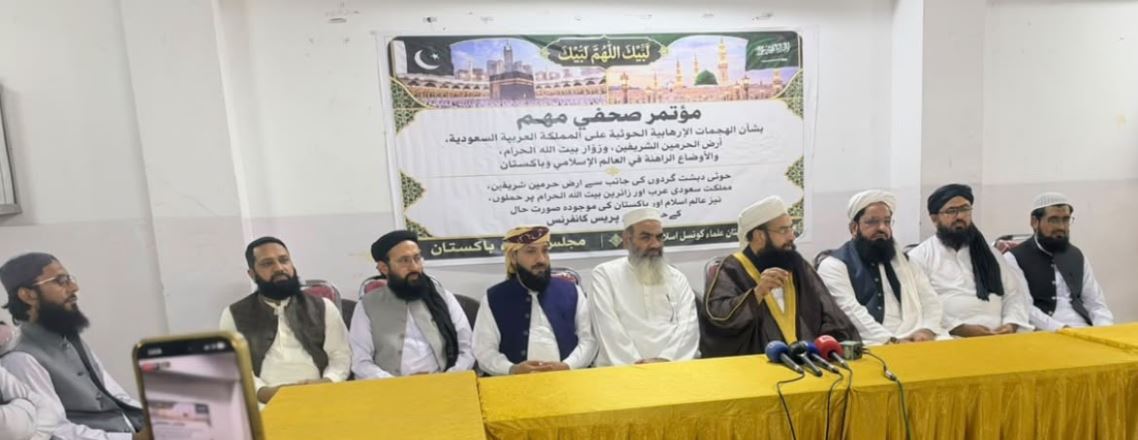
Addressing a press conference, Chairman of the Pakistan Ulema Council and Secretary-General of the International Tazeem-e-Haramain Sharifain Council, Hafiz Muhammad Tahir Mehmood Ashrafi spoke alongside scholars, religious leaders, senior Muftis and political figures from different schools of thought, including Maulana Nauman Hashir, Maulana Tahir Aqeel Awan, Maulana Abu Bakr Hameed Sabri, Maulana Abdul Hadi, Maulana Zulfiqar Ahmed, Maulana Saad Hazravi, Maulana Zahid Mansoor, Maulana Aslam Siddiqui, Mufti Umar Farooq, Maulana Asad Zakaria Qasmi, Maulana Abdul Mateen, Mufti Mubashir Nizami and Maulana Bilal Ahmed said Makkah al Mukarramah and Madinah al Munawwarah were the holiest centres for Muslims worldwide. Targeting the Haramain Sharifain, the guests of Allah, Umrah pilgrims, innocent civilians, airports, residential buildings, hospitals and other civilian infrastructure constituted serious terrorism and an unforgivable crime. They said no religious, political or moral justification could be offered for such attacks.
They made it clear that the situation was neither a dispute between two countries nor a Shia-Sunni or sectarian issue. Rather, an armed terrorist group was attacking the innocent people of Yemen and the Kingdom of Saudi Arabia. They said the group had killed innocent people in Yemen, destroyed mosques and civilian infrastructure, and was now targeting the Haramain Sharifain, the guests of Allah, Umrah pilgrims and Saudi Arabia’s civilian population.
Those who engage in terrorism, kill innocent people and attack sacred places, they said, have no connection with any religion, school of thought or sect. Whether the perpetrators belong to Fitna al Khawarij, Hindutva extremism, Houthi terrorist groups, Daesh, Al-Qaeda, Tehreek-e-Taliban Pakistan, Jundullah, Lashkar-e-Jhangvi or any other international terrorist organisation, the same standard must apply to their crimes.
They warned that justifying one terrorist group on the basis of political or sectarian affiliation would provide a pretext for excusing the crimes of other terrorist organisations. The position, they said, was clear: the killing of innocent people, attacks on sacred places and targeting of civilian populations were forbidden, condemnable and unacceptable under all circumstances.
The martyrdom of Bangladeshi Umrah pilgrim Mufti Nasrullah, who was killed while in a state of Ahram, along with other innocent civilians, had plunged the Muslim Ummah into grief. They expressed heartfelt condolences to the families of the victims, solidarity with the injured and prayers for their speedy recovery. They said that an attack on the guests of Allah was, in effect, an attack on the religious sentiments and human conscience of the entire Muslim Ummah.
The religious scholars and leaders fully endorsed the clear and unequivocal position of the Government of Pakistan that the security of the Haramain Sharifain and the Kingdom of Saudi Arabia constituted a red line for Pakistan. The people of Pakistan, religious scholars, government and national security institutions stood with Saudi Arabia’s sovereignty, territorial integrity, peace and stability.
Pakistan-Saudi defence cooperation, they said, reflected the historic relations and shared interests of the two brotherly countries. Any aggression against the Kingdom of Saudi Arabia or the Haramain Sharifain would be viewed as a threat to Pakistan and the entire Muslim Ummah.
They acknowledged the services rendered by the Kingdom of Saudi Arabia under the leadership of Custodian of the Two Holy Mosques King Salman bin Abdulaziz and Crown Prince and Prime Minister Mohammed bin Salman for the service of the Haramain Sharifain, assistance to the Palestinian people, humanitarian support for the suffering people of Yemen and the promotion of unity across the Muslim world.
Describing attempts to portray terrorism against Saudi Arabia as support for Palestine or Yemen as a blatant deception, they said targeting Makkah al Mukarramah, Madinah al Munawwarah, the guests of Allah and innocent civilians in the name of Palestine did not serve the Palestinian people but instead sought to create division within the Muslim Ummah.
The International Tazeem-e-Haramain Sharifain Council, Pakistan Ulema Council and their allied organisations fully endorsed the collective religious Fatwas, legal opinions and declarations of Islamic scholars that have declared attacks on the Haramain Sharifain, civilian populations and innocent people forbidden, a form of Fasad fil-Ard (corruption on earth) and contrary to Islamic teachings.
They emphasised that condemnation of Houthi terrorism was not directed against any sect or school of thought, but represented a clear religious and humanitarian position against terrorism, armed rebellion, unlawful killing and attacks on sacred places. While determining matters of faith and disbelief was the responsibility of qualified scholars in accordance with established principles of the Quran and Sunnah, terrorism, the unlawful killing of people and attacks on sacred places could never be described as Islamic acts.
They called upon the United Nations, the Organisation of Islamic Cooperation, the Arab League and the international community to move beyond statements of condemnation and take immediate, effective and decisive measures against Houthi terrorism, attacks on civilian infrastructure and threats to the Haramain Sharifain. They also demanded accountability for those providing the Houthis with missiles, drones, financial resources and other forms of assistance.
At the appeal of the Pakistan Ulema Council and its allied organisations, Friday, October 16, 2026, will be observed nationwide as a Day of Condemnation of Houthi Terrorism and Solidarity with the Haramain Sharifain and the Kingdom of Saudi Arabia. Religious scholars and prayer leaders will highlight the sanctity of the Haramain Sharifain, the protection of the guests of Allah, the condemnation of terrorism and the importance of unity within the Muslim Ummah in their Friday sermons.
Resolutions condemning the attacks and expressing solidarity with Saudi Arabia will be adopted at Friday congregations. Special prayers will also be offered for the peace and security of the Kingdom of Saudi Arabia, the Haramain Sharifain, Pakistan and the entire Muslim Ummah.
In the same connection, an All-Parties Conference on the Sanctity and Protection of the Haramain Sharifain will be held in Islamabad on Wednesday, October 21, 2026. The conference will bring together prominent scholars and religious leaders representing different schools of thought, heads of religious and political parties, minority representatives and leading civil society figures.
The conference will announce a future course of action for protecting the Haramain Sharifain, expressing solidarity with the Kingdom of Saudi Arabia, developing a common national and collective Muslim position against Houthi terrorism, and promoting unity across the Muslim Ummah.
Reiterating their position, they said Pakistan’s religious scholars, spiritual leaders and people stood with Custodian of the Two Holy Mosques King Salman bin Abdulaziz, Crown Prince Mohammed bin Salman, the Saudi government and the brotherly Saudi people. They declared that no compromise could be made on the sanctity, security and defence of the Haramain Sharifain.
They said the protection of the Haramain Sharifain is a shared responsibility of the entire Muslim Ummah.