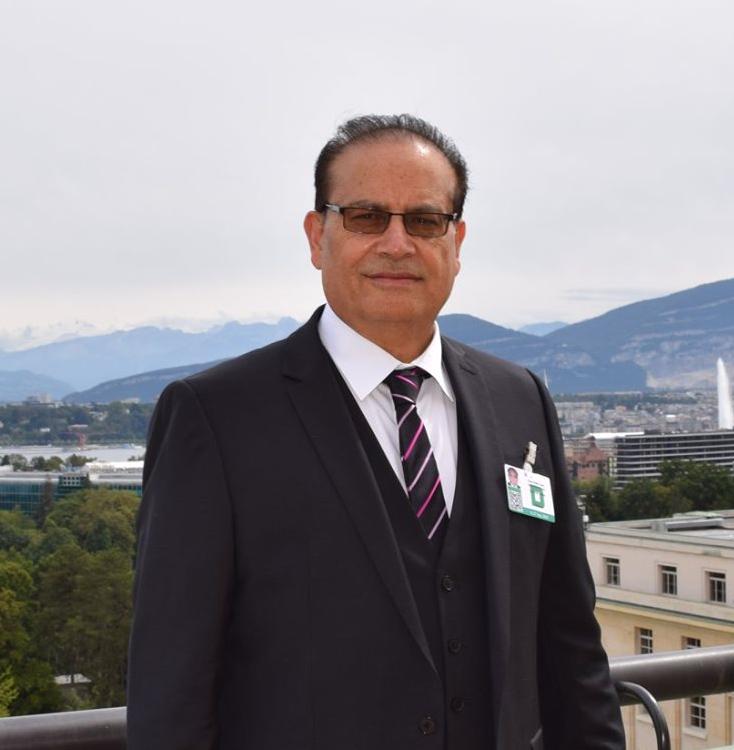
Qamar Bashir
For decades, the United States has exercised unmatched global influence. From military interventions in Afghanistan, Iraq, Libya, and Syria to sanctions regimes and regime-change rhetoric elsewhere, Washington has often justified its actions as necessary to defend democracy, human rights, or international security. Yet power, when exercised without consensus or legitimacy, invites resistance. The recent tensions surrounding Greenland, Europe’s diplomatic pushback, and disagreements over Venezuela and Iran reveal a deeper transformation underway in the international system—one where even long-standing allies are increasingly unwilling to accept unilateral dictates.
The controversy over Greenland became symbolic of this shift. When suggestions emerged from Washington that the United States had strategic interest in acquiring Greenland—a semi-autonomous territory of Denmark—the reaction from Europe was swift and unified. Denmark rejected the notion outright, and European leaders closed ranks in defense of territorial sovereignty. The message was clear: Europe would not tolerate transactional geopolitics that treated sovereign territories as negotiable assets. What might once have been dismissed as rhetorical bravado instead triggered serious diplomatic backlash, reinforcing Europe’s commitment to sovereignty and collective unity.
This episode reflected a broader pattern. European leaders, long accustomed to operating within the transatlantic alliance, have increasingly asserted strategic autonomy. Disagreements over trade tariffs, defense spending, immigration policies, and approaches toward Russia and China have widened the transatlantic gap. When criticism of Europe’s social and immigration policies was delivered in blunt terms from Washington, European officials responded not with silence but with institutional confidence, reiterating that domestic policy decisions belong to sovereign governments and the European Union collectively—not external actors.
The Ukraine war further deepened these tensions. While Europe and the United States remain aligned in supporting Kyiv, debates over burden-sharing, diplomatic engagement, and long-term security guarantees exposed differing strategic visions. Europe began discussing the possibility of enhancing its own defense capabilities independent of U.S. leadership, including increased defense spending and greater coordination under EU frameworks. The conversation about “strategic autonomy” gained momentum—not as a rejection of NATO, but as recognition that overreliance on any single power carries risks.
Beyond Europe, the situation in Venezuela has also sparked controversy. The U.S. position toward Venezuela’s leadership, including recognition of opposition figures and sanctions targeting state institutions, has been criticized by some international actors as interference in sovereign affairs. Supporters argue such measures promote democratic accountability; critics contend they undermine international norms. Regardless of perspective, the episode underscores a central question of modern geopolitics: who has the authority to determine legitimacy within another state?
Iran represents perhaps the most volatile example of this dynamic. U.S. naval deployments in the Persian Gulf, sanctions related to Iran’s nuclear program, and rhetoric surrounding regime behavior have heightened tensions. European states, while critical of certain Iranian policies, have often favored diplomatic engagement and adherence to negotiated frameworks such as the Joint Comprehensive Plan of Action (JCPOA). The divergence illustrates a growing reluctance among U.S. allies to endorse military escalation without clear multilateral backing.
Meanwhile, global power distribution is shifting. China’s Belt and Road Initiative has expanded infrastructure and trade partnerships across Asia, Africa, and parts of Europe. More than 140 countries have engaged in some form of cooperation under this framework. For many developing nations, China’s model—emphasizing economic investment without overt political conditions—offers an alternative to Western engagement strategies. Whether one views this approach as pragmatic partnership or strategic influence expansion, its appeal signals dissatisfaction with older interventionist models.
Canada, too, has demonstrated quiet but meaningful recalibration. In response to trade pressures and tariff disputes, Ottawa diversified its trade relationships, signing agreements beyond the United States and strengthening ties with Asia and Europe. This was not confrontation, but adaptation—evidence that even close allies hedge against unpredictability.
At the heart of these developments lies a philosophical tension about power. The principle that “power corrupts” is often invoked, but power can also isolate when it disregards consensus. In a globalized world, economic interdependence, multilateral institutions, and diplomatic networks limit unilateral action. Aircraft carriers and sanctions regimes remain formidable tools, yet legitimacy increasingly derives from coalition-building rather than coercion.
This brings us to the role of the United Nations. Critics frequently describe the UN as toothless or ineffective. Yet the UN’s authority depends entirely on the willingness of its member states—especially permanent Security Council members—to abide by collective decisions. When powerful states exercise vetoes to block resolutions or bypass UN authorization for major actions, institutional credibility erodes. Reform debates persist, but strengthening the UN requires political will from its most influential members.
The larger lesson emerging from Europe’s assertiveness and broader global reactions is not the decline of American power, but the recalibration of global expectations. Allies are no longer passive recipients of U.S. leadership; they are stakeholders demanding consultation and respect. Sovereignty, multilateralism, and rule-based order remain guiding principles for much of the international community. When any nation—however powerful—appears to deviate from these norms, resistance grows.
There is also a practical dimension. Military intervention in complex societies has historically produced unintended consequences, including instability and migration flows that affect neighboring regions. European reluctance to engage in new conflicts reflects lived experience from past interventions. Diplomacy, sanctions calibrated within international law, and negotiated agreements may lack dramatic visibility, but they offer more sustainable outcomes than unilateral force.
The evolving geopolitical landscape suggests a transition toward multipolarity. The United States remains a superpower with unmatched military and economic capabilities. Europe is consolidating political cohesion. China continues to expand its economic footprint. Regional actors assert greater independence. In such a system, responsible leadership requires restraint, coalition-building, and respect for sovereignty.
Power, in its most constructive form, means capacity to stabilize rather than destabilize; to convene rather than coerce; to strengthen institutions rather than circumvent them. History demonstrates that even dominant powers benefit from alliances grounded in mutual respect. The pushback witnessed from Europe over Greenland and other policy disputes may, in fact, serve as a corrective—reminding all nations that diplomacy anchored in international law carries greater legitimacy than unilateral declarations.
Ultimately, the question is not whether the United States possesses power. It undeniably does. The question is how that power is exercised. In an interconnected world facing shared challenges—from climate change to economic inequality to nuclear proliferation—cooperative frameworks are not signs of weakness but instruments of durability. Strengthening multilateral institutions, respecting sovereignty, and engaging adversaries through dialogue may not yield immediate victories, but they preserve long-term stability.
The future international order will not be shaped by dominance alone. It will be shaped by responsibility. And in that responsibility lies the true measure of leadership.
Qamar Bashir
Press Secretary to the President (Rtd)
Former Press Minister, Embassy of Pakistan to France
Former Press Attaché to Malaysia
Former MD, SRBC | Macomb, Michigan