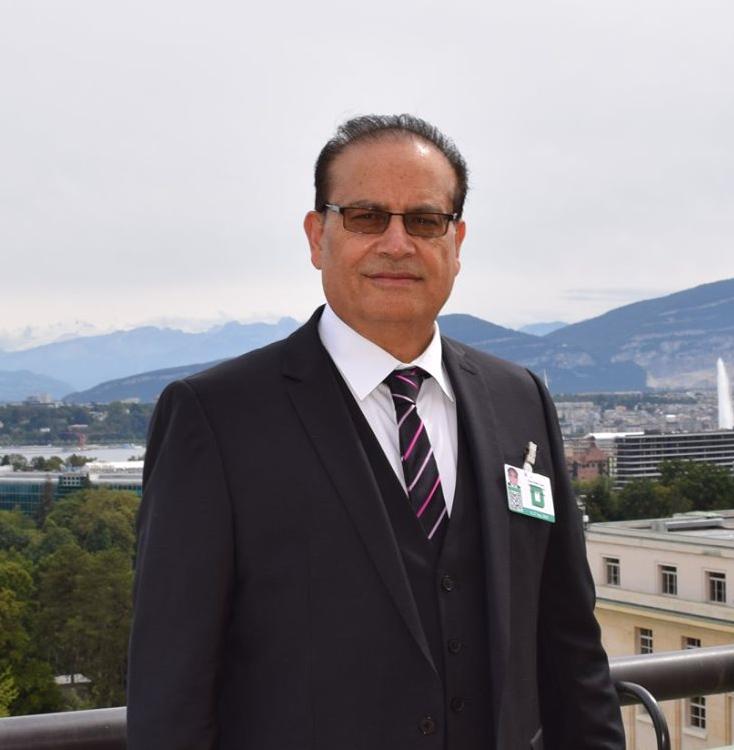
Qamar Bashir
Pakistan crossed another dark milestone when the DG ISPR held his politically charged press conference on 4 December 2025 in Islamabad—a briefing that signaled not professionalism, but power; not security, but political domination; not institutional neutrality, but institutional fear. The nation watched as a military spokesperson delivered a fierce ideological assault on an elderly man already locked behind bars: Imran Khan. After nearly three years of isolation, broken communication, severed organizational links, and denied legal relief, he was declared a “national security threat.”
In Pakistan’s political vocabulary, that term is not descriptive—it is fatal. It pushes a political opponent outside the sphere of citizenship and dangerously close to being labelled an “enemy of the state,” a label historically weaponized in Pakistan to justify irreversible outcomes.
The absurdity of branding a man in solitary confinement as a threat to a nuclear state of 240 million has not gone unnoticed. Imran Khan has no access to television, no political machinery left, no communication with his party, no legal recourse, and no presence on the ground. If he still poses a threat, the threat is not him—the threat is the weakness of the system that trembles at the mere idea of him.
This pattern is not new. Pakistan has a long history of producing “security threats” from among its own political leaders—only to resurrect them when circumstances shift.
Nawaz Sharif was declared a security risk, jailed, exiled, stripped of political rights, and disqualified for life. The state projected him as a conspirator, a destabilizer, and a liability. Yet when his utility re-emerged, the same state brought him back on a red carpet, wiped away all convictions, and reinstalled him into political respectability. Benazir Bhutto was repeatedly branded a national danger, exiled, chased through fabricated cases, only to be recalled when political engineering required her. Even Zulfikar Ali Bhutto—executed under the label of being a threat—was posthumously resurrected so completely that his ideology still anchors Pakistan’s largest political dynasty.
The message is clear: in Pakistan, security threats are manufactured, not discovered, and resurrected, not eliminated. Their destruction and their revival carry the same signature—military necessity.
But Imran Khan represents something unprecedented: a man who, even in chains, commands legitimacy that no amount of engineering can fully dissolve. And that is where the danger lies for the establishment. Declaring him a “security threat” is not about politics—it is about preparing public ground for permanent removal, because if imprisonment is insufficient and political erasure is incomplete, the state appears to be contemplating a solution beyond politics.
This chilling conclusion becomes sharper when placed against Pakistan’s newly consolidated military architecture. The political nervousness of the DG ISPR cannot be separated from the creation of the Chief of Defence Forces (CDF) under the 27th Constitutional Amendment. This restructuring abolished the Chairman Joint Chiefs of Staff Committee and placed all armed forces—army, navy, air force, cyber, intelligence, and space—under a single command held by Field Marshal Asim Munir. His tenure, renewable every five years, and his legal status, backed by amendments to the Pakistan Army Act, have created the most centralized military command Pakistan has witnessed in half a century.
In such a system, dissent is not opposition—it is treason. Popular legitimacy is not competition—it is danger. And an imprisoned leader with the loyalty of millions becomes a symbolic threat to a command structure built on totality, continuity, and unchallenged supremacy.
The press conference also revealed another uncomfortable truth. When journalists asked pointed, probing questions—about political overreach, constitutional violations, engineered dismantling of political parties, and the legal basis for calling a prisoner a security threat—the DG ISPR visibly lost composure. He advised reporters to “focus on other issues,” “leave the army alone,” and “not drag the military into unnecessary controversy.” His irritation made one fact undeniable: the most powerful institution in Pakistan now lacks the confidence to face civilian questioning.
The contradictions deepened when the spokesperson insisted, “The state is above the army,” and claimed that “the state will decide the fate” of a man the army has branded a threat. This would have carried weight in a country where parliament legislates independently, courts rule autonomously, and governments govern freely. But in Pakistan’s current reality—where parliament passes military-authored amendments, courts deliver establishment-aligned verdicts, and civilian governments act as administrative arms of GHQ—the claim collapses.
When the DG ISPR says “the state will decide,” he is describing the institution speaking through him. And when the same institution labels a defenseless prisoner as a national enemy, the fate implied is not a political one—it is existential.
Yet even this suffocating structure cannot escape the judgment of history. No authoritarian system—whether apartheid South Africa, military South Korea, communist Czechoslovakia, or pre-independence Bangladesh—has survived the moment when its people realize their rulers fear prisoners more than they fear public collapse. Every regime that declared a man in chains as the nation’s greatest danger eventually fell. And the prisoner, once helpless, became the symbol of national awakening.
A state does not fall because of a man in solitary confinement; it falls because of those who rule through fear and forget that nations ultimately belong to their people. When a government and an entire military hierarchy must be reengineered to contain a prisoner, it is not the prisoner who is powerful—it is the regime that is terrified. No decree, no amendment, no uniform, and no manipulated narrative can suppress the collective will of a nation once awakened. The more the state tries to erase Imran Khan, the more it exposes its own illegitimacy. And when a state trembles before a man in chains, the people eventually realize the chains are not on the prisoner—they are on the nation itself. The day those chains break, the prisoner becomes the leader, and the regime that feared him becomes a footnote in history.
Qamar Bashir
Press Secretary to the President (Rtd)
Former Press Minister, Embassy of Pakistan to France
Former Press Attaché to Malaysia
Former MD, SRBC | Macomb, Michigan, USA