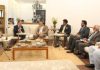


ISLAMABAD, Nov 6 (DNA): Federal Minister for Planning, Development and Special Initiatives Professor Ahsan Iqbal on Friday urged the media to play a proactive role in highlighting critical national challenges, strengthening public accountability and keeping development priorities at the centre of national discourse.
He said the country’s future depended on addressing issues that often remained overshadowed by political controversies.
Addressing an event titled “Media Dialogue on Effective Development Communication,” he said media coverage shaped national priorities, attracted public attention and held institutions accountable, stressing that issues which did not become part of public discourse often failed to receive the attention needed for their resolution.
“What gets asked, gets done, and what does not get asked, does not get done,” he remarked, urging journalists to focus on challenges confronting Pakistan’s development, economic growth and long-term national progress.
He observed that critical issues such as slow progress in literacy, population growth, early childhood development, limited access to higher education, weak export performance and leakages in public development spending deserved sustained media scrutiny.
Referring to the country’s demographic challenges, he said Pakistan was moving towards a population explosion, while early childhood education and care remained neglected despite the fact that around 90 per cent of cognitive abilities developed during the first five years of life.
“Pakistan 2047 is in its mother’s lap today,” he said, stressing that investment in children’s early development was essential for building a capable and productive future generation.
The minister said Pakistan’s economic sovereignty was at risk without a substantial increase in exports, setting a target of taking exports to $100 billion by 2035 to reduce dependence on the International Monetary Fund (IMF) and external financing.
Comparing Pakistan’s export performance with Vietnam, he said the two countries had exported $6 billion and $2.5 billion, respectively, in 1990, but Vietnam’s exports had since reached $475 billion, while Pakistan’s remained around $40 billion.
He also pointed out that only 13 per cent of Pakistani youth had access to higher education, compared with 30 per cent in a neighbouring country, 25 per cent in Bangladesh and 60 per cent in China, calling for greater debate on the country’s human capital development.
Highlighting governance challenges, he said systemic leakages and commissions in development spending undermined the value of public resources. Every rupee allocated to development projects should deliver its intended benefits, he stressed.
He said the Planning Ministry had introduced transparency measures, including placing development projects online and establishing a public helpline to report misuse of resources, but emphasised that independent media scrutiny was equally important.
“Every development project has a story, and that story is not just about the inauguration. The story begins with the outcomes of the project,” he said, urging journalists to examine whether schools were delivering quality education and whether university campuses and laboratories were serving their intended purposes.
The minister also called for greater media attention to preventive healthcare, tobacco consumption, passive smoking and food adulteration, citing a recent survey in which nearly half of the tested samples of packaged milk and ghee failed to meet prescribed standards.
He said development communication should go beyond reporting official announcements and ceremonies to investigate outcomes, expose shortcomings and promote behavioural change.
Stressing the need to bring development issues into mainstream public debate, he said meaningful media engagement and public participation could provide the necessary impetus to accelerate Pakistan’s development journey.