LAHORE, SEP 9 /DNA/ – Australian High Commissioner to Pakistan Timothy Kane has expressed optimism that negotiations on a modernised Pakistan-Australia Bilateral Investment Treaty will be concluded by December this year, describing the agreement as an important step towards encouraging greater Australian investment in Pakistan.
He said that Australia and Pakistan already had a Bilateral Investment Treaty dating back to 1998, but the agreement needed to be modernised according to the changing requirements of both economies. He said the finalisation of the modernised treaty would send a positive signal to Australian investors regarding investment opportunities in Pakistan.
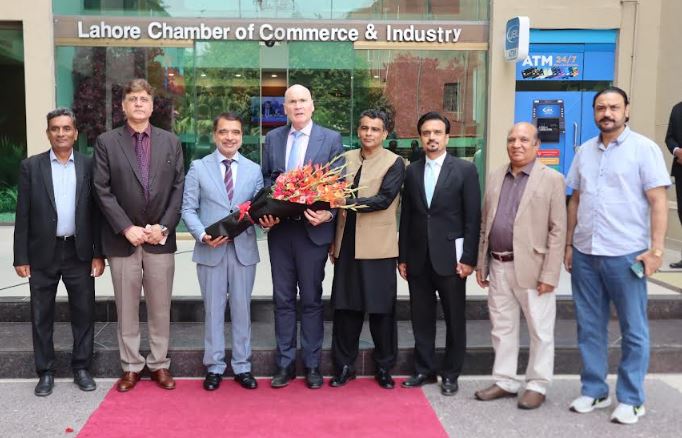
The Australian High Commissioner was speaking at the Lahore Chamber of Commerce & Industry, where LCCI President Faheem Ur Rehman Saigol warmly welcomed him and appreciated Australia’s longstanding cooperation with Pakistan. Director Trade and Education Azhar Shah and Chairman PIEDMC Major (R) Javed Iqbal were also present. LCCI Executive Committee Members Amir Ali, Nadeem Ansari and Karamat Ali Awan attended the meeting.
LCCI President Faheem Ur Rehman Saigol said Pakistan-Australia relations had a strong foundation and that both countries had enjoyed cordial and friendly ties since 1947. He highlighted Australia’s status as a highly developed, resource-rich and major trading economy, saying Pakistan could learn from Australia’s experience in economic management, agriculture, mining, education and technology.
The LCCI President said bilateral trade in goods had declined from 973 million dollars in 2024-25 to 672 million dollars in 2025-26, according to State Bank of Pakistan figures. During the period, Pakistan’s exports to Australia decreased from 285 million dollars to 275 million dollars, while imports from Australia declined from 688 million dollars to 397 million dollars. He stressed the need for joint efforts to reverse this declining trend and set a target of taking bilateral trade to at least 3 billion dollars.
Faheem Ur Rehman Saigol said Pakistan’s exports to Australia mainly comprised home textiles and apparel, rice, surgical instruments and sports goods. He identified industrial workwear, safety gloves for the mining and agriculture sectors, auto parts, engineering goods, leather products, spices, specialty food products, pink salt, marble and stone products, furniture and carpets as promising areas for export expansion.
He said Australia supplied Pakistan with important raw materials and inputs including pulses, oilseeds, grains, cotton, iron and steel waste, insecticides and paper products, which supported Pakistan’s industrial and food security requirements.
The LCCI President urged the early convening of the Pakistan-Australia Joint Trade Committee, saying the forum had not met since March 2023. He also called for negotiations on a preferential trade arrangement, pointing out that several competing countries enjoyed duty-free access to Australia while Pakistani exporters did not. He said the mining and mineral sector also offered significant opportunities for joint ventures, as Pakistan possessed substantial mineral resources while Australia had world-class expertise in exploration, mining technology, mineral processing and mine management. The LCCI President highlighted education and skills development as another key area for bilateral cooperation and called for greater collaboration in vocational education, technical training, research and digital skills.
He said Pakistan’s young and increasingly skilled IT workforce and Australia’s sophisticated technology market created strong opportunities for cooperation in software development, business-process services, artificial intelligence and cybersecurity. Faheem Ur Rehman Saigol also informed the Australian High Commissioner about the Special Investment Facilitation Council (SIFC), established by the Government of Pakistan to facilitate foreign investment through a single-window mechanism. He said the platform could help Australian investors meet procedural requirements more efficiently.
The LCCI President expressed hope that the visit of the Australian High Commissioner would provide fresh momentum to bilateral trade, investment and economic cooperation and pave the way for stronger engagement between the business communities of Pakistan and Australia.
Australian HC further said that both countries needed to do more to strengthen their trade and economic relationship and referred to the Pakistan-Australia Joint Trade Committee meeting held in Canberra last August, where a number of issues were discussed, including improved market access for Pakistani mangoes and better facilities in Pakistan for checking mangoes before their potential export to Australia.
Timothy Kane said agriculture remained a major area of cooperation between the two countries, noting that Australian agricultural trade with Pakistan was worth almost one billion Australian dollars last year. He said the Australian Centre for International Agricultural Research (ACIAR) had maintained a presence in Pakistan for more than four decades and had invested almost 100 million dollars in cooperation with Pakistani universities, businesses and other stakeholders in agricultural research and innovation.
He said Australia was assisting Pakistan in areas including better water management, improved seeds, drought-resistant varieties and seeds adapted to changing climatic conditions. He added that an Australian agricultural delegation was currently in Lahore and would also visit Faisalabad.
The Australian High Commissioner highlighted the growing cooperation in livestock and dairy development, saying more than 100,000 Australian cattle had so far been exported to Pakistan, with most of them going to Punjab. He said Australian cattle genetics could significantly improve milk production and strengthen local herds.
Timothy Kane said a Pakistani delegation would visit Australia next month to examine opportunities in pulses, including varieties better adapted to Pakistan’s climatic conditions. He also referred to a Pakistani delegation’s recent visit to Australia to study the country’s biosecurity system, saying Australia was pleased to support Pakistan in improving biosecurity management.
He further said Australia was looking forward to exporting GMO canola to Pakistan following the country’s approval of genetically modified canola, adding that Australia had traditionally supplied Pakistan with non-GMO canola.
The High Commissioner said the trade relationship had to be a two-way street and Australia wanted to see more Pakistani exports and investment in the Australian market. He revealed that during his current visit to Lahore, he had met a major Pakistani apparel company that was interested in entering the Australian market. He said Pakistani apparel products offered impressive quality and had strong potential in Australia, particularly because of the country’s multicultural population.
He said there were also opportunities for greater Australian investment in Pakistan’s mining and resources sector, acknowledging the challenges involved while noting Australia’s extensive experience in mining, exploration, mineral processing and resource development.
Speaking about education and skills development, Timothy Kane said education represented a major component of Pakistan-Australia economic relations. He said there had been around 20,000 Pakistani students in Australia until recently, although the number had declined somewhat during the last 18 months to two years.
He also called for new areas of cooperation, including pharmaceuticals and biotechnology, saying Pakistan had considerable expertise and export potential in pharmaceuticals and that both countries could explore collaboration, new markets and greater cooperation in biotechnology.
On business visas, the Australian High Commissioner said Australia’s visa system was non-discriminatory and that applicants who followed the required procedures and provided the necessary information generally had a strong chance of obtaining visas. He said Australian authorities were keen to facilitate genuine business visitors with clearly defined appointments and purposes.
He said Pakistani professionals were also making a strong contribution to Australia, particularly engineers, accountants and IT specialists. He noted that the Pakistani diaspora in Australia numbered around 145,000 people and had doubled over the past decade, while remittances from Australia to Pakistan had crossed one billion dollars last year.
He said there were currently no plans for a Free Trade Agreement, but described the recent Joint Trade Committee engagement as very positive and said Australia remained keen to move the bilateral relationship forward in a qualitative manner.=DNA