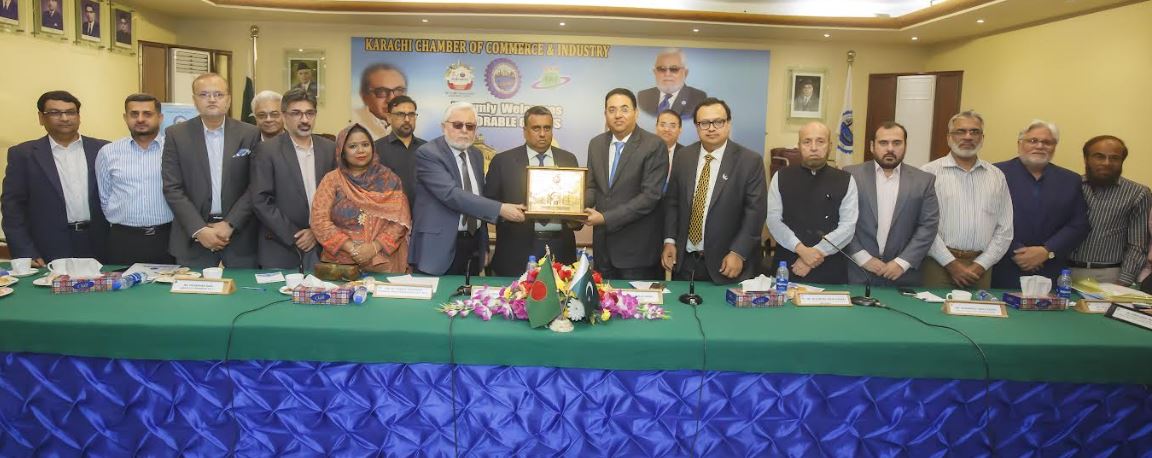
KARACHI, APR 13 /DNA/ – High Commissioner of Bangladesh, Md. Iqbal Hussain Khan has stated that relations between Bangladesh and Pakistan are witnessing positive momentum, as reflected by the exchange of high-level delegations from both sides, demonstrating a strong commitment by both governments to further strengthen bilateral ties.
Speaking during his visit to the Karachi Chamber of Commerce & Industry (KCCI), the High Commissioner remarked that the current phase represents a “golden opportunity” to expand bilateral cooperation. He noted that while certain logistical challenges persist, particularly in air and maritime connectivity, these can be effectively addressed through mutual understanding and coordinated efforts. “At present, I do not see any major barriers that cannot be overcome”, he added.
The meeting was attended by Deputy High Commissioner of Bangladesh Muhammad Sakib Sadakat; Chairman Businessmen Group (BMG) Zubair Motiwala; Vice Chairman BMG Tariq Yousuf; President KCCI Muhammad Rehan Hanif; Senior Vice President KCCI Muhammad Raza; Chairman Diplomatic Missions & Embassies Liaison Subcommittee Ahsan Arshad Sheikh; Former President KCCI Junaid Esmail Makda; and members of the KCCI Executive Committee.
Highlighting growing people-to-people and cultural linkages, the High Commissioner noted the increasing exchange of artists and participation of Bangladeshi players in the Pakistan Super League (PSL), which reflects strengthening cultural connectivity. He further shared that over 100 Bangladeshi students are currently enrolled in Pakistani institutions, particularly in medical, dental, and technical fields.
He also pointed out that a growing number of Bangladeshi patients are seeking medical treatment in Pakistan, including liver and kidney transplants as well as cancer care. Additionally, he expressed keen interest in exploring Pakistan’s mining potential, particularly coal reserves in Tharparkar, and noted Bangladesh’s demand for limestone, suggesting that both countries explore viable trade opportunities in minerals.
Chairman BMG Zubair Motiwala, in his remarks, emphasized that bilateral trade between Pakistan and Bangladesh remains below US$1 billion, which is far below its true potential. He highlighted the opportunity for Pakistan to support Bangladesh’s garment sector, particularly in technology transfer, process optimization, and value addition, to create a mutually beneficial, win-win partnership.
He proposed practical measures to enhance trade facilitation, including simplifying visa processes and establishing dedicated help desks at both Karachi Chamber and Dhaka Chamber/Federation offices to assist businesspersons seeking to expand bilateral trade.
Motiwala also underscored the importance of strengthening banking channels, noting that while progress has been made over the past year, with a Pakistani bank entering Bangladesh and others in the pipeline, further acceleration is required to facilitate smoother financial transactions.
He stressed the urgent need for direct air connectivity between Karachi and Dhaka, stating that even limited weekly flights would significantly enhance trade, business travel, and bilateral engagement. Similarly, he welcomed the commencement of direct maritime shipments to Bangladesh, describing it as a major step forward in improving trade logistics.
Highlighting the potential for technology collaboration, Motiwala noted that Pakistan can offer cost-effective solutions to Bangladesh’s garment industry, including software systems, computerized cutting and stitching machinery, quality control technologies, and inventory management systems.
He also emphasized the scope for joint ventures in the garment sector, particularly leveraging Bangladesh’s strong female workforce participation, which has been a key driver of its export success. “Pakistan can learn from Bangladesh’s model of gender-inclusive employment, while offering technological and industrial support”, he added.
Motiwala identified multiple sectors for deeper collaboration, including energy, mines and minerals, healthcare, education, and the blue economy. He noted the vast potential in Pakistan’s mineral reserves across Balochistan and Khyber Pakhtunkhwa, inviting Bangladeshi investors to explore opportunities in this sector.
He also pointed out the need for both countries to address high energy costs and explore alternative solutions, including regional energy cooperation. Additionally, he highlighted the untapped potential of Pakistan’s 1,200-kilometer coastline, stating that with the right strategy, seafood exports alone could reach up to US$10 billion within three to four years, as estimated by international studies.
Motiwala informed that KCCI will be sending a high-level trade delegation to Bangladesh in the first week of May 2026. The delegation aims to engage with key stakeholders, including the Federation of Bangladesh Chambers of Commerce & Industry (FBCCI), as well as the Ministries of Commerce and Industries, to explore policy frameworks and best practices.
He acknowledged Bangladesh’s strong export performance, reaching approximately US$48 billion, and expressed Pakistan’s interest in learning from Bangladesh’s cost management strategies and export-oriented policies. “Understanding how Bangladesh has achieved competitive production costs will be critical for enhancing Pakistan’s export competitiveness”, he remarked.
Earlier, President KCCI Muhammad Rehan Hanif, in his welcome address, stated that Pakistan-Bangladesh relations are undergoing a significant transformation toward a forward-looking partnership driven by trade, connectivity, and shared economic opportunities.
He noted that the business communities of both countries are keen to build stronger collaboration in sectors such as textiles, pharmaceuticals, agriculture, and information technology. Enhanced connectivity, streamlined visa regimes, and increased people-to-people interaction would further unlock this potential.
President Hanif reiterated that KCCI firmly believes in economic diplomacy as a key driver of bilateral relations. “Karachi, as the economic hub of Pakistan, stands ready to play a pivotal role in strengthening commercial ties with Bangladesh”, he said, adding that KCCI will actively facilitate B2B linkages, trade delegations, joint ventures, and knowledge exchange between the private sectors of both countries.