
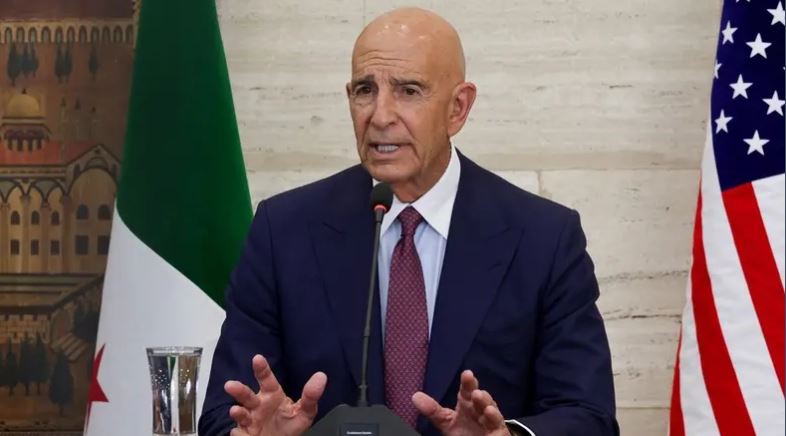
WASHINGTON: A senior aide to US President Donald Trump said Tuesday that Washington was not withdrawing from the Middle East but was moving away from efforts to control the region, calling on regional allies to assume greater responsibility for their own security.
US Ambassador to Turkey and Special Presidential Envoy for Syria and Iraq Tom Barrack said the shift reflected a changing American approach to the region, with Washington seeking to maintain its partnerships while reducing its direct involvement in regional conflicts.
“The bargain is not to own, not to control, but to tend, not to leave. We’re not leaving,” Barrack said at the Global Security Forum in Doha.
Barrack described the evolving US strategy as a transition rather than an abandonment of its longstanding security commitments, acknowledging that Washington could no longer be expected to resolve every regional crisis or guarantee open trade and secure waterways at any cost.
“The US no longer wants to own, doesn’t need to own,” he said, pointing to previous American interventions in Iraq, Afghanistan, Libya and Syria that failed to produce lasting solutions.
Barrack cited what he described as 23 regime changes across the broader Middle East and surrounding regions involving American influence, questioning whether decades of US intervention had delivered the intended results.
“Every time we try and intervene, change the person or the regime, it seems to have been a mistake,” he said.
He argued that Washington needed to establish clearer limits on its involvement while giving countries in the region greater responsibility for determining their own political and security futures.
Regional security and US intervention
As part of that shift, Barrack said regional governments would need to develop their own security arrangements rather than depend primarily on American military protection.
He pointed to discussions involving Saudi Arabia, Turkey, Pakistan and potentially Egypt as examples of emerging regional alignments that could play a greater role in maintaining stability.
Barrack said the United States would continue supporting its partners but was increasingly reluctant to commit American forces to additional ground conflicts.
Iran and the Strait of Hormuz
The envoy also addressed Iran, saying Trump remained open to pursuing a peaceful settlement despite the recent military escalation and its consequences across the Middle East and beyond.
Barrack called for a ceasefire, the reopening of the Strait of Hormuz and steps to alleviate economic hardship facing Iranians. He stressed that any negotiated settlement would require compromise and sustained diplomatic engagement.
He also warned that regional governments could no longer assume Washington would intervene to resolve every crisis, pointing to growing skepticism among Americans about the costs of military involvement in the Middle East.
“Americans … are saying, ‘Why would I want to lose one American life for what’s happening in the Middle East?’” Barrack said.
Despite those concerns, Barrack rejected suggestions that the United States was retreating from the region, arguing that Washington was instead seeking to redefine its role by encouraging greater regional cooperation and reducing its reliance on direct military intervention.
“This transition is complicated and difficult,” he said, acknowledging that Washington lacked a ready-made blueprint for navigating the changing regional order.