
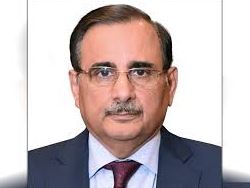
ISLAMABAD, JAN 2 /DNA/ – The Federation of Pakistan Chambers of Commerce & Industry’s Businessmen Panel (BMP) has strongly condemned the Federal Board of Revenue’s decision to allow duty- and tax-free imports of Chinese goods through the Sost Dry Port for Gilgit-Baltistan, warning that the move would open floodgates of smuggling, under-invoicing, and institutional corruption, while further squeezing already struggling domestic industries.
Former FPCCI president and Chairman of the Businessmen Panel (BMP), Mian Anjum Nisar, while referring to the SRO 2488(I)/2025, clarified that the notification does not provide an unconditional or blanket tax exemption. Under the SRO, non-levy of sales tax, income tax and federal excise duty is linked to quota limits, online authorization through the Customs Computerized Clearance System, and certification that the imported goods are consumed within the territorial limits of Gilgit-Baltistan. However, he cautioned that conditions on paper do not automatically translate into effective control on ground.
Mian Anjum Nisar stated that Pakistan’s industrial sector is already under immense pressure due to historically high energy tariffs, rising input costs, heavy taxation, tight financing conditions, and weak domestic demand. In such an environment, even conditional tax relief on imported finished and intermediate goods creates market distortions that place documented local manufacturers at a serious disadvantage.
He said that while the stated objective of the SRO is to facilitate economic activity in Gilgit-Baltistan, past experience clearly demonstrates that similar region-specific tax concession regimes have been repeatedly misused. Referring to earlier exemptions granted to erstwhile FATA and PATA regions, he noted that those concessions were also subject to conditions and monitoring requirements, yet duty- and tax-free goods found their way into settled areas across the country, damaging local industries and causing significant revenue losses.
According to the BMP chairman, the risk of diversion remains high in the case of Gilgit-Baltistan due to geographical challenges, limited enforcement capacity, and the overstretched nature of Customs and enforcement agencies. He warned that expecting authorities to fully ensure that conditionally exempted goods remain confined within GB is unrealistic, particularly when profit incentives for diversion are substantial.
Mian Anjum Nisar emphasized that Pakistan currently has surplus capacity in key industrial sectors, especially steel and construction materials, and there is no supply-side justification for allowing even conditionally tax-relieved imports of finished goods. He stated that the construction and infrastructure needs of Gilgit-Baltistan can be adequately met through locally manufactured products supplied via documented channels, which would support employment, sustain industrial operations, and contribute to the national exchequer.
He cautioned that allowing conditional tax relief on Chinese imports, even within quota limits, would encourage unfair competition. Domestic manufacturers are required to pay full customs duties, sales tax, income tax, federal excise duty, and exceptionally high electricity and gas tariffs. Competing with partially tax-relieved imports under such circumstances is neither fair nor sustainable, he added.
The BMP chairman also raised concerns about under-invoicing and misdeclaration risks associated with the Sost Dry Port route, noting that any form of tax concession increases incentives for such practices. He warned that once a parallel supply chain develops under the guise of regional consumption, it becomes extremely difficult to dismantle, leading to long-term damage to the formal economy.
While acknowledging that the S.R.O. empowers Customs authorities to withdraw the benefit in cases of misdeclaration or movement of goods outside Gilgit-Baltistan, Mian Anjum Nisar stressed that enforcement after the fact does not undo market damage already caused by the leakage of tax-relieved goods into mainland markets.
He reiterated that the Businessmen Panel fully supports the socio-economic development of Gilgit-Baltistan and recognizes the region’s unique challenges. However, he maintained that sustainable development should be achieved through infrastructure investment, improved connectivity, facilitation of local enterprises, and freight or transport support rather than import-based tax concessions that distort national markets.
Mian Anjum Nisar urged the federal government to revisit the implementation framework of SRO 2488(I)/2025 in close consultation with the business community and chambers, and to consider restricting any conditional tax relief strictly to raw materials where necessary, while excluding finished and intermediate goods that directly compete with local industry.
He further stressed the need for stronger safeguards, including advance guarantees against duties and taxes, independent verification of consumption certificates, and transparent monitoring mechanisms jointly overseen by federal and provincial authorities.
The BMP chairman warned that Pakistan’s economic recovery depends on protecting documented industry, ensuring fair competition, and learning from past policy failures. He said that conditional concessions must be enforceable in reality, not just well-drafted on paper, otherwise they risk becoming another channel for smuggling, under-invoicing, and erosion of the tax base.











 has)