Pakistan’s Security Landscape – 2025 | Overall Trends:
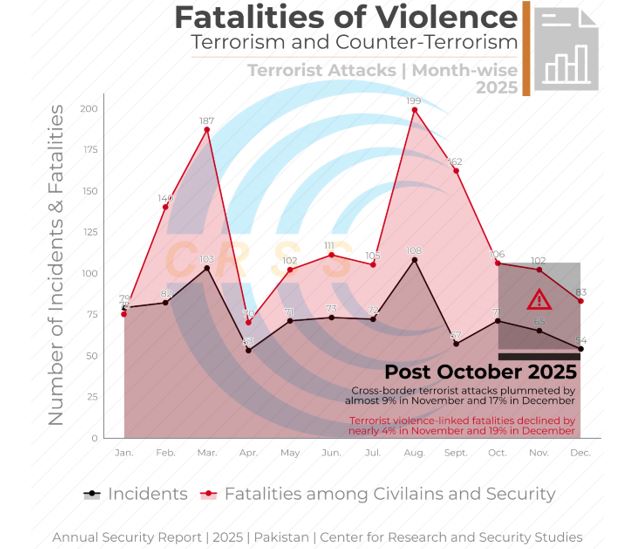
Pakistan recorded a significant drop in cross-border terrorist attacks and violence-linked fatalities after it closed down the border to Afghanistan on October 11. Terrorist attacks went down by almost 17% in December, preceded by 9% decline in November. Terrorist violence-linked fatalities among civilians and security officials also fell in the last quarter of 2025, by nearly 4% and 19% each in November and December, data collected by the Center for Research and Security Studies (CRSS) as part of its Annual Security Report 2025.
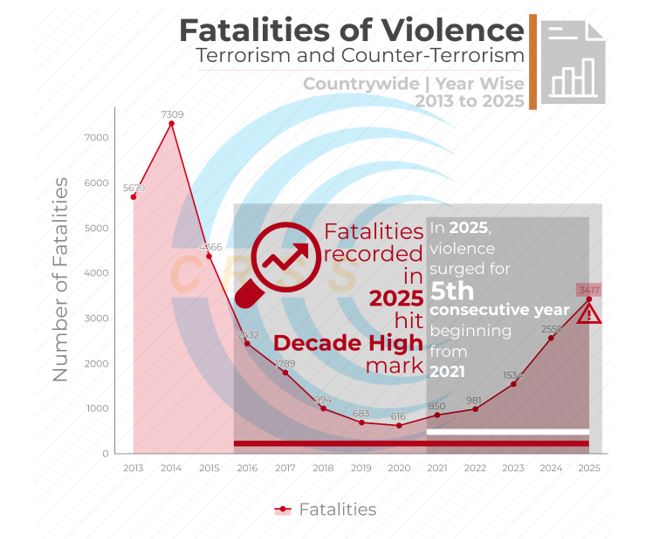
With an almost 34% surge in overall violence, the year 2025 went by as the most violent year for Pakistan in a decade. The country has suffered a sustained escalation in violence for five consecutive years since 2021, coinciding with the Taliban’s return to power in Afghanistan; with almost 38% in 2021, over 15% in 2022, 56% in 2023, nearly 67% in 2024, and 34% in 2025.
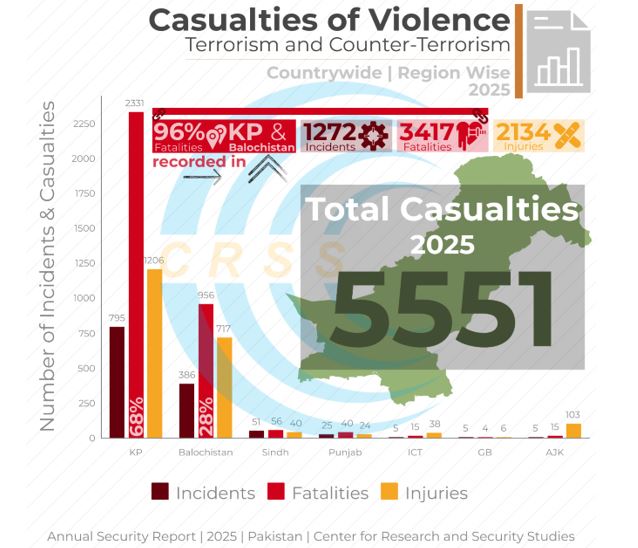
As many as 3417 violence-linked fatalities and 2134 injuries among civilians, security personnel, and outlaws resulted from 1272 incidents of violence; terrorist attacks and counter-terrorism operations. 2025 marked another grim year for Pakistan’s security landscape.
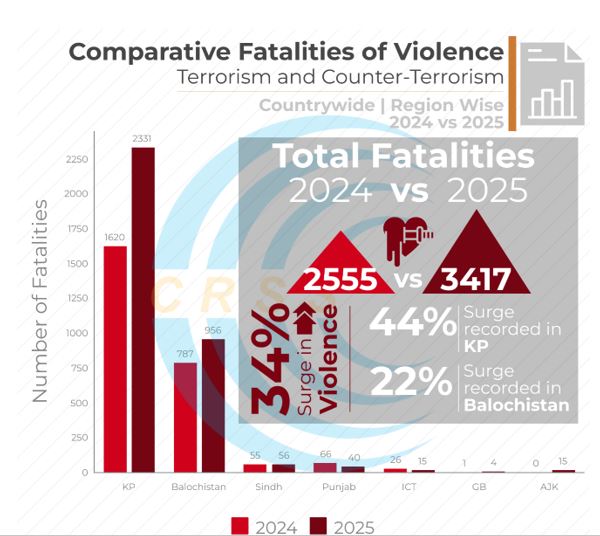
The comparative data for 2024 and 2025 reveals a sharp escalation in terrorism and counter-terrorism linked violence nationwide, with fatalities rising from 2555 in 2024 to 3417 in 2025, marking an increase of 862 deaths, or a roughly 34% year-on-year surge in violence.
The most significant surge in violence was recorded in KP, where the fatalities rose from 1620 in 2024 to 2331 in 2025, an absolute increase of 711 deaths, accounting for over 82% of the net national rise and marking almost a 44% year-on-year surge in violence in the province.
Balochistan also had an upward trend, with fatalities increasing from 787 to 956; an additional 169 deaths, which are nearly 22% higher than the previous year’s figures.
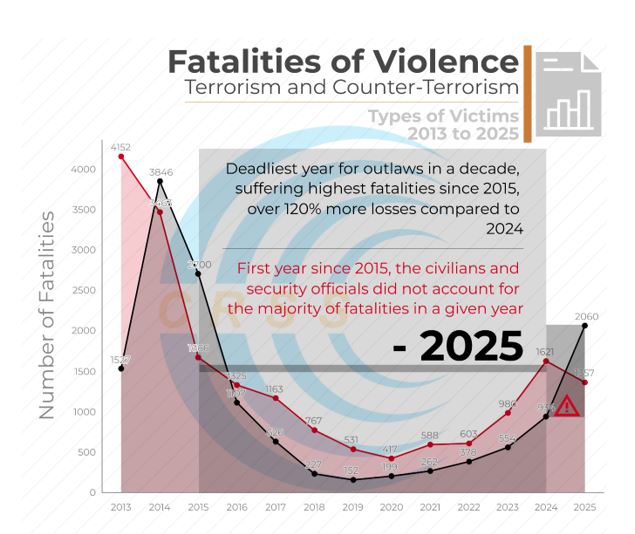
The outgoing year turned out to be the deadliest year for outlaws in a decade as well. They accounted for the majority of fatalities recorded this year – surpassing the fatal losses suffered by the civilians and security officials combined, with October being the deadliest month for them as the security forces intensified nationwide counterterrorism operations, followed by November as their second deadliest month.
Regional Impact of Violence:
Violence remained heavily concentrated in the country’s northwestern Khyber Pakhtunkhwa (KP) and southwestern Balochistan provinces, with both accounting for over 96% of all fatalities and almost 93% of violent incidents recorded during the entire 2025.
KP was the worst-hit region, suffering over 68% (2331) of the total violence-linked fatalities, and around 63% (795) of the incidents of violence, followed by Balochistan, accounting for 28% (956) of the fatalities and over 30% (386) of the incidents of violence.
In contrast, Punjab and Sindh experienced comparatively lower levels of violence. The former recorded 25 incidents of violence resulting in 40 fatalities and 24 injuries, representing just 1.15% of total casualties, while the latter saw 51 incidents causing 56 fatalities and 40 injuries; 1.73 percent of the total. These figures suggest relative containment of violence despite the provinces’ large populations, likely reflecting stronger policing and intelligence-led counter-terrorism efforts.
Azad Jammu and Kashmir (AJK) and the Islamabad Capital Territory (ICT) stand out for a different reason. While incidents numbers remain minimal, the injury figures are relatively high, with the former recording 103 injuries, and the latter registering 38, from just five incidents at each location.
AJK recorded 15 fatalities in 2025 compared to zero violence in 2024, an occurrence which is significant in itself, indicating that violence is gradually spreading to regions which were peaceful earlier.
Gilgit-Baltistan (GB) remained the least affected region, with negligible fatalities and injuries, confirming that large-scale violence has not taken root there. Compared to last year, though small in absolute numbers, the region recorded a four-fold increase from 1 to 4 fatalities.
In contrast, several regions experienced declines in fatalities with ICT recording reduction from 26 to 15, Punjab from 66 to 40, and Sindh from 55 to 56, denoting a marginal incline.
These reductions suggest relative containment of lethal violence in Pakistan’s political and economic centres.
Civilians, Security Forces, and Outlaws’ Fatalities | Historical Trends:
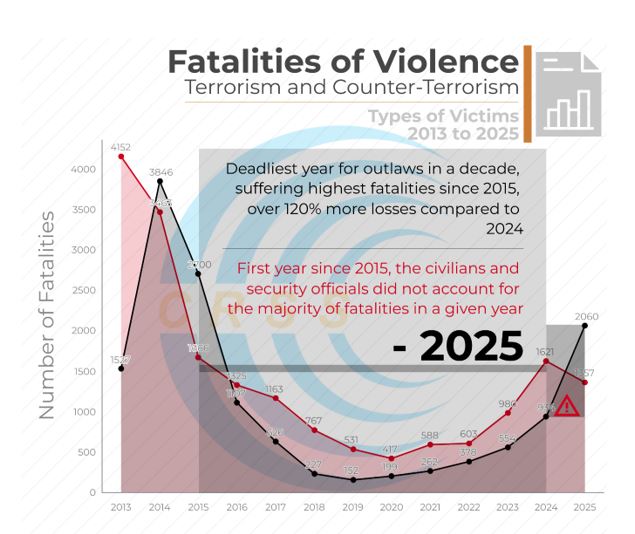
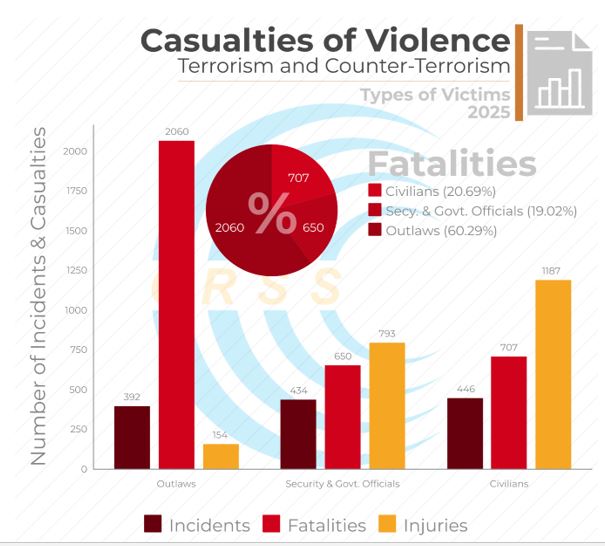
With about 2060 deaths as a result of at least 392 security operations, the outlaws accounted for over 60% of the fatalities recorded this year, surpassing the combined fatal losses among the civilians and security officials i.e., 1357 fatalities (40% of total) suffered in around 880 terrorist attacks.
The outlaws may have suffered the most of the fatalities in 2025, but the toll of injuries remained higher among civilians and security officials, suffering over 93% of all injuries recorded, compared to 7% among outlaws. The majority of the injuries were sustained by the civilians (1187 – 56%), followed by security officials (793 – 37%), and outlaws (7% – 154).
The data ranging from 2013 to 2025, also reveals that 2025 turned out to be the deadliest year for outlaws in a decade, as they suffered their highest fatalities since 2015, and surged by over 120% this year compared to 2024, with October being their deadliest month (with 319 fatalities) this year as the security forces intensified nationwide counterterrorism operations, followed by November as their second deadliest month.
On the other hand, the fatalities among civilians and security officials reduced this year by over 24% and 5%, respectively, compared to last year. Also, 2025 happened to be the first year since 2015 that, with their losses combined, the civilians and security officials did not account for the majority of fatalities in a given year.
Security forces remained the primary targets of terrorist and insurgent groups, resulting in 374 fatalities within the Army and Frontier Corps (FC). This toll included 22 high-ranking officers: one Lieutenant Colonel, 16 Majors, four Captains, and two Lieutenants. Additionally, 341 lower-ranking soldiers were killed and over 400 were wounded. The police force suffered 216 casualties, including seven high-ranking officials (one SSP, three DSPs, and four SHOs), alongside 203 personnel killed and 265 injured.
Responsibility for these attacks was claimed primarily by the TTP (targeting 227 personnel; 121 fatalities, 106 wounded), followed by the BLA (87 killed, 124 wounded), the BLF (12 killed, 10 wounded), and ISKP (4 killed, 12 wounded).
Overall, 2025 was recorded as the deadliest year for Pakistan in a decade, with 3417 violence-linked fatalities being the highest since 2015. The historical data indicates year-on-year surge in nationwide violence for five consecutive years since 2021, coinciding with the Taliban’s return to power in Afghanistan, with almost 38% in 2021, over 15% in 2022, 56% in 2023, nearly 67% in 2024, and 34% in 2025.