
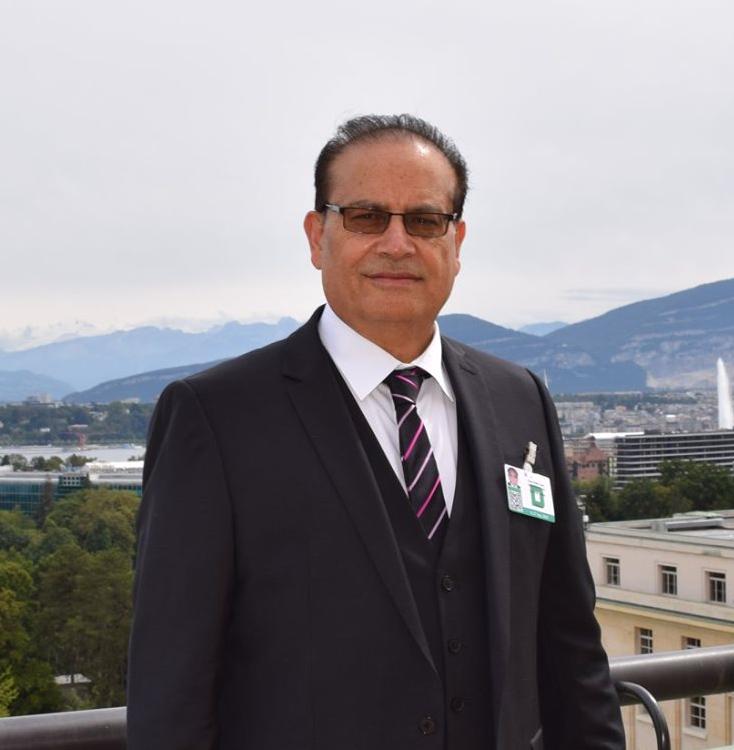
Qamar Bashir
Christmas is one of the most cherished moments in the global calendar, marking the birth of Jesus Christ — one of the greatest prophets in human history. According to Christian belief, he was born in Bethlehem, a humble town in the West Bank that today remains under Israeli occupation. From that land emerged a message that still echoes across centuries: love your neighbor, seek truth, forgive freely, and show mercy even in hardship.
For Muslims, Jesus — Isa ibn Maryam (peace be upon him) — is not only respected but deeply revered. The Qur’an dedicates an entire chapter to his miraculous birth and to the purity and piety of his mother, Mary. Islam affirms that Mary conceived Jesus by the will of God, without a biological father, and that the infant Jesus spoke in her defense — a miracle highlighting divine power and mercy.
Islam teaches that God sent many prophets — Abraham, Moses, Jesus, and finally Muhammad (peace be upon them all) — as guides for humanity. Belief in all of them is a core Islamic principle. The foundational faith includes belief in all prophets, revealed scriptures, angels, the Day of Judgment, and God’s decree. This reflects Islam’s spiritual inclusiveness: a Muslim cannot reject Jesus or Moses and still claim faith. The Qur’an presents Jesus as a noble prophet who healed the sick, defended the weak, and called people to righteousness.
Christians and Muslims share deep respect for his moral example. Islamic tradition also teaches that Jesus will return near the end of time as a sign of God’s justice. That belief strengthens the spiritual connection between the two faiths rather than weakening it.
Across much of the Muslim world, Christmas is acknowledged with warmth and respect. In Malaysia, Indonesia, the Gulf states, and elsewhere, public spaces display Christmas decorations, and citizens of different faiths greet one another sincerely. That spirit of coexistence reflects the higher purpose of religion: to bring people closer to God and to one another.
Yet the world today stands painfully distant from the teachings of Jesus. The message of humility has been overshadowed by arrogance; compassion has been replaced with dominance; and the defense of the weak has too often yielded to the pursuit of wealth, territory, and power.
From Europe to the Middle East to Africa, wars continue to scar humanity. The conflict between Russia and Ukraine has dragged on with staggering human cost — soldiers and civilians alike suffering displacement, injury, and death while entire cities are destroyed and generations traumatized.
In Gaza and the broader Israeli-Palestinian conflict, tens of thousands of civilians have been killed or wounded, and families live under unimaginable loss and fear. The civil war in Sudan has unleashed famine, displacement, and brutality on a massive scale.
Tensions between Armenia and Azerbaijan over Nagorno-Karabakh have uprooted communities and shattered lives. Border friction between Thailand and Cambodia periodically flares, affecting vulnerable border populations. And the Caribbean region is witnessing rising confrontation involving Venezuela and the United States — another reminder of how competition over resources and power can spiral toward conflict.
Looming over all of this is the dangerous and often-overlooked nuclear risk in South Asia. India and Pakistan — both nuclear-armed neighbors — have fought multiple wars and experienced repeated crises. Any future conflict between them, if it were ever to escalate to nuclear exchange, could kill millions in minutes and devastate the region for generations. It is a sobering reminder that war today carries consequences far beyond the battlefield — consequences that threaten the survival of entire nations.
Behind many of these conflicts lie the same driving forces: greed, the hunger for dominance, the thirst for hegemony, disrespect for international law, and a chilling indifference to human suffering. Power becomes a prize rather than a responsibility. Neighbors become enemies rather than fellow human beings. War, sanctions, and blockades punish ordinary people — the poor, the elderly, and especially children — while the powerful speak in cold language about strategy and national interest.
This reality stands in total contradiction to what Jesus taught. His message condemned arrogance. He challenged the tyranny of wealth over conscience. He uplifted the marginalized, called for humility, and insisted that the moral worth of a society is measured by how it treats the weakest among it.
Christmas should therefore be more than a seasonal ritual. It should be a moment of moral awakening. A time when Christians and Muslims — who together make up over half of humanity — reflect on their shared spiritual foundation: belief in one God, devotion to truth, compassion, justice, humility, and service to others.
Today, the sacred books that once guided civilizations often sit unread on shelves, gathering dust while nations prepare for war instead of peace. Christmas is the time to wipe away that dust — literally and symbolically — and return to the message inside: love your neighbor, protect the innocent, feed the hungry, forgive the offender, and speak truth to power.
If even a fraction of that message were followed, wars would not be waged for land, oil, minerals, or geopolitical advantage. The enormous resources consumed by conflict could instead lift millions out of poverty, build schools and hospitals, and restore dignity to forgotten communities. True greatness lies not in the size of a nation’s military, but in the depth of its compassion and the justice of its actions. This is the heart of the matter: Faith without justice is empty, worship without mercy is incomplete and peace without humility is impossible.
When humanity rediscovers this shared spiritual core — not as slogan, but as living practice — peace will no longer remain a distant ideal. It will become a real and achievable way of life. And perhaps then, Christmas will not simply mark the birth of a prophet. It will mark the rebirth of the values he taught — compassion over cruelty, humility over arrogance, and peace over war — lighting a path forward for all humanity.