ISLAMABAD, FEB 13 /DNA/ – The rise of Western civilization, as opposed to the rest, signifies the emergence of a qualitatively new type of civilization marked by distinct cultural, scientific, and political transformations. Contemporary debates on modernity must move beyond economic metrics and address deeper moral and civilizational questions, including balance, values, and intellectual responsibility.
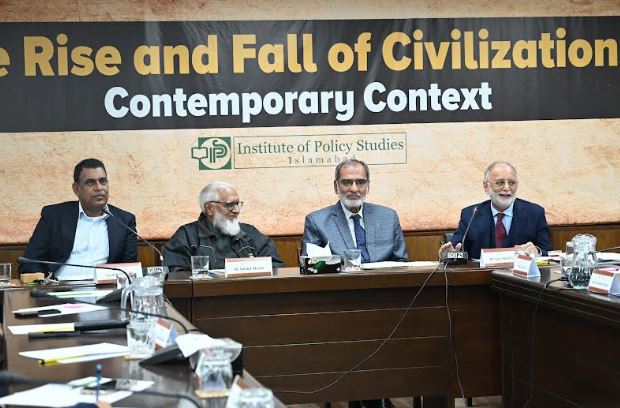
These reflections emerged during a discussion session titled “The Rise and Fall of Civilizations: Contemporary Context” at the Institute of Policy Studies (IPS). This discussion was organized around Syed Sardar Ali’s thesis regarding modernity, Islam, and Pakistan. The session brought together scholars, practitioners, and students for an in-depth exchange on the trajectory of Western ascendancy and the challenges confronting the Muslim world.
Presenting his thesis, Sardar Ali, founder and chairman of Pakistan Crescent Foundation, elaborated on what he termed the “Great Divergence.” He argued that until around 1800, most civilizations functioned at comparable subsistence-level productivity. Thereafter, Western societies showcased exponential growth in production and power, creating an unprecedented distinction with other societies. This transformation, he suggested, was driven by three simultaneous modernizations: a cultural shift toward philosophical rationalism, the institutionalization of the scientific method and inductive logic, and the consolidation of political authority through the Westphalian state system.
Sardar Ali contended that democracy in the West emerged as a consequence of industrialization and material transformation rather than serving as its initial cause. He maintained that Muslim civilization did not undergo an absolute decline; rather, it failed to adopt and internalize the new paradigm, for which it could have used its scientific progress. He suggested objectively identifying the underlying sources of Western prominence rather than relying solely on nostalgia for past achievements.
Participants raised a wide range of critical questions and offered thoughtful observations.
Nasir Hafeez identified the role of war, conflict, and destruction as catalysts of Western transformation. Prof Jalil Aali highlighted the legacy of inductive reasoning within the Muslim intellectual tradition, citing figures such as Allama Muhammad Iqbal, and argued that empirical inquiry predated Europe’s scientific revolution.
Sarmad Alvi noted that early modern scientists such as Isaac Newton were not necessarily antagonistic to religion, though institutional shifts gradually marginalized clerical authority in Europe. Nazir Ahmed Vaid emphasized that civilizations rise and fall on the strength of their values, warning that material advancement devoid of moral coherence leads to social fragmentation.
Prof Dr Safir Akhtar observed that civilizations have historically learned from one another, citing how early Islamic governance borrowed administrative tools such as the diwan system from the Persian Empire. Dr Taimiyyah Sabiha argued that the binary of “East versus West” is itself a colonial construct and suggested that the underlying debate may instead concern differing theological and philosophical paradigms.
Dr Yasir Riaz critiqued the reliance on productivity metrics, cautioning against adopting Western-centric frameworks that overlook the scale of ancient Eastern economies. Maulana Dr Mohammad Ghiyas proposed that the doctrine of the Finality of Prophethood placed greater intellectual responsibility upon Muslims to employ reason and scientific inquiry in managing worldly affairs.
Dr Sohaib Zafar pointed to empirical traditions in the works of Ibn Sina and Al-Razi, suggesting that the scientific journey began centuries before the 17th century. He argued that assessing civilizational success solely through economic output risks neglecting moral and metaphysical dimensions.
In his remarks, Prof Dr Khalid Masud, ad hoc judge, Shariat Appellate Bench, Supreme Court of Pakistan, observed that many Muslim societies today operate in a state of dependency, fostering a defensive posture toward knowledge. He revisited the historical tension between Ilm-ul-Kalam and philosophy, referencing debates associated with Al-Ghazali and Ibn Rushd, and suggested that prioritizing theological orthodoxy over philosophical inquiry may have had long-term intellectual consequences.
Co-chair of the session, Dr Ijaz Shafi Gilani, founder and chairperson, Gallup Pakistan, summarized the author’s emphasis on modernity as the seed of a new production process but cautioned that the “pure” pursuit of Western modernity has generated significant imbalances, including environmental degradation and demographic challenges.
In his concluding remarks, Khalid Rahman, chairman IPS, stated that the session formed part of IPS’s ongoing engagement with questions of civilizational renewal, knowledge, and contemporary global challenges. He emphasized that such discussions should be integral to think tank discourse, adding that analyzing and synthesizing observations from the event would help identify responses to prevailing challenges.
The seminar concluded with a consensus that understanding the rise and fall of civilizations requires rigorous historical inquiry, intellectual self-critique, and a balanced framework that integrates material progress with Islam’s moral and spiritual dimensions.