

BY MUHAMMAD MOHSIN IQBAL
Leadership is the mirror through which the moral character of a nation is reflected. In societies that claim democratic maturity, elected leaders are expected to embody restraint, dignity, and respect for the rights and sensibilities of all citizens. The ballot is not merely a mechanism of power transfer; it is a covenant of trust, through which people entrust their representatives with the protection of their honour, faith, and fundamental freedoms. India has long projected itself as the world’s largest democracy, taking pride in constitutionalism, pluralism, and the rule of law. Yet, from time to time, incidents occur that crack this carefully constructed façade and expose uncomfortable truths beneath the surface.
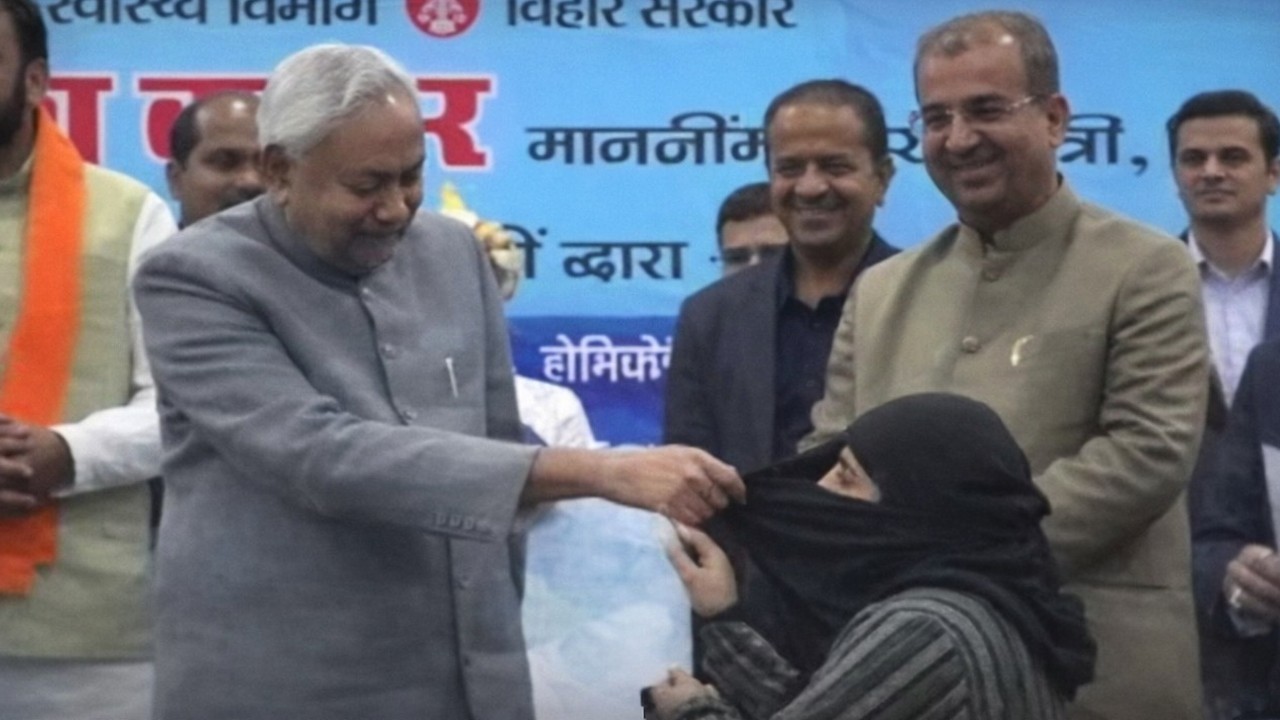
One such incident recently unfolded in the Indian state of Bihar, where Chief Minister Nitish Kumar, crossed a line that no civilised leader should even approach. At a public function, in full view of cameras and attendees, he forcibly removed the veil of a Muslim female Dr. Nusrat Parveen. The act was not accidental, nor could it be dismissed as a momentary lapse of judgment. It was a deliberate intrusion into the personal, religious, and bodily autonomy of a woman, carried out by the highest executive authority of the province. In a single moment, the dignity of an individual was violated, and the moral claims of a state were laid bare.
The veil, irrespective of one’s personal views about it, represents choice, faith, and identity for millions of Muslim women. To tear it away by force is to send a chilling message that power may trample belief, and authority may humiliate the vulnerable without consequence. That the victim was a doctor, a professional who had devoted her life to public service, only deepened the cruelty of the act. Instead of honouring her contribution, the state reduced her to an object of spectacle, her dignity sacrificed at the altar of political arrogance.
History and tradition, including India’s own civilisational narratives, have long warned against such abuse of power. In Hindu mythology, the episode of Sita in the Ramayana stands as a timeless moral lesson. After her abduction by Ravana and confinement in Ashoka Vatika, Sita was subjected to repeated pressure and humiliation, including threats against her dignity, in an attempt to break her resolve. As mentioned in some versions of the Ramayana, there is an incident where Ravana, in a fit of rage and frustration, tries to disrobe Sita by grabbing her sari. The episode is remembered not merely as a tale of captivity, but as a moral indictment of coercion and moral transgression. Ravana’s actions are condemned not because of power exercised, but because of power misused. The story serves as a reminder that the violation of a woman’s dignity, whether physical or symbolic, has always been regarded as an act of moral failure, not strength. When contemporary leaders echo, even faintly, such conduct, the comparison is neither flattering nor avoidable.
The outrage that followed was neither surprising nor unwarranted. Voices across the world condemned the incident as an assault on human rights and women’s dignity. For a country that tirelessly lectures others on democratic values, the episode proved deeply embarrassing. It punctured the illusion that constitutional guarantees automatically translate into lived equality, especially for minorities. Democracies are not judged by lofty speeches or constitutional preambles alone, but by the everyday conduct of those who wield power. In this case, that conduct fell disastrously short.
What makes the incident even more troubling is that it does not stand in isolation. India’s recent history is replete with examples where state power has been used to intimidate, marginalise, or humiliate minorities. From lynchings carried out in the name of cow protection, to discriminatory citizenship laws, to the routine targeting of Muslim homes and places of worship, a pattern has emerged that cannot be ignored. Each incident, when viewed separately, is often explained away as an aberration. Taken together, they form a disturbing narrative of shrinking space for dissent, diversity, and dignity.
Women, particularly from minority communities, have borne a disproportionate share of this burden. Instances of harassment, public shaming, and weaponisation of identity have become increasingly frequent. The Bihar episode thus fits into a wider mosaic of moral decline, where political power appears emboldened to test how far it can go without meaningful accountability. The silence or half-hearted responses from institutions that are meant to act as checks only reinforce this perception.
Equally revealing has been the reaction of the Indian media. While some voices courageously called out the wrongdoing, large segments of the mainstream media treated the incident with evasiveness, minimisation, or selective outrage. This reluctance to confront power has become a hallmark of a media culture more invested in proximity to authority than in the pursuit of truth. When journalists behave like trained sniffers who detect controversy only when it suits the rulers, public trust inevitably erodes.
The moral funeral of such leadership, it may be said, has already been held. When those at the helm lose the ability to distinguish between authority and entitlement, between leadership and domination, they forfeit their moral legitimacy. No amount of electoral victory can compensate for the loss of ethical compass. Power may command obedience, but it cannot compel respect.
In the end, the real tragedy is not merely the humiliation of one woman, but the steady corrosion of values that a democracy claims to cherish. If leadership does not correct itself, if institutions do not assert their independence, and if society grows numb to injustice inflicted on the “other,” then the proud slogans of democracy will ring hollow. The Bihar incident stands as a stark reminder that democracy without morality is an empty shell, and power without accountability is nothing more than organised cruelty.