Asnar Mahmood Bhatti
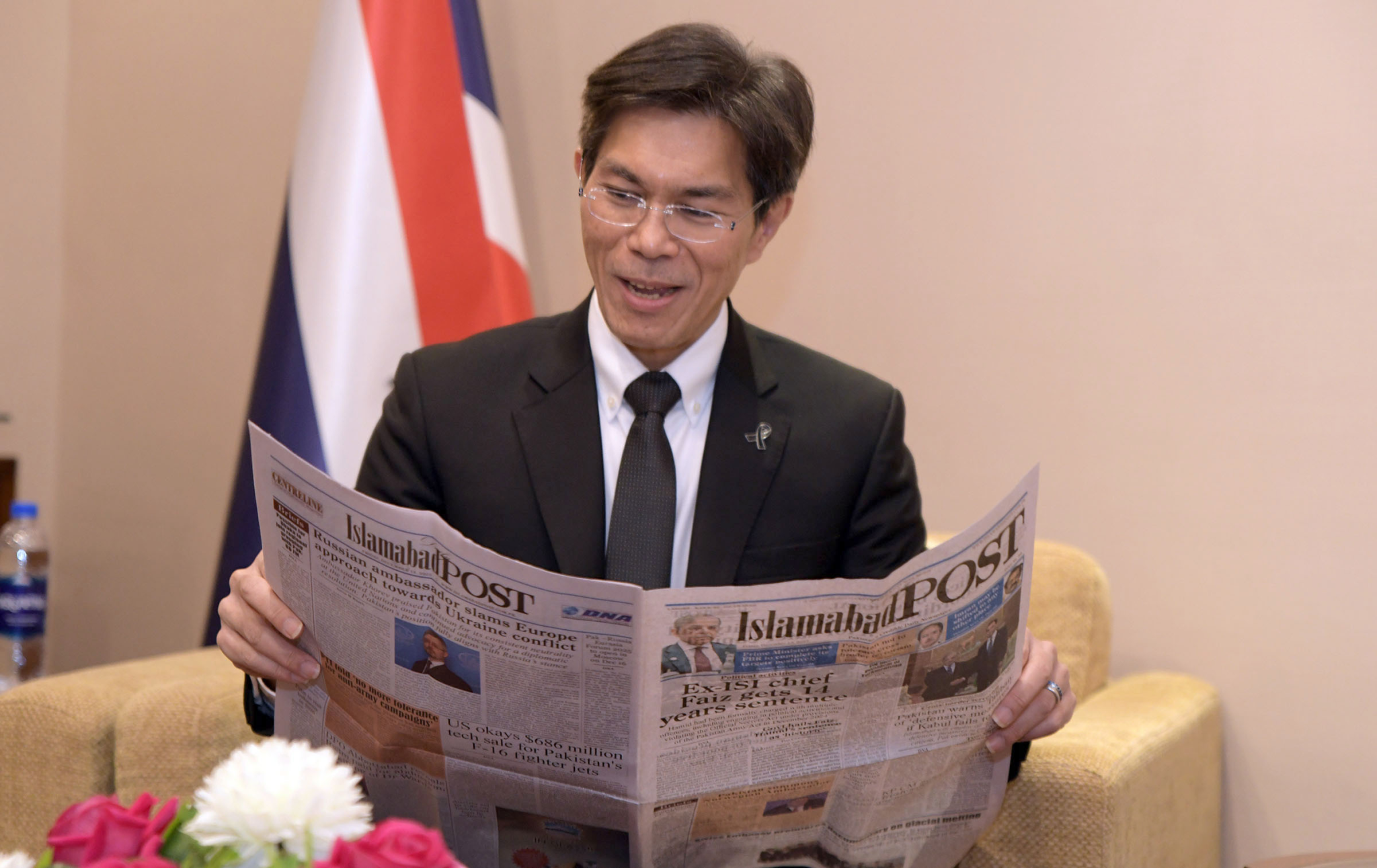
ISLAMABAD: H.E. Rongvudhi Virabutr, the Ambassador of Thailand to Pakistan, recently gave an exclusive interview to Daily Islamabad POST, Centreline, and Diplomatic News Agency.
Reflecting on his diplomatic experience in Pakistan, he shared that having just reached his one-year anniversary on December 1, 2025, he can say without reservation that Pakistan is truly a “Land of Friendliness and Opportunity.”
Despite the distance, the initial feeling of being far from home vanished instantly as he discovered that Thailand and Pakistan share a profound cultural DNA—from the warmth and generosity of the people to their deep, ancient histories.
The Pakistani spirit embraced him, making him feel at home from the very beginning. His mission, however, does not permit him to simply enjoy the hospitality without giving back in meaningful ways.
He sees Pakistan as a nation of immense, untapped potential—a strategic hub with resilient and dynamic people. With this vision, he is fully committed to advancing Thailand–Pakistan relations and unlocking the shared strengths of the two countries to the fullest.
Their ties, he emphasized, must go beyond traditional friendship and evolve into a sustainable partnership for development. He calls this a “Prosperity Partnership,” focused on delivering tangible, results-driven achievements that citizens can truly see and feel, creating a breakthrough in bilateral relations for generations to come.
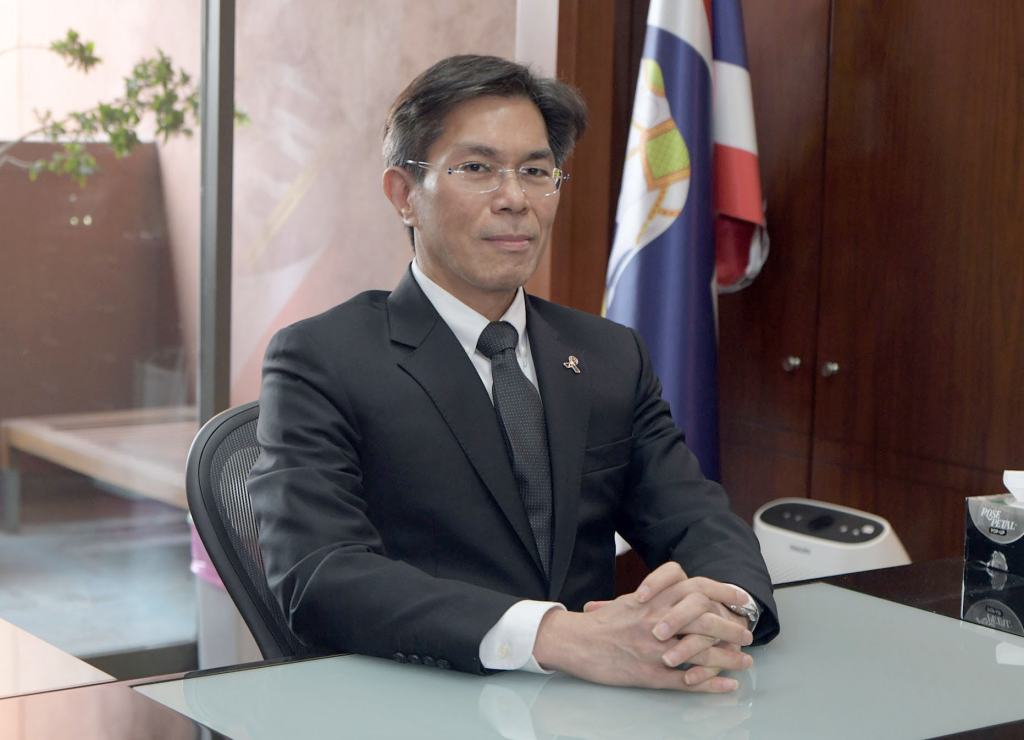
When asked about promising areas of cooperation, Ambassador Virabutr highlighted two core dimensions: Government-to-Government (G2G) economic dynamism and People-to-People (P2P) connectivity. On the G2G front, trade and investment are decisive.
Despite global fluctuations, two-way trade rebounded to USD 1.6 billion last year, but the goal is to double this volume through “Win-Win Trade”—combining Pakistan’s textiles and IT strengths with Thailand’s automotive and food processing expertise.
A particular game-changer is the Halal industry. Thailand, as one of the world’s leading Halal food producers—the “Kitchen of the World”—is ready to collaborate with Pakistan’s vast Muslim market. Advancing mutual recognition of Halal certification can unlock billions in food and cosmetics trade, creating a universal language of trust and quality.
New investment collaborations in these high-value sectors are both feasible and imperative, with further potential in defense and beyond. On the P2P side, tourism is the most powerful connector. At present, the two nations know each other but are not yet close; they contact but are not fully connected.
Tourism helps bridge this gap, but the aim is genuine familiarity and trust that positions them as first destinations for each other. The Royal Thai Embassy is committed to expanding tourism and cultural initiatives—through food, music, and art—so that cooperation is not only economic but also deeply people-to-people.
On the Pakistan–Thailand Free Trade Agreement (FTA), the Ambassador described it as not just a technical document but a Strategic Gateway to a new era of economic prosperity for Pakistan. He views the FTA as having decisive importance and is resolutely committed to pushing it to completion swiftly.
The perception that the FTA creates a disadvantage must be changed into the understanding that it is the “Key to Global Competitiveness” for Pakistan, specifically by reducing the cost of imported raw materials and boosting domestic production efficiency. Crucially, the FTA will act as a “Talent Multiplier,” particularly in the digital and services sectors.
By including provisions for the mobility of digital professionals, Pakistan’s strength as a leading global freelancer hub can be leveraged, creating up to $20 billion in added economic value. Coordinating with ministries and think tanks, the Embassy is building unwavering confidence. The final conclusion of the FTA will send the clearest signal to global investors: “Pakistan is ready for a New Era of Prosperity.”
On tourism and connectivity, Ambassador Virabutr emphasized that “Connectivity is the New Key in Diplomacy.” People-to-people relations built “from heart to heart” are inherently more durable than state-level interactions.
Clear targets have been set: doubling the number of Pakistani tourists to Thailand to 100,000 per year and expanding tourists from Thailand interested in Buddhist sites in Pakistan’s Gandhara region to 10,000 per year.
The priority is breaking logistical barriers. With current flight frequency and capacity at maximum, a virtual meeting was held in February 2026, and formal negotiations are being pushed to secure a decisive increase in air frequency and capacity, bringing more flights and accessible ticket prices.
Efforts are underway to make visiting Thailand easier for Pakistani tourists, with the e-visa system as one mechanism. Concurrently, perfect Halal Tourism programs are being designed in Thai provinces like Krabi and Ayutthaya, while Thailand is promoted as a Global Medical Hub for Pakistani patients. Tourism, through these decisive actions, becomes a genuine “Bridge of Trust.” Regarding investment, Thai investors are practical: they commit where policy is clear, not just where potential is high. The Embassy’s approach is to work with the Pakistani government to dramatically improve the Ease of Doing Business (EODB) ranking, which serves as the “compass” for global investors.
The FTA’s conclusion is also the ultimate trigger point, providing legal certainty and investment protection. Beyond that, new S-curve avenues are being explored: joint R&D in the defense industry, expansion of the Halal food processing sector, and infrastructure projects. Strategically, Thai companies view Pakistan as a vital Strategic Gateway to Central Asia and the wider Middle East, positioning the partnership as a regional economic accelerator.
To be continued