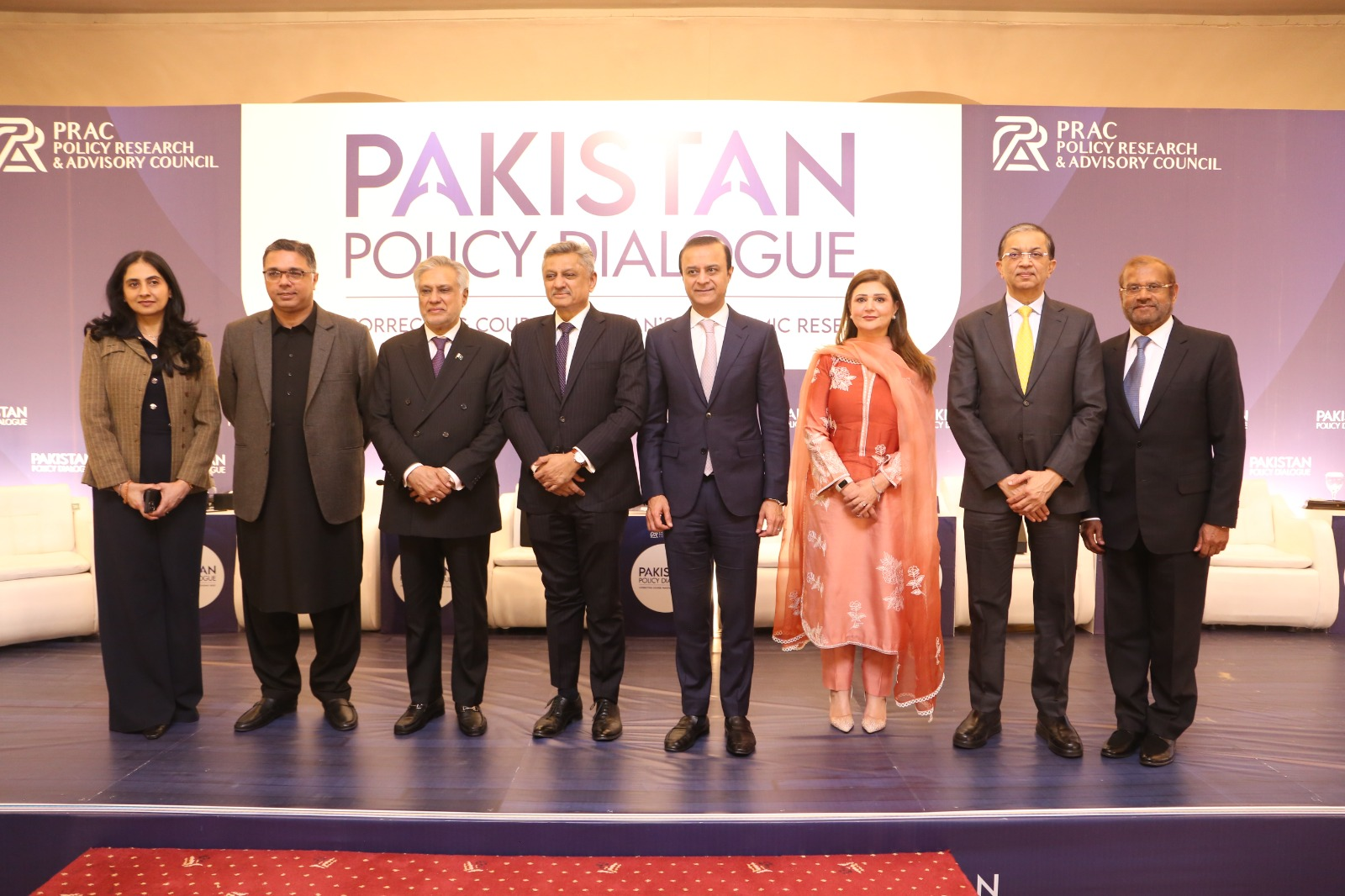
ISLAMABAD, JAN 14 /DNA/ : Senator Muhammad Ishaq Dar, Deputy Prime Minister and Minister for Foreign Affairs of Pakistan, was the Chief Guest at the Pakistan Policy Dialogue, Correcting Course: Pakistan’s Economic Reset, held in Islamabad. Speaking on the need for an economic reset anchored in realism, reform discipline, and constructive collaboration, he said, “Resetting and correcting course is about strengthening the foundations of the economy itself. This requires responsible governance, consistent policies, and institutions that operate with continuity beyond political cycles. What is now required is a technology-enabled approach to governance that reforms public service delivery and ensures policy intent translates into measurable outcomes.”
Highlighting the government’s achievements on the diplomatic front, the Deputy Prime Minister said “All diplomatic efforts are geared towards helping business boost exports and create mutual partnerships based on economic interests.”
The Dialogue convened senior policymakers, corporate leaders, and development experts to deliberate on pragmatic reform pathways, growth-oriented policy choices, digitization, and institutional strengthening at a critical juncture for Pakistan’s economy.
Organized by the Policy Research and Advisory Council (PRAC) in collaboration with the CORPORATE PAKISTAN GROUP (CPG) and Nutshell Group as Strategic Partner, with the Ministry of Commerce (MoC) and Trade Development Authority of Pakistan (TDAP) as Founding Partners, the Pakistan Policy Dialogue is envisioned as a recurring national platform for evidence-based policy discourse. The Dialogue was supported by Bank Alfalah and BankIslami, as Platinum and Gold Partners, respectively
.
The Inaugural Session, “Resetting Pakistan’s Economic Direction,” brought together prominent stakeholders.
Speakers included Prof. Ahsan Iqbal, Federal Minister for Planning, Development and Reforms; Senator Muhammad Aurangzeb, Federal Minister for Finance and Revenue; Senator Dr. Musadik Malik, Federal Minister for Climate Change and Environmental Coordination;
Muhammad Ali, Adviser to the Prime Minister on Privatisation; Dr. Ishrat Husain, N.I., H.I., author, economist, former Federal Minister and former Governor, State Bank of Pakistan; Muhammad Younus Dagha, Chairman, PRAC; and Muhammad Azfar Ahsan, Pakistan’s former Minister for Investment and Chairman, CPG.
Prof. Iqbal highlighted the importance of planning, productivity, and export competitiveness in Pakistan’s economic recovery, noting that a durable reset must balance short-term stabilization with long-term development objectives. He observed, “Compared to 1947, Pakistan has progressed, but globally it still lags behind peers.
A future-forward approach is needed rather than exploiting past conflicts for media mileage. Developed countries stand on universal primary enrollment, robust health markers, at least 90% literacy, political stability, and sectoral development; Pakistan lags on all fronts.”
Senator Aurangzeb outlined government reform priorities and the focus on macroeconomic stability. He said, “Our focus is on existential challenges: achieving sustainable growth for a USD 3 trillion economy requires addressing rapid population growth and climate risks, including floods that heavily impact GDP. At the same time, emerging sectors like crypto and blockchain, driven by youth and freelancers, need formalization and regulation, with the government providing an enabling ecosystem.”
Senator Dr. Malik highlighted the need for equitable resource distribution, particularly for women and fresh graduates, stating, “Until you democratize capital and empower new entrants, nothing will change.”
Muhammad Ali stressed the essence of privatization and the government’s need to focus on areas best left to private enterprise, saying, “Four major weaknesses have challenged us: stretched public resources, informal economic activity, idle or speculative capital, and lack of inclusion.”
Dr. Husain emphasized the dynamic nature of policy making and the need to shift focus to services exports: “Technology has shifted the paradigm toward services, whose growth rate outpaces goods. Yet, we remain focused on goods.
Concentrating on human resources and service exports is essential for sustainable growth.”
Younus, underscored solutions-oriented policymaking, noting, “Pakistan has moved decisively from default risk to macroeconomic stability, with inflation falling nearly 80 percent, foreign exchange reserves rising to USD 21 billion, and the current account returning to surplus.
The critical question is what drove this turnaround; tight policy rates or favorable global commodity prices? More importantly, how prepared are we for the next disruption, particularly AI? Sustainable growth will depend on strong human capital, AI-ready skills, productive cities, effective local governments, and a coherent, predictable policy framework that builds investor confidence.”
Azfar connected the theme and the need for expedited action by saying, “A meaningful economic reset requires collaboration between the state and private sector, guided by evidence-based policy and long-term vision. Pakistan’s growth trajectory can only be corrected through structural reforms, investment in human capital, and a governance framework that translates policy into measurable results.”
Post-inaugural sessions featured focused policy discussions. The panel “Bridging the Digital Divide” explored digital infrastructure, financial inclusion, and technology adoption. Panelists included Aamir Ibrahim, CEO, Jazz and Chairman, Mobilink Microfinance Bank; and Mujeeb Zahur, Managing Director Pakistan, S&P Global Pakistan, moderated by Saquib Ahmad, Global Chief Growth Officer, Systems Limited.
Aamir advocated for a cashless economy, stating, “Digital allows us to trace every transaction. Rast QR codes should be at every outlet, and above all, we must double down on execution.” Mujeeb added, “Capital and private markets assess countries through standardized benchmarks, with digital infrastructure, policy frameworks, and ease of doing business central to risk evaluation. Policymakers must prioritize government digitization to enhance investor confidence and attract capital.” Saquib concluded, “We play a pivotal role in facilitating digitization and must align with government efforts to maximize impact.”
The session “Green Growth Pathways for a Climate-Vulnerable Pakistan” focused on financing, policy alignment, and private-sector participation. Panelists included Nadia Rahman, Member, Planning Commission of Pakistan; Dr. Samuel Rizk, Resident Representative, UNDP Pakistan; Maheen Rahman, CEO, InfraZamin Pakistan; and Ayla Majid, Founder and CEO, Planetive, moderated by Sajjeed Aslam, Partner and Co-Founder, Spectreco LLC, USA. Nadia emphasized mobilizing private capital for decarbonization: “Decarbonization requires financing beyond the government’s limited 5% fiscal space. Instruments like Green Panda Bonds, green sukuk, carbon finance, public-private partnerships, and debt-for-climate swaps are critical.” Dr. Rizk stressed coordinated climate responses: “Climate and disaster programs must be nationally led, not piecemeal. When funding aligns with a unified strategy, individual efforts can deliver meaningful impact.” Maheen highlighted water and agriculture concerns: “We lose 10 years of water every year due to glacier melt. Climate’s impact on agriculture must be addressed over the next five years. “Ayla noted the need for innovative investment tools: “Capital markets and banks lack the depth to meet all needs. Technology, such as tokenization and digital asset frameworks, can democratize investment and mobilize capital across sectors.”
The session “Restoring Competitiveness: Fixing the Macroeconomic Framework” included Khurram Schehzad, Adviser to the Finance Minister; Ahsan Zafar Syed, President, Engro Corporation; Huma Fakhar, Founder, MAS Capital and MAP Group; Dr. Khaqan Hassan Najeeb, Economist and former Advisor, Ministry of Finance; and Muhammad Jawed Bilwani, Chairman, J.B. Industries and former President, KCCI, moderated by Assad Hameed Khan, Country Head Pakistan, ACCA.
Khurram Schehzad highlighted policy reforms: “To enhance competitiveness, we have begun opening up the economy through the last budget, phasing tariff and customs reforms over five years to improve efficiency, attract investment, and build a competitive market. A key structural shift this year is policy correction, moving from enforcement-led to finance and revenue-focused policies.” Huma reflected on contrasting realities: “Two realities exist: the traditional struggling economy and a vibrant, emerging startup and SME sector performing exceptionally well.”
The closing session, “From Dialogue to Delivery: Advancing Pakistan’s Growth Agenda,” featured Mohammad Ali Tabba, CEO, Lucky Cement, who shared private-sector perspectives: “With landmark privatizations like PIA and Pakistani companies acquiring exiting multinationals, the country is demonstrating business capability. To achieve sustainable growth, Pakistan must address structural bottlenecks in energy, water, and exports, aiming for 5–6% annual growth to create jobs and strengthen economic resilience.”
Younus concluded with a focus on human resource development and multi-stakeholder collaboration. The Dialogue ended with consensus on reinforcing partnerships between the state, policymakers, business leaders, financial institutions, and development partners. Future editions aim to deepen evidence-based policymaking, private-sector engagement, and support Pakistan’s ongoing economic reset.