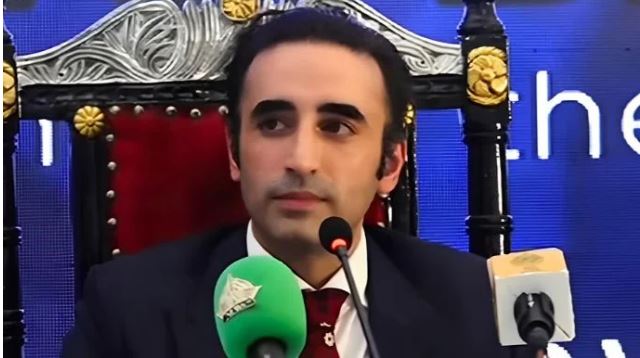
KARACHI: Pakistan Peoples Party (PPP) Chairman Bilawal Bhutto-Zardari has warned that if Sindh is divided by force, questions will be asked about the blood spilled on the streets in Karachi and Hyderabad.
Addressing an event at the Karachi Press Club, Bilawal said: “If the province is divided by force, society will be divided, it will lead to enmity, ordinary people will take up arms, and the bloodshed will not be limited to a single death.”
He said the PPP supports the creation of provinces in line with the wishes of the people, the Constitution and the law. “Where we are opposing, it is over force and coercion. We do not want division through force,” he said.
Bilawal said the Constitution already lays down a procedure, and that suggesting a referendum amounted to looking for an unconstitutional method. “If you are looking for an unconstitutional method, how can the PPP be with you?” he asked.
He said referendums in Pakistan’s history had been held for undemocratic purposes. “It is not about a referendum, it is about intent,” he said.
Referring to a provincial minister’s call for a referendum, he said: “Hold a referendum in your own assembly first.” He added that the Sindh Assembly had stated its position on the division of Sindh “not once, but ten times”.
The PPP chairman said he had not been consulted on the creation of provinces. “As far as making provinces is concerned, I have not been spoken to,” he said. He added that the constitutional, democratic and legal procedure had not been followed. “I do not know what Mohsin bhai is trying to do,” he said.
Bilawal said neither the prime minister nor the cabinet had said anything about the provinces, and that the matter had not even been debated in the cabinet, let alone parliament. “When such things are done through back doors, they do not last forever,” he said.
He also said the provinces had not received the financial resources due to them. “You plunder the province’s resources, then ask why the health system is weak and why the road is broken,” he said. The federal government, not the provincial governments, was responsible for why money was not being spent on the people of Pakistan, he added.
Bilawal said he had invited the prime minister to sit down with the Sindh government so that they could solve the people’s problems together.
He said he had backed Shehbaz Sharif for prime minister and wanted him to succeed. “We made Shehbaz Sharif the prime minister, I would like him to be successful,” he said. He added that the prime minister should have enough authority to control his ministers.
To another question about new provinces, the PPP chairman said: “If they use force, brother will kill brother in Sindh. I cannot see bloodshed.”
Bilawal said One Unit had also been imposed by force, but the people of Sindh did not step back from their struggle. He added that the decision to make Karachi the capital had likewise been taken by force in the past, and recalled that “Quaid-e-Awam” had restored the status of all provinces, including Sindh and Balochistan, through the 1973 Constitution.
On the demand for a referendum, he said the Constitution already provided a procedure. “We are ready to resist any unconstitutional method firmly,” he said.
He said neither he nor the president had been consulted on new provinces, which was giving rise to doubts.
Turning to finances, Bilawal said 16 years had passed since the 18th Amendment was approved, yet the provinces had still not received their financial resources. He said the provinces’ share of the petroleum levy came to about Rs1.7 trillion, and that all provinces were contributing from their own shares for national interest and security.
The federal government, not the provinces, was responsible for money not being spent on the public, he said. He also noted that authority over rare minerals lay with provincial governments, and that the federation and provinces must work together to attract global investment.
The PPP chairman said some of those proposing new provinces had never won an election, and their political future did not depend on the public vote. “I am a politician who has done politics for generations, and I will not take any step against the will of the people,” he said.
Bilawal calls Imran Khan a political prisoner
The PPP chairman said that he considered incarcerated PTI founder Imran Khan a “political prisoner”, adding that he wanted to see the day when no prime minister is jailed after leaving office.
He said whoever became prime minister ended up in jail. “Should I believe that all the prime ministers were thieves, or is this political vendetta?” he asked.
“I want to see the day when someone becomes prime minister and does not have to go to jail afterwards,” he said. He added that consensus would have to be built for this to happen.
On PTI’s troubles, the PPP chairman said they were partly the result of politics and partly of the party’s own mistakes and actions.
Bilawal said he would try to convene a round-table conference or an all parties conference (APC), with the system’s collapse and its reset as the agenda. “I would like a round-table conference to be held on the topic of the destroyed system and the system reset,” he said.
He said the effort was to enable all political parties to build consensus so that inflation and poverty could be ended.
‘Political reset’
The PPP leader called for a political reset of the country’s system, saying its deterioration was “deliberate” rather than accidental.
“I believe the system has not collapsed; it has been deliberately destroyed,” Bilawal added.
The PPP chairman also acknowledged his own shortcomings for the system’s condition, saying he accepted that he too was at fault.
Bilawal further argued that the proposed solution to the country’s problems would not address the underlying issues.
Calling for a reset, he stressed that the process should be political rather than non-political. “This system needs a reset, but the reset will not be non-political; it will be political.”
He also emphasised the need to restore public confidence in the country’s institutions, saying confidence in all institutions, including the media and parliament, would have to be rebuilt.
Bilawal stressed the need to discuss the challenges facing the country amid changing international and regional circumstances.
“Pakistan’s people have never faced difficulties like those they are experiencing today,” the PPP chief said, adding that poverty, unemployment and inflation were rising rapidly.
Bilawal also voiced concern over the impact of the prevailing circumstances on the public, particularly people from poorer and disadvantaged backgrounds.
“I am frightened about what will happen to the people under these circumstances,” he said.
Tarar slams PPP over ‘dual role’
Reacting to Bilawal’s hard-hitting speech, Information Minister Attaullah Tarar asked: “Isn’t enjoying the power and doing opposition at the same time a blatant contradiction?”
The minister said that no agenda can be imposed without the will of the people, describing a referendum as the best way to ascertain public opinion.
“A referendum is part of the Constitution and it is a constitutional procedure,” Tarar said, adding that he best interest of the people should be kept in view when it comes to a referendum.
He said that everyone had been part of the system for decades, and no one could now separate themselves from its flaws.
The minister said that it was beyond understanding that NAB reforms had been carried out by the same people who were now blaming the institution.
On the issue of provinces, the information minister said the debate could not be stopped. “It is a democratic and legal requirement that this debate should continue,” he said.
The minister added that good governance and reforms were the agenda of all governments.
Separately, Senate Opposition Leader and PTI-allied Majlis Wahdatul Muslimeen (MWM) chief Allama Raja Nasir Abbas has said that they were ready to sit for talks on rolling back the 26th and 27th constitutional amendments through parliament, calling for restoration of trust.
The opposition leader said all political parties were responsible for the prevailing crisis in the country. “The solution at this time is that the 26th and 27th amendments be withdrawn through parliament,” he said.
MQM-Pakistan spokesperson, however, said the establishment of new provinces was a constitutional requirement, questioning why any discussion on the issue triggered such a strong reaction.
The spokesperson said a majority of residents in Sindh’s urban areas, as well as people across the country, supported the creation of new provinces.
Jamiat Ulema-e-Islam-Fazl (JUI-F) spokesperson Aslam Ghauri described Bilawal’s statement as realistic, saying the party viewed it with appreciation. He said the PPP leader had endorsed JUI-F’s stance by exposing what he called the government’s mandate.
He said the PPPs’ position on the division of provinces had now become clear, adding that JUI-F shared the same stance on the issue.
Ghauri said the experience of holding referendums had always been tainted, arguing that there was no need for one if the Constitution already provided a mechanism to resolve an issue.
The JUI-F spokesperson warned that a referendum could be misused under the cover of the Constitution, just like the imposition of an emergency and governor’s rule.