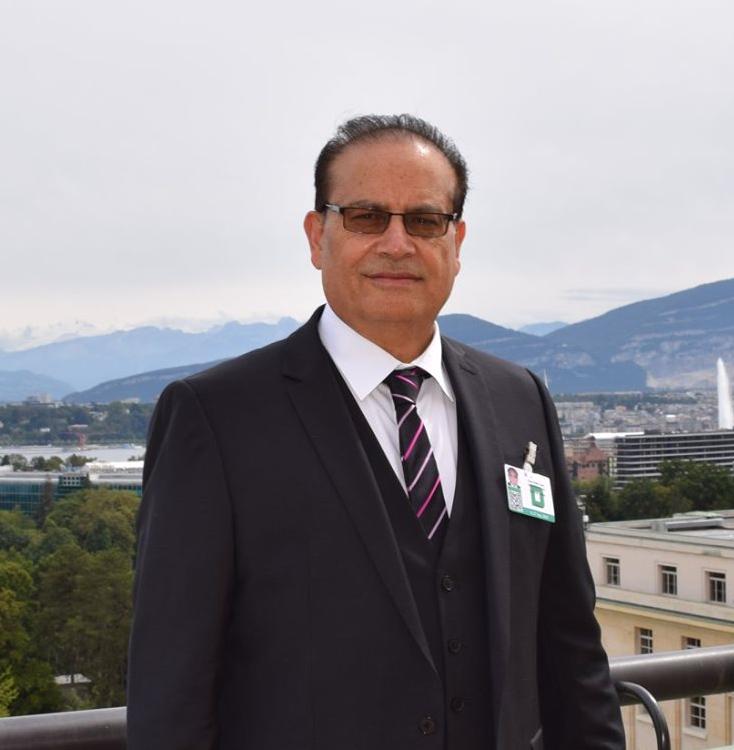
Qamar Bashir
Press Secretary to the President (Rtd)
Former Press Minister, Embassy of Pakistan to France
Former Press Attaché to Malaysia
Former MD, SRBC | Macomb, Michigan, USA
On December 14, 2025, Australia was jolted out of its sense of safety. At Bondi Beach in Sydney, a space synonymous with openness, community, and peaceful coexistence, gunmen opened fire on members of the Jewish community gathered to celebrate Hanukkah. Eleven people were killed and many more injured. Families, children, and elders—people with no role in war, policy, or geopolitics—were turned into victims of terror.
The attack was immediately and rightly condemned by Australia and the world. There can be no ambiguity: the killing of civilians anywhere is criminal, immoral, and indefensible. No grievance, no ideology, no historical wound justifies such an act. The Jewish community in Australia, like Jewish communities everywhere, deserves safety, dignity, and protection.
Yet condemnation alone does not prevent recurrence. If the world wishes to stop such horrors from repeating, it must confront a harder truth: violence does not arise in isolation. It is shaped, amplified, and redirected by global political behavior—especially when power is exercised without accountability.
The Bondi Beach massacre occurred in a world already saturated with unresolved wars, mass civilian suffering, and a growing perception that international law is applied selectively. This perception—whether ignored or dismissed by those in power—has consequences. When pain is denied in one place, it does not disappear. It travels. It mutates. And it eventually erupts where the innocent live.
The Hamas attack of October 7, 2023, which killed Israeli civilians and took hostages, was universally condemned. That condemnation was justified. What followed, however, shattered moral balance. Israel’s military response in Gaza resulted in the deaths of tens of thousands of Palestinian civilians, the destruction of homes, hospitals, schools, and the deliberate deprivation of food, water, and medical aid. International legal institutions and humanitarian organizations warned that collective punishment and starvation had become tools of war.
This matters not to excuse terrorism or antisemitism—both are crimes—but to understand how unchecked state violence creates global insecurity. When a state presents itself as above scrutiny, when it dismisses civilian deaths as necessary or inevitable, it sends a message to the world that human life is conditional. That message does not stay confined to Gaza. It seeps into streets, minds, and communities across continents.
The Jewish community worldwide has increasingly been placed in an impossible position. Jews in Australia, Europe, or North America do not command armies, blockade borders, or authorize bombardments. Yet they increasingly find themselves vulnerable to backlash generated by actions taken by a government thousands of miles away. This conflation is unjust, dangerous, and morally wrong—but it is fueled by the refusal of powerful leaders to acknowledge the global consequences of their conduct.
This refusal was starkly illustrated in the aftermath of the Bondi Beach killings. Instead of engaging in self-reflection or acknowledging how Israel’s actions in Gaza have heightened global tensions and endangered Jewish communities abroad, Israeli Prime Minister Benjamin Netanyahu publicly criticized the Australian government, accusing it of failing to provide adequate security to the Jewish community.
In doing so, Netanyahu acted not as a statesman grappling with consequences, but as if he were a ruler passing judgment on sovereign nations—assigning blame outward while absolving himself entirely. There was no acknowledgment that the relentless violence in Gaza, the images of starving children, and the dismissal of international law have contributed to an environment in which rage is exported globally. There was no recognition that leadership carries responsibility not only for battlefield outcomes, but for the safety of one’s people everywhere.
By placing the burden solely on Australia’s security apparatus, Netanyahu effectively treated the Bondi Beach massacre as an isolated policing failure—rather than as a symptom of a wider moral and political breakdown. This posture is not only arrogant; it is dangerous. It ignores the simple reality that actions taken in the Middle East now reverberate instantly across the world.
A similar warning emerged just one day earlier, on December 13, 2025, in Palmyra, Syria. A lone suspected Islamic State gunman attacked a convoy of U.S. and Syrian partner forces during a key leader engagement. The assault killed two U.S. Army soldiers and a civilian interpreter, and wounded three others. Partner forces killed the attacker at the scene. President Donald Trump vowed serious retaliation.
That attack, like Bondi Beach, underscored the same truth: wars fought far from home do not remain distant. They return—sometimes as direct attacks, sometimes as unpredictable consequences. Soldiers, interpreters, and civilians pay the price for conflicts whose political roots remain unresolved.
This reality struck even closer to home in Washington, D.C., where a lone Afghan gunman killed one U.S. soldier and critically wounded another. His act was criminal and indefensible. But it was also a reminder that decades of war leave behind trauma and grievance that do not end with troop withdrawals. When conflicts are managed through force rather than resolution, the aftershocks linger in human lives.
Today, the same pattern threatens to repeat itself in the Western Hemisphere. Tensions between the United States and Venezuela, and increasingly involving Colombia, are escalating. Once again, familiar language is resurfacing—delegitimization, sanctions, pressure, and whispers of regime change. The narrative being constructed against Venezuela echoes the one once built against Iraq: moral urgency, existential threat, inevitability of action.
We know how that story ended. Iraq was destabilized. Libya collapsed. Syria fractured. The Middle East was turned upside down. Millions were displaced. Extremism flourished. And the consequences spilled into Europe, North America, and beyond.
Venezuela may be weaker than the United States militarily, but modern conflict teaches a clear lesson: retaliation does not strike power centers; it strikes soft targets. It does not reach presidents; it reaches soldiers, worshippers, commuters, and children. Innocent Americans—both civilians and service members—become exposed to the revenge of those whose loved ones were killed far away.
This is not justification. It is historical reality. Violence creates memory. Memory creates resentment. Resentment seeks release—often against those least responsible.
The tragedies at Bondi Beach, in Palmyra, in Washington, and the looming risks in Venezuela and Colombia all point to the same conclusion: when leaders refuse accountability, insecurity becomes global. No border, no ocean, no alliance can contain the consequences.
The only alternative is restraint, diplomacy, and genuine multilateral engagement. Institutions like the United Nations exist to prevent this chain reaction—to replace unilateral force with collective responsibility. They are imperfect, but bypassing them guarantees repetition of failure.
If humanity continues to normalize collective punishment, regime-change wars, and selective morality, the violence will keep returning—again and again—against people who never chose these conflicts. Peace is not a moral luxury. It is a strategic necessity.
Only by choosing introspection over arrogance, law over impunity, and dialogue over domination can the world hope to prevent the next Bondi Beach—and the next innocent life lost to a war they never owned.
Qamar Bashir
Press Secretary to the President (Rtd)
Former Press Minister, Embassy of Pakistan to France
Former Press Attaché to Malaysia
Former MD, SRBC | Macomb, Michigan, USA