GILGIT-BALTISTAN, SEP 22 /DNA/ – The Government of Gilgit-Baltistan, the Agence Française de Développement (AFD), the European Union, and the Aga Khan Foundation (AKF) launched the “Gilgit-Baltistan Rural Development and Climate Resilience” project today, marking a significant step towards enhancing climate resilience and improving the quality of life across all districts of Gilgit-Baltistan.
The EUR 54.24 million (PKR 17.2 billion) project, supported through a combination of AFD financing, a European Union (EU) grant, AKF funding and community contributions, aims to improve living conditions and strengthen the resilience of communities to climate change and natural disasters.
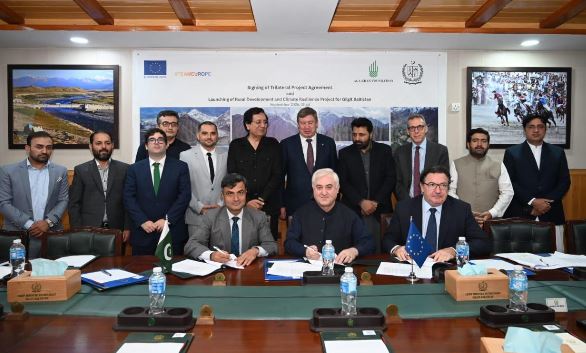
Additional Chief Secretary (Development), Gilgit-Baltistan, Mr. Riaz Ahmed; AFD Country Director, Mr. Marc-Antoine Leclercq; and CEO, Aga Khan Foundation Pakistan, Mr. Akhtar Iqbal, formally signed the agreement.
The “Gilgit-Baltistan Rural Development and Climate Resilience” project will deliver a comprehensive package of climate-resilient interventions across all districts of Gilgit-Baltistan. The interventions will range from improving access to safe drinking water and sanitation services through 216 water supply and sewerage schemes (117 drinking water supply schemes and 30 sanitation projects including sewerage network and wastewater treatment).
Additionally, 1200-1300kW of clean energy is also expected to be generated through hydropower initiatives. The project will also strengthen climate resilience through vulnerability assessments across all 110 Union Councils, alongside the green retrofitting of 3,000 households and energy-efficient, resilient construction of 700 households.
The project will further invest in people and institutions through training in climate-smart planning, enterprise development and sustainable infrastructure management. The project is expected to reach approximately 43,200 households (325,600 people), with women comprising at least 40% of beneficiaries.
During the event, Northern Pakistan Energy Limited (NPak Energy) also presented the key findings of the Gilgit-Baltistan Energy Master Plan. Developed as a 30-year roadmap under the EU-funded “Energy Plus” project, a EUR 31 million (PKR 9.8 billion) initiative supporting the transition towards a climate-resilient and low-carbon economy in Gilgit-Baltistan and Chitral.
The Master Plan aims to establish a reliable, affordable and climate-resilient energy system for the region. Developed in partnership with the Water and Power Department of the Government of Gilgit-Baltistan, NPAK Energy and other stakeholders, the Master Plan outlines a strategic pathway for addressing Gilgit-Baltistan’s energy deficit while harnessing its significant renewable energy potential.
Honourable Chief Minister of Gilgit-Baltistan, Mr. Amjad Hussain Azaar, welcomed the AFD and European Union delegations and officials from the Aga Khan Foundation to Gilgit. Speaking on the occasion he noted,
“The project would be an important milestone for the sustainable development and prosperity of the people of the region and for protecting communities from the adverse impacts of climate change.
The objective of this project is not merely to utilise funds or to complete schemes, but to deliver tangible benefits to the people, including improved access to essential services, electricity for remote villages, and employment opportunities for young people.
The project will provide clean water, improved sanitation, resilient and energy-efficient housing, community-level micro-hydropower, stronger local institutions, and employment opportunities, with community participation central to identifying and implementing interventions. He noted that efforts are underway to address the energy crisis through the solarisation of government buildings and the development of a regional grid.”
Ambassador of the European Union to Pakistan, H.E. Mr Raimundas Karoblis noted, “Team Europe is the main development partner for Gilgit Baltistan.
Today marks a pivotal moment in our shared commitment to a sustainable and resilient future for Gilgit-Baltistan. With the launch of the Rural Development and Climate Resilience Project, and the handover of the Gilgit-Baltistan Energy Master Plan, we reaffirm our continued dedication to tackling climate change while fostering inclusive growth in Gilgit Baltistan.
The European Union and its Team Europe partners stands proudly alongside the Government of Gilgit-Baltistan, and the Aga Khan Foundation to turn these plans into action, ensuring no one is left behind in the transition to a greener, more resilient future.”
The Country Director Agence Française de Développement (AFD) Pakistan, Mr. Marc-Antoine Leclercq added, “AFD has a long and productive partnership with Aga Khan Foundation, Pakistan and in many other countries where an excellent work done by AKDN agencies is worth appreciating. We strongly believe this project will benefit Gilgit-Baltistan population through improvement of the basic services.
The Government of Gilgit Baltistan will benefit from this opportunity by enhancing the institutional capacity for implementing community driven approach particularly in remote region of Gilgit Baltistan-an innovative approach for public investment.
We are looking forward to this cooperation with Government of Gilgit to reach our common sustainable development targets”.
The Chief Executive Officer of the Aga Khan Foundation, Pakistan, Mr Akhtar Iqbal, said, “The Gilgit-Baltistan Rural Development and Climate Resilience Project reflects our long-standing commitment towards improving the quality of life of mountain communities through climate-resilient infrastructure, renewable energy, strengthened local institutions, and inclusive economic opportunities.
We highly appreciate the longstanding partnership and support of the European Union and the Agence Française de Développement (AFD), which have been instrumental in advancing sustainable and climate-resilient development in Pakistan.
Through this partnership with the Government of Gilgit-Baltistan and our development partners, we aim to support communities in building a more resilient, sustainable, and prosperous future.”
The signing ceremony concluded with a renewed commitment by all partners to work collaboratively towards inclusive, resilient, and sustainable development for the people of Gilgit-Baltistan.