Saifullah Ansar
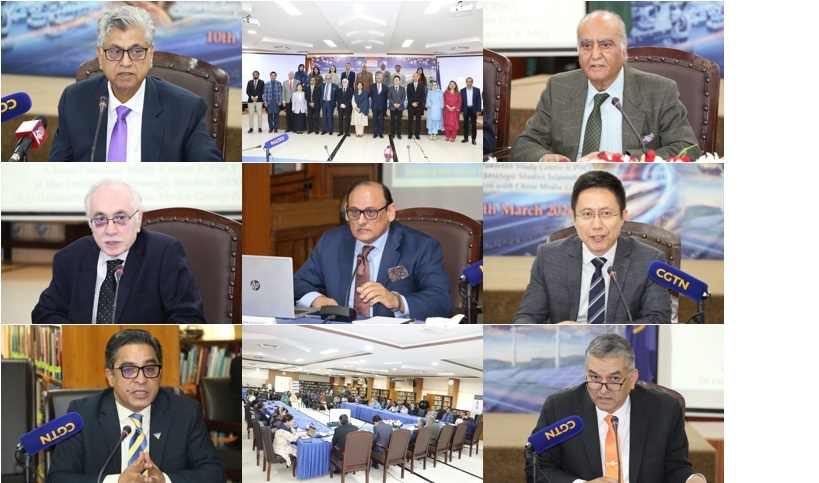
ISLAMABAD: China Pakistan Study Centre (CPSC) at the Institute of Strategic Studies Islamabad (ISSI) in collaboration with China Media Group (CMG) organised a seminar titled “China in Springtime: The 15th Five-Year Plan – The Global Significance and opportunities of Chinese Modernization” The event highlighted China’s recently concluded Two Sessions, which set the course for the country’s governance, economic growth, and global engagement.
Chairman ISSI, Ambassador Khalid Mehmood, in his welcome remarks highlighted that China’s modernization under the 15th Five-Year Plan reflects a strong focus on innovation, sustainability, and people-centered development. He noted that China’s evolving development trajectory carries important global implications and presents opportunities for cooperation, particularly with partners like Pakistan. Emphasizing the significance of the China–Pakistan Economic Corridor, he underscored that collaboration in areas such as technology, green development, and connectivity will further strengthen the longstanding strategic partnership between the two countries.
The Chief Guest, Mr Murtaza Solangi, reflected on the broader geopolitical context of China’s development trajectory, noting that the deliberations of the National People’s Congress and the Chinese People’s Political Consultative Conference provide insights into China’s long-term economic planning and policy priorities. He observed that China continues to emphasize steady economic growth, technological self-reliance, innovation, and green transformation while expanding the digital economy and strengthening domestic consumption. Highlighting the evolving global environment, he remarked that the world is transitioning toward a multipolar world order, in which countries of the Global South will play an increasingly significant role. Pakistan, given its strategic location and longstanding partnership with China, can contribute constructively to a more balanced and cooperative international system.
Ambassador Masood Khalid, in his keynote address, highlighted the importance of understanding China’s development model through its Five-Year Plans, noting that the planning process, initiated in 1953, has evolved into a pragmatic framework combining long-term vision with periodic evaluation. He observed that these plans have driven China’s remarkable transformation, including lifting over 800 million people out of poverty and building world-class infrastructure. Continued investment in education, research, and innovation has enabled China to emerge as a major economic and technological power.
Dr Hassan Daud Butt highlighted China’s development trajectory as the gradual building of a “Great Wall of Development.” Despite demographic, environmental, and geopolitical challenges, China has sustained strong economic growth and technological advancement, particularly in innovation and clean energy. Referring to the forthcoming 15th Five-Year Plan, he underscored its focus on innovation, green development, and high-quality growth, while emphasizing that Pakistan could benefit by strengthening special economic zones, expanding technological cooperation, promoting renewable energy, and enhancing people-to-people linkages with China.
Dr Tahir Mumtaz Awan highlighted that the 15th Five-Year Plan marks an important step toward achieving socialist modernization by 2035, with a focus on shifting from high-speed to high-quality growth driven by technological innovation, modern industry, and stronger domestic demand. Referring to Pakistan, he emphasized the importance of utilizing China-Pakistan Economic Corridor Phase 2.0 to enhance cooperation in technology transfer, renewable energy, agriculture, and industrial development.
The Guest of Honour, Mr. Wang Shengjie, Political and Press Counsellor at the Chinese Embassy in Islamabad, stated that the 15th Five-Year Plan reflects a comprehensive and consultative planning process that incorporates inputs from diverse segments of society. Emphasizing China’s commitment to multilateralism and global development, he stated that initiatives such as the Belt and Road Initiative continue to create opportunities for partner countries. Mr. Wang reaffirmed that China remains committed to strengthening cooperation with Pakistan across various sectors and sharing the benefits of its development for mutual prosperity.
Earlier, Dr Talat Shabbir, Director, CPSC, highlighted the significance of China’s Two Sessions in shaping the country’s economic and governance policies and their global impact. He underscored the opportunities these developments present for Pakistan, particularly in enhancing economic collaboration through CPEC.
The event was attended by diplomats, scholars, policy practitioners, and media professionals, reflecting broad interest and engagement in the discussions.