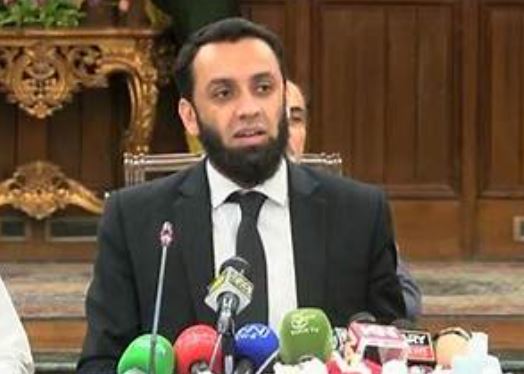
ISLAMABAD, Feb 03 (DNA): Minister for Information and Broadcasting Attaullah Tarar on Tuesday told the Senate that the federal government had launched coordinated initiatives to counter extremism and terrorism through religious harmony, narrative-building, and strict implementation of the National Action Plan (NAP).
Replying to a question during Question Hour, the minister said that a Paigham-e-Aman Committee had been constituted without discrimination on the basis of sect or political affiliation.
He said scholars from all schools of thought and representatives of different religions from across Pakistan had been included in the committee, which was actively touring the country to promote a counter-narrative against extremism, violence, and terrorism.
He said the committee included religious scholars, senior government officials, and minority representatives. The members of the committee are Maulana Abdul Karim, Mufti Rahim, Allama Arif Wahidi, Pir Naqeebur Rehman, Allama Hussain Akbar, Dr Raghib Naeemi, Maulana Tahir Ashrafi, Maulana Tayyab Panjpiri, Allama Ziaullah Bukhari, Bishop Azad Marshall, Rajesh Kumar Hardasani, and Sardar Ramesh Singh Arora.
Attaullah Tarar said building a credible counter-narrative against violent extremism was primarily the responsibility of religious scholars, adding that the government had also established a Counter Violent Extremism (CVE) Cell in the Information Ministry.
He said a third-party audit mechanism had been put in place to assess the reach and impact of the narratives produced by the CVE Cell, particularly through digital platforms.
The minister informed the House that a fully functional digital communication department was disseminating the counter-extremism narrative nationwide. Referring to recent political engagement, he said the visit of the Khyber Pakhtunkhwa chief minister to the Prime Minister was a positive development and would help improve coordination between the federal government and KP, especially on law and order and counter-terrorism.
Meanwhile, later, Talal Chaudhry also briefed the Senate on the government’s broader strategy to counter extremism, telling senators that both kinetic and non-kinetic measures were being pursued simultaneously.
He said the most recent meeting on counter-extremism had been held under the leadership of the Information Minister, while the Paigham-e-Aman Committee, chaired by the Prime Minister, had formulated a comprehensive outreach programme spanning universities, madaris, mosques, and other segments of society.
Talal Chaudhry stressed the need for a full parliamentary debate on the 14-point National Action Plan-II (NAP-II), noting that the original NAP had been formulated after the Army Public School tragedy during the PML-N government and later revised during the PTI government with the consensus of all provinces.
He informed the House that a high-level coordination committee on counter-terrorism, chaired by the Prime Minister and attended by all chief ministers and heads of security institutions, met regularly to review progress, while the Interior Minister chaired meetings twice a month. A separate “hardening of the state” committee, he added, was also monitoring implementation of all 14 NAP points.
The minister said past success against terrorism had only been achieved when all political forces stood united behind the
security forces, emphasizing that similar unity was required once again to defeat extremism and terrorism.
He said the government was ready to present a detailed briefing on the implementation of all NAP-II points, including provincial and federal performance, if the House decided to allocate time for an in-depth discussion.