
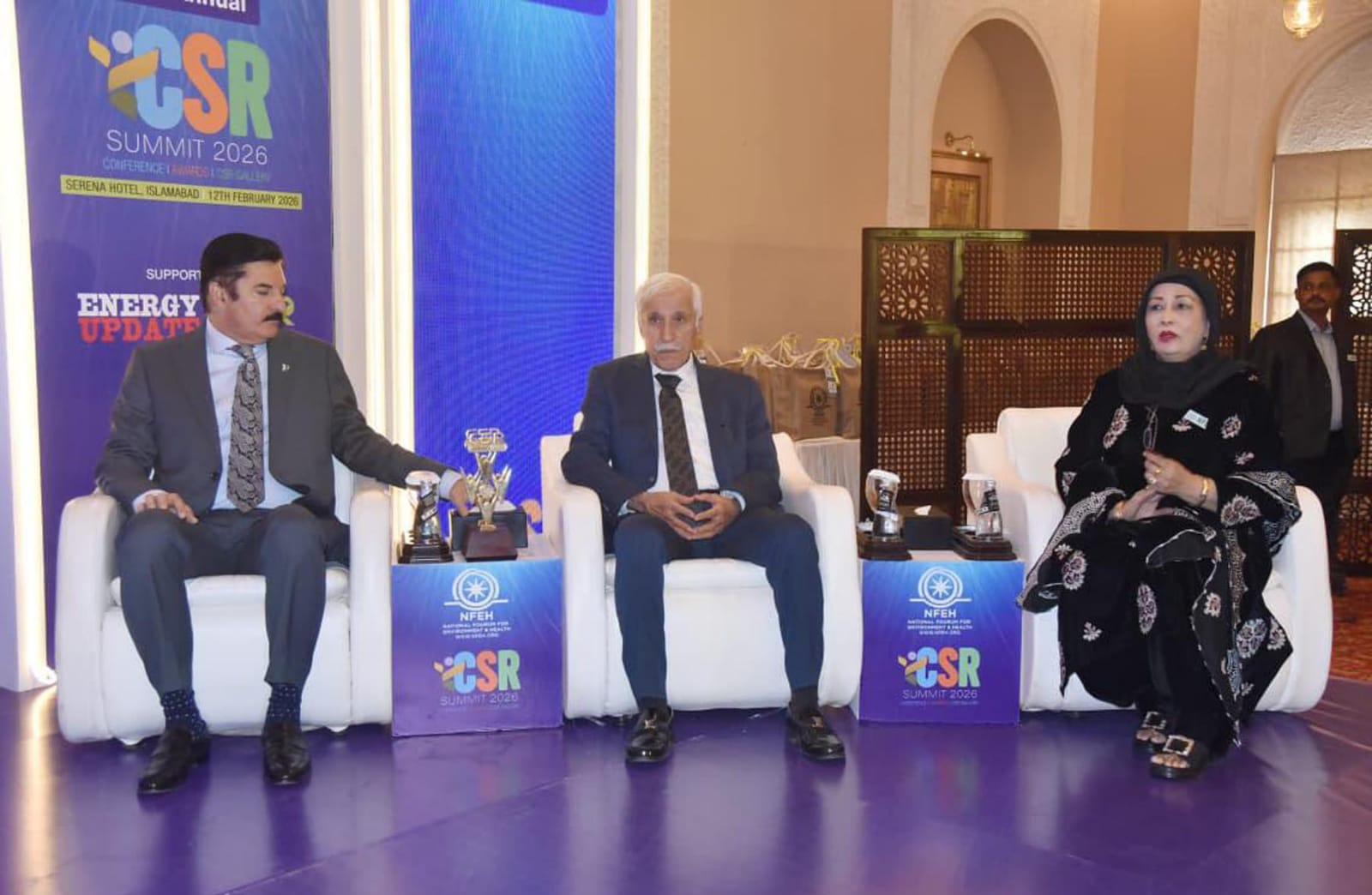
ISLAMABAD, FEB 13 /DNA/: Khyber Pakhtunkhwa Governor Faisal Karim Kundi has said that around one million women across the country are currently benefiting from the Benazir Income Support Programme (BISP), adding that the number of beneficiaries should gradually decrease as poverty and economic backwardness decline in Pakistan rather than continuing to rise.
He expressed these views while speaking as the Chief Guest at the 18th Annual CSR Summit & Awards 2026, organised by the National Forum for Environment and Health (NFEH) at a local hotel. On the occasion, more than 70 national and multinational organisations were honoured with CSR Awards in recognition of their outstanding contributions to social welfare, sustainability, and community development.
Addressing a distinguished gathering of corporate leaders, policymakers, and development practitioners, Governor Kundi said a continuous increase in the number of BISP beneficiaries should be a matter of concern, as it reflects the growing number of families being pushed below the poverty line due to economic hardship.
He highlighted that past governments led by the Pakistan Peoples Party had taken landmark initiatives for women’s empowerment by establishing institutions such as First Women Bank Ltd and women police stations to ensure gender equality, social justice, and economic participation of women.
The Governor stressed that the business community can play a transformative role in reducing poverty and backwardness through meaningful CSR initiatives. He assured participants that the doors of the Governor House in Khyber Pakhtunkhwa remain open for collaborative programmes with the corporate sector aimed at uplifting underprivileged communities. He also praised the province’s business fraternity for continuing to contribute to the national economy despite challenging security conditions.
Presiding over the ceremony, Federal Minister for Investment Qaiser Ahmed Sheikh said Corporate Social Responsibility has evolved into an integral component of modern business strategy. He noted that investment today is not limited to economic indicators but must focus on improving lives, generating employment, reducing poverty, and strengthening social stability.
He emphasised that businesses are now key partners in social progress alongside economic growth. Referring to China’s remarkable journey of sustainable development, he observed that long-term planning, industrial policy, technological advancement, and consistent investment in education and skills had enabled China to lift hundreds of millions out of poverty. He said this transformation demonstrates that education, innovation, and human capital development are the pillars of sustainable growth.
The Minister underlined that investment in human resources remains the most effective pathway to poverty reduction and economic stability. He reiterated that strengthening education, research, and skill development through public–private partnerships is essential for inclusive and long-term national progress.
Former Federal Minister for Investment Muhammad Azfar Ahsan described the presence of 26 million out-of-school children as one of Pakistan’s biggest barriers to development.
He said meaningful national progress would remain difficult to achieve unless this challenge is addressed, adding that the business community can play a critical role under its sustainability and CSR commitments. He called for unified efforts by stakeholders from politics, business, and the economic sector to collectively overcome these challenges.
Former Chief of the Naval Staff Muhammad Asif Sandila shared the progress of the Mowain Foundation, established in 2015. He said the foundation began by adopting two government schools and has now expanded to managing 338 schools with an enrolment of 45,000 students, 60 per cent of whom are girls. He added that 76 per cent of the foundation’s 3,300 graduates have become self-employed after receiving vocational training, stressing that technical skills must accompany formal education to economically empower underprivileged families.
Musarrat Jabeen, Executive Director of the Securities and Exchange Commission of Pakistan (SECP), highlighted ongoing efforts to strengthen documentation and reporting of sustainability, ESG, and CSR compliance among major corporate organisations.
Humaira Zia Mufti, Secretary of the National Commission on the Status of Women (NCSW), noted that women make up only 23 per cent of the formally employed workforce in Pakistan. She pointed out that while women constitute nearly half of the agricultural workforce, most remain unpaid. She outlined NCSW’s ongoing initiatives to promote financial empowerment, gender equality, and justice through the use of digital technologies.
NFEH President Muhammad Naeem Qureshi said the CSR Summit is held annually to bring together leaders from industry, business, charities, philanthropy, government, and the public sector under one platform to coordinate efforts for addressing social and economic challenges.
NFEH General Secretary Ruqiya Naeem said the summit recognises and honours leading organisations in sustainability, philanthropy, and good corporate governance, acknowledging their vital contributions to the welfare of marginalised communities.
Renowned speakers including medical influencer Affan Qaiser, leadership trainer Umair Jalianwala, Fruit of Sustainability CEO Sarim Mehmood, SSWMB Managing Director Tariq Ali Nizamani, NFEH Vice-President Nadeem Ashraf, and other distinguished participants also addressed the summit, sharing insights on sustainable development, social impact, and corporate responsibility.