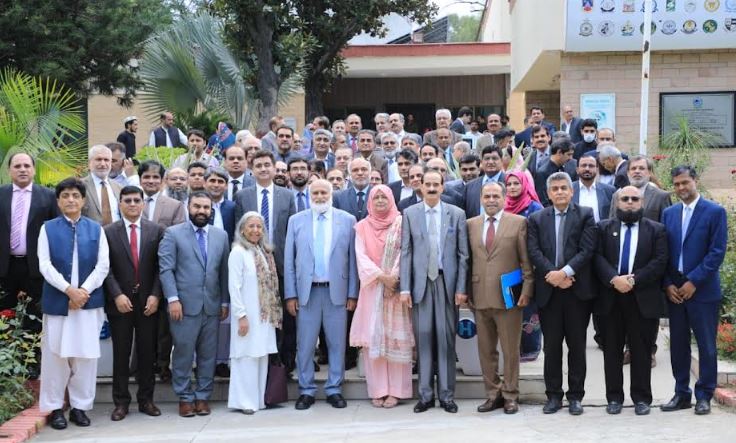
ISLAMABAD, MAY 12 /DNA/ – The Higher Education Commission (HEC) Pakistan brought together heads of universities from across the country to discuss key reforms, challenges facing the higher education sector, and the future priorities aimed at its strengthening the for an enhanced role of academia in the socio-economic development of the country.
The meeting was attended by Prof. Dr. Zahoor Ahmed Bazai, Chair, Vice Chancellors’ Committee, Prof. Dr. Niaz Ahmad Akhtar, Chairman HEC, and Prof. Dr. Zia Ul Haq, Executive Director HEC with participation of over 200 Vice Chancellors and Rectors of public and private sector universities joining both physically and virtually.
The meeting marked the formal launch of HEC’s online and paperless degree attestation system thus enabling the applicants to get their educational documents attested without visiting HEC or submitting any original degrees/transcripts.
In addition, HEC also announced the Best Researcher Awards 2025 and National Research Programme for Universities Awards 2025-2026 (Federal Zone) in recognition of the outstanding research contributions of the faculty members in promoting a culture of research and innovation in the country.
In his address, Dr. Niaz Ahmad Akhtar extended his felicitation to the academia and the entire nation on the first anniversary of the Marka-e-Haq, paying rich tribute to the gallant military, the political leadership, and the nation. “The soldiers of our motherland proved their utmost professionalism and vigilance while the nation stood united with the brave armed forces,” he said. He also highlighted Pakistan’s indigenous technological and strategic capabilities and lauded the contribution of academia towards the national security, innovation, and self-reliance. Referring to his recent visits to universities in various regions, he shared his contentment that the universities are performing “extremely well”. He reiterated HEC’s resolve in facilitating and enabling the higher education institutions, in line with its mandate. Highlighting the significance of youth development, he urged the universities to stay focused on building the future of nation by equipping the youth with employability-focused education, skills, and ethical values.
The Chairman underlined HEC’s recent initiatives and reforms, including the launch of a paperless degree attestation system, the approval of policy on Dual, Double and Joint Degree Programmes, internationalisation efforts through policies like Transnational Education Policy, digitalisation of university operations, and the requirement of HEC’s NoC to set up any new campuses. He also apprised the forum of the HEC’s National Skill Competency Test (NSCT) for IT graduates to align academic outcomes with the rapidly evolving demands of the global technology sector.
Dr. Akhtar appreciated the provincial HECs for their cooperation with the HEC Pakistan particularly in execution of its policies. He urged the universities to develop curricula in line with their specific needs while ensuring adherence to the HEC guidelines on curriculum development. Sharing updates on Pakistani universities progress in various international rankings, he dilated on various committees constituted by HEC to recommend reforms in key academic areas, and improvement of their global standing. Acknowledging that the higher education sector is confronted with severe financial hardships, he said that efforts are afoot to work with the government to ensure resolution of the issue. He noted that administrative and academic expenditures of the HEIs have risen sharply, as the students’ enrolment has significantly risen to approx.3.9 million.
Earlier in his welcome address, Executive Director HEC Dr. Zia Ul Haq shared comprehensive presentations on HEC’s new interventions in the form of policies and initiatives. Describing the HEC Policy on Dual, Double and Joint Degree Programmes, he said the framework is aimed at providing greater academic flexibility to students and institutions. He maintained that the policy is applicable to both public and private sector universities and allows the higher education institutions to develop local-local and local-foreign collaborations.
Dr. Haq briefed the participants on HEC’s fully online and paperless degree attestation system, stating that the revamped mechanism significantly reduces processing time, enabling swift verification while eliminating long queues of applicants.
The Executive Director also briefed the university leadership on updates about the HEC’s policy on engagement of visiting faculty in higher education institutions. He underlined that HEC is revising the Criteria for establishment of a new University and Institution in line with the current academic and institutional requirements.
The HEC’s Executive Director also shared a detailed presentation on the financial constraints facing the sector. He said that the recurring funding to HEC has been stagnant since 2018 against the ever-increasing expenses, rise in the student enrolment ratio and the number of recruited faculty and staff. He stressed the need for uninterrupted allocation and release of funds to the sector for the real impact of academic endeavours.
Prof. Dr. Zahoor Ahmad Bazai, Chair of the Vice Chancellors’ Committee Meeting & Vice Chancellor of University of Balochistan, Dr. Attaullah Shah, Vice Chancellor- Karakorum International University, Gilgit, Dr. Muhammad Zahid Latif, Rector- National University of Sciences & Technology, Islamabad, Dr. Najma Najam, Pro-Vice Chancellor- Institute for Art & Culture, Lahore, Dr. Jahanzeb Khan, Vice Chancellor University of Science and Technology Bannu, Dr. Tehmina Nangraj, Vice Chancellor- Begum Nusrat Bhutto Women University Sukkur, Sindh, Dr. Usman Ghani, Director, Institute of Management Sciences, Peshawar and others also expressed their views and identified different areas needing interventions for improvement. Other Vice Chancellors also engaged in detailed discussions through a Question & Answer Session.
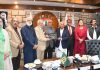
On this occasion, the Best Publication Awards were conferred upon Dr. Ilhan Niaz of Quaid-i-Azam University in Social Sciences, Dr. Hafiz Muhammad Rizwan of University of Veterinary and Animal Sciences in Life Sciences, and Prof. Dr. Muhammad Aslam of Bahauddin Zakariya University, Multan in Physical Sciences. Meanwhile, the Best Researcher Awards were awarded to Prof. Dr. Ghulam Ali Arain of University of Lahore in Social Sciences, Dr. Muhammad Usman Rashid of Shaukat Khanum Memorial Cancer Hospital and Research Centre in Life Sciences, and Prof. Dr. Muhammad Sharif of University of the Punjab in Physical Sciences. The Best Young Researcher Awards were presented to Dr. Faheem Gul Gilal of Sukkur IBA University in Social Sciences, Dr. Khalid Mehmood of The Islamia University of Bahawalpur in Life Sciences, and Dr. Haider Ali of NED University of Engineering and Technology in Physical Sciences.
HEC also bestowed NRPU Awards upon 47 researchers from universities of Federal Zone under NPU Call 2025-26. The NRPU Call 2025-26 placed special emphasis on strategic and emerging sectors including artificial intelligence, climate change, agriculture and food security, energy sustainability, oil and gas, mining and geology, medical and health sciences, engineering technologies, social development, and industrial innovation. As many as 169 detailed proposals were received by HEC for the awards. Out of 169 proposals, 142 have been awarded across the country.
The meeting concluded with a renewed commitment from HEC and the participating Vice Chancellors to work collaboratively for the promotion of quality higher education, research, innovation, and academic excellence in Pakistan, strengthening academia’s role in the national development.