
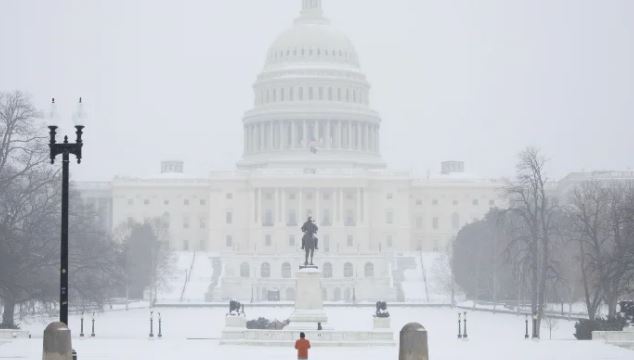
WASHINGTON: A monster storm barreling across swathes of the United States has killed at least 10 people and prompted warnings to stay off the roads, mass flight cancelations and power outages, as freezing conditions persisted into Monday.
As the storm dumped snow, sleet and freezing rain across the wide expanse, officials cautioned that an Arctic air mass behind the system would see temperatures fall dangerously low for days, prolonging disruptions to daily life.
The US National Weather Service (NWS) told Americans to expect more of the same weather conditions into Monday morning.
New York Mayor Zohran Mamdani said five people were found dead outside over the weekend in freezing temperatures. While he did not confirm the deaths were weather-related, he told reporters “there is no more powerful reminder of the danger of extreme cold.”
People sled on a snow-covered hill in Cherokee Park on January 25, 2026 in Louisville, Kentucky, US, January 25, 2026. — AFP
People sled on a snow-covered hill in Cherokee Park on January 25, 2026 in Louisville, Kentucky, US, January 25, 2026. — AFP
In Texas, authorities confirmed three deaths, including a 16-year-old girl killed in a sledding accident.
Two people died in Louisiana from hypothermia, the southern state’s health department said.
The PowerOutage.com tracking site showed more than 840,000 customers without electricity as of Sunday night, mostly in the US South where the storm intensified Saturday.
In Tennessee, where a band of ice has downed power lines, more than 300,000 residential and commercial customers were without electricity, while Louisiana, Mississippi and Georgia — where such storms are less common — each had over 100,000 outages.
The outages are particularly dangerous as the South is being walloped by treacherous cold that the NWS warns could set records.
Authorities from Texas to North Carolina and New York urged residents to stay home due to the perilous conditions.
“Stay off the roads unless absolutely necessary,” Texas’s Emergency Management Division posted on X.
The storm was moving Sunday into the northeast, dumping snow and sleet on heavily populated cities including Philadelphia, New York and Boston.
At least 20 states and the US capital Washington have declared states of emergency.
Residents in the capital Washington awoke to a blanket of several inches of snow on sidewalks and roads, followed by heavy sleet.
Federal offices have been preemptively closed for Monday.
Several major airports in Washington, Philadelphia and New York had nearly all flights cancelled for the day.
Tracking site Flightaware.com showed more than 19,000 flights into and out of the country had been scrapped since Saturday.
President Donald Trump, who was riding out the storm at the White House, said on his Truth Social platform Saturday: “We will continue to monitor, and stay in touch with all States in the path of this storm. Stay Safe, and Stay Warm!”
Polar vortex
The brutal storm system is the result of a stretched polar vortex, an Arctic region of cold, low-pressure air that normally forms a relatively compact, circular system but sometimes morphs into a more oval shape, sending cold air spilling across North America.
People walk across Sixth Avenue as snow falls in New York City, US, on January 25, 2026. — AFP
People walk across Sixth Avenue as snow falls in New York City, US, on January 25, 2026. — AFP
Scientists say the increasing frequency of such disruptions may be linked to climate change, though the debate is not settled and natural variability plays a role.
But Trump — who scoffs at climate change science and has rolled back green energy policies — questioned how the cold front fit into broader climatic shifts.
“WHATEVER HAPPENED TO GLOBAL WARMING???” the Republican leader posted.
The NWS warned that heavy ice could cause “long-duration power outages, extensive tree damage, and extremely dangerous or impassable travel conditions,” including in many states less accustomed to intense winter weather.
Authorities warned of life-threatening cold that could last a week post-storm, especially in the Northern Plains and Upper Midwest, where wind chill lows were forecast to dip to extremes under -50°F (-45°C).
Such temperatures can cause frostbite within minutes.