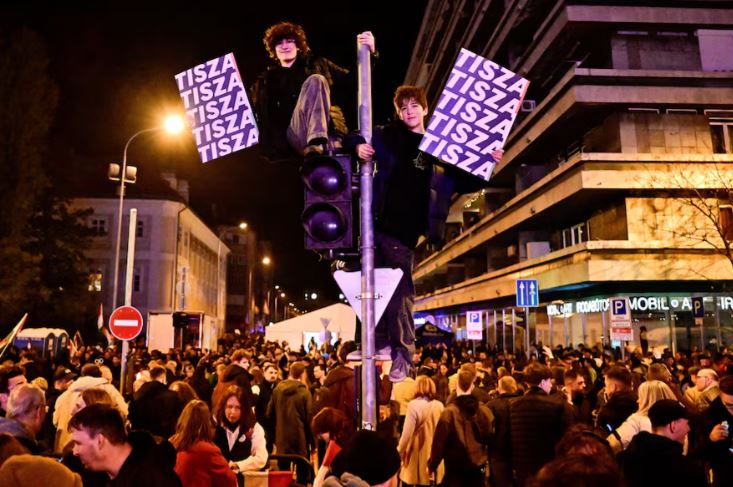
BUDAPEST, April 13 – Hungarians were waking up to a political earthquake on Monday, after a landslide victory for the centre-right opposition reverberated everywhere from Washington to Kyiv, sending local markets surging and turning Budapest into a party zone.
The ballot’s implications stretched far beyond the borders of the landlocked country of under 10 million people, as outgoing nationalist Prime Minister Viktor Orban was a key ally of both U.S. President Donald Trump and Russia’s Vladimir Putin, and had frustrated European efforts to aid war-torn Ukraine.
Supporters of election winner Peter Magyar’s Tisza party hope he can unblock billions in European Union funds frozen over concerns about democratic standards, bolster the rule of law and hold those they accuse of wrongdoing under the previous government to account thanks to his two-thirds supermajority.
“It is an immense honour that you have empowered us to form a government with the most votes ever received, and to work for the next four years for a free, European, functioning, and humane Hungary,” Magyar posted on X on Monday.
The Hungarian forint surged 2.5% to a more than four-year high against the euro on Monday, while the Budapest stock exchange gained almost 3% in anticipation of the EU funds starting to flow.
EU leaders, Ukraine’s President Volodymyr Zelenskiy and Trump’s Democrat opponents in the United States have all warmly welcomed Magyar’s victory. Orban has blocked a 90-billion-euro ($105 billion) loan to war-battered Ukraine.
German Chancellor Friedrich Merz said on Monday that decision-making in the EU, including with regard to Russia, would become easier after Magyar’s win.
The Kremlin said on Monday Russia respected the choice of Hungarian voters and would continue what it called “pragmatic ties” with the new government in Budapest.
‘WE WANT TO STAY WITHIN THE EUROPEAN UNION’
In Budapest many residents were recovering from wild celebrations that saw the streets of the capital thronged with revellers well into the early hours.
Among those letting themselves go was Zsolt Hegedus, a leading candidate for health minister, whose dance moves on stage following Magyar’s speech went viral online.
Tisza supporters spoke on Monday morning of their optimism about the end of Orban’s adversarial relations with Brussels.
“We are part of the European Union and we want to stay within the European Union,” said network engineer Gyula Ferenc Teleki.
Magyar has pledged a sweeping anti-corruption drive, including stronger judicial independence and tougher public procurement rules to help secure the release of the EU funds.
On Sunday, Magyar called on Hungary’s chief prosecutor, the heads of the top court and the media authority, and other officials to resign, saying the country’s public institutions had been captured by Orban loyalists over the past 16 years.
“I cannot believe…,” said Peter, who declined to give his surname, his voice cracking with emotion as he spoke about the election result.
“We have so many problems because the Hungarian state is not in good condition, but I think we have many funds from the EU, they will be coming, and maybe the new government has a better way to rule this country.”
Some conservatives, including a former Polish minister granted asylum in Hungary by Orban, lamented the election result.
“Conservative Poland and Europe have lost a very important bastion,” said Marcin Romanowski, who served in Poland’s previous nationalist Law and Justice government. He is wanted by Polish prosecutors on charges of abuse of power.
Reporting by Anita Komuves, Kristina Than, Anna Lubowicka, Marco Trujillo, Writing by Alan Charlish, Editing by Gareth Jones