Islamabad: Coordinated and uniform action and a comprehensive policy framework, along with the inclusion of local stakeholders and Track 2 actors, are required to restore the deteriorated Pakistan-Afghanistan relationship, regulate cross-border trade, protect civilians, and ensure sustainable governance. Unilateral measures and purely militarized interventions cannot resolve the region’s complex security, humanitarian, and economic challenges.
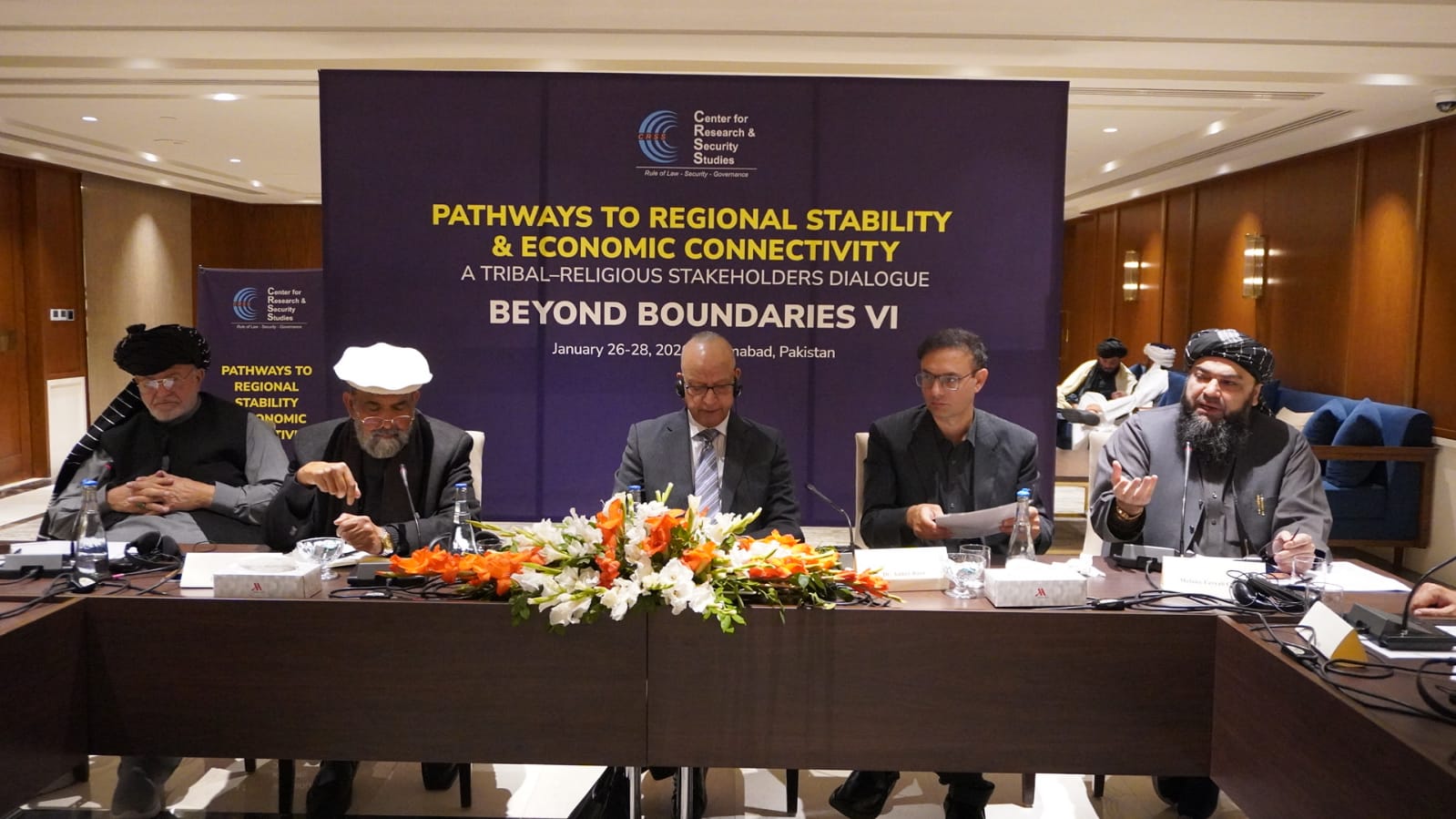
This was the recurring message at Beyond Boundaries VI: Dialogue on Regional Stability and Economic Connectivity, recently held in Islamabad. Organized by the Center for Research and Security Studies (CRSS), the three-day dialogue brought together tribal elders, religious scholars, thought leaders, and policy and security experts from Khyber Pakhtunkhwa, Balochistan, and Islamabad.
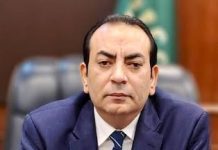
Dr. Shoaib Suddle, Chairman of the One-Man Commission on Minority Rights, emphasized that tribal and religious leaders have historically acted as bridges between communities and the state, and that their engagement is essential for lasting peace.
He stressed that terrorism is neither rooted in Islam nor tribal culture, and that justice, dialogue, economic empowerment, and regional connectivity form the foundation for sustainable stability.
Peace and stability in the Pak-Afghan and the broader region cannot be achieved with power alone, but instead fostered through mutual respect, security cooperation, and good governance.
The tribal leadership has a proven history of successfully mediating conflicts between Pakistan and Afghanistan during some of the most testing times in the two nations’ bilateral histories, and the efforts to achieve peace in the region cannot succeed in isolation from their participation.
Thus, the wisdom, experience, expertise and relevant understanding of the Pak-Afgan tribal and religious fraternity must be leveraged to promote peaceful coexistence between the two sides, at a time when the tensions between Pakistan and Afghanistan have surged to their highest levels in decades.
He urged both sides to i) prioritize the greater collective interest over hatred and wisdom over anger, ii) convert the border line into a pathway for economic connectivity and empowerment at the local, national and regional level, instead of an instrument of politics.
The availability of economic, social and political development opportunities to the tribal communities across the Pak-Afghan border region, will embolden them to be part of the solutions, refute divisive narratives, and gatekeep against the extremist activities. Once onboarded and entrusted with these mandates, they can virtually act as the eyes and ears of the state for peace, security, and good governance.
Former Chairman CII, Dr. Qibla Ayaz reflected on the FATA merger’s aftermath, noting that administrative delays prevented development funds from reaching local communities, leaving citizens frustrated and vulnerable. He highlighted the need for visible investment in infrastructure, health, and education to break cycles of violence and displacement.
He said that there exists an ample space between Pakistan and Afghanistan for collaboration on the security issues of mutual concern, which can create stakes for cooperation in other areas of contention.
Track 2 diplomacy has a huge potential for positively and constructively soothing the acrimony currently at its highest in the history of the two countries, with tribal leaders and border communities as the stakeholders and leaders of dialogue. As victims of the tensions and harbingers of solution, their grievances with the state should never be mistaken for rebellion against the state. Diplomatic options of engagement over punitive measures like border closures. Diplomatic options of engagement over punitive measures like border closures must be prioritized.
Chief Khateeb KP, Molana Tayyab Qureshi, emphasized that counterterrorism is not the sole responsibility of the state; rather, it requires active participation from all segments of society, with both collective and individual efforts playing a critical role in addressing the menace of terrorism that continues to afflict Pakistani society.
CRSS Executive Director Imtiaz Gul stressed that dialogue over unilateral action, diplomacy over force, and inclusive decision-making are crucial for rebuilding public trust.
Participants expressed grave concern over the surge in terrorist activity across KP and border districts despite repeated military operations. Civilians continue to face displacement, restricted movement, and disruption of livelihoods. Tribal leader Malik Khan Marjan highlighted that fragmented policies and inconsistent approaches have weakened public trust, and that jirga-based dialogue and inclusive decision-making offer the most sustainable path to conflict resolution. Malik Bismillah Afridi underscored the human cost of forced evacuations in Tirah Valley, urging clear protocols to protect civilians during counterterrorism operations. Malik Abdul Razzaq noted that the absence of a uniform refugee and returnee policy perpetuates recurring crises along both sides of the border.