
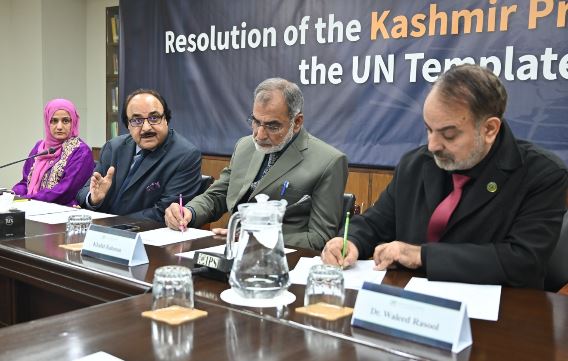
The deaths of Kashmiris is the death of the UN’s commitment to the right to self-determination: Dr Gilani
Islamabad, December 22: /DNA/ – India internationalized the Kashmir dispute by referring it to the UN in 1948. In its submissions, India itself endorsed the will of the people of Jammu and Kashmir to accede to Pakistan, or to opt for independence, thus unconditionally conceding the case’s jurisdiction under the UN Charter. This legally anchors the Kashmir issue within the UN framework of self-determination, rendering all of India’s unilateral actions, particularly those taken after August 5, 2019, legally untenable and contrary to the will of the Kashmiri people.
These observations were made during a public talk titled “Resolution of Kashmir Problem under the UN Template,” held at the Institute of Policy Studies (IPS), Islamabad. The participants included Dr Syed Nazir Gilani, president Jammu Kashmir Council on Human Rights, Khalid Rahman, chairman IPS, Farzana Yaqoob, former minister Azad Jammu and Kashmir (AJK), and Dr Waleed Rasool, executive director Institute of Dialogue, Development, and Diplomatic Studies.
During his discourse, Dr Gilani focused on the centrality of international law and UN mechanisms in understanding the Kashmir dispute. He noted that the ongoing sufferings in Kashmir represent not only a grave humanitarian tragedy but also a serious erosion of the UN’s fundamental principle of the right to self-determination. Citing Article 1(2) of the UN Charter, he stressed that the people of Jammu and Kashmir possess an equal and inalienable right to determine their political future through free and fair means. In this context, he emphasized that the “death of Kashmiris is the death of the UN’s commitment to self-determination”.
Dr Gilani further highlighted that both the UK and the US had historically been willing to offer third-party mediation to resolve the dispute, including proposals to refer the matter to the International Court of Justice. However, to realize such a course, Pakistan needs to cultivate institutional expertise and related political arrangements in AJK. Likewise, in addition to advancing development and good governance, the Government of Kashmir must proactively assert its legal and political mandate at international forums. One possible avenue is invoking the principle of restitution to challenge India’s illegal actions in Kashmir and its broader violations of the UN framework.
Stressing the need for greater initiative, Farzana Yaqoob underlined the need to adopt a proactive approach to the Kashmir issue. She suggested that the governments of both Pakistan and AJK must fully utilize the legal and political options available under their respective constitutional frameworks to advance the case of Kashmir at different forums.
In concluding remarks, Khalid Rahman underscored that Kashmir is neither a bilateral nor a territorial issue, nor merely a human rights concern. Rather, it is an international conflict recognized by the UN and reaffirmed through its resolutions. He emphasized that Pakistan must strengthen its narrative by grounding it in historical developments and facts. Moreover, in addition to building its case on human rights violations in Kashmir, Pakistan needs to build a strong legal case that can serve as the fundamental framework for resolving the dispute. This, he stressed, requires exposing weaknesses in India’s position while consistently reinforcing the legal merits of Pakistan’s case under international law.