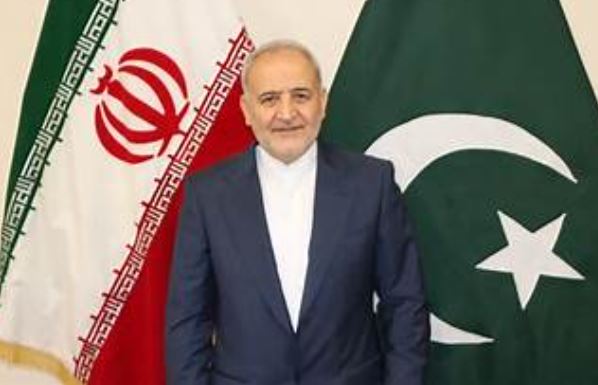
ISLAMABAD, Mar 14: Ambassador of the Islamic Republic of Iran to Pakistan, Dr. Reza Amiri Moghadam, has stated that International Quds Day represents the voice of oppressed muslims in Palestine and across the world.
Addressing a gathering organized by the Embassy of the Islamic Republic of Iran in Islamabad, the ambassador said that International Quds Day was initiated by Iran’s late Supreme Leader Ruhollah Khomeini and is observed every year on the last Friday of the holy month of Ramadan, known as Jumat-ul-Wida.
He said the day reminds the world of the sacrifices made by, Late Supreme Leader, Ayatollah Ali Khamenei (Shaheed), who raised his voice against Israeli oppression in Palestine, Lebanon, Syria, and Yemen.
According to him, Ayatollah Ali Khamenei sacrificed his life in the struggle for justice and freedom.
The ambassador welcomed political leaders, government representatives, and members of civil society who participated in the Quds Day event held in Islamabad.
He emphasized that the sacrifices of martyrs continue to inspire Muslims worldwide to stand against injustice.
Referring to regional developments, the ambassador said that several attempts were made to destabilize Iran during the past year, but they failed due to the unity and wise leadership of the Iranian nation.
He stated that the first attempt involved the martyrdom of senior Iranian military commanders, which adversaries believed would weaken Iran’s resolve, but the nation remained strong.
He further claimed that during certain demonstrations in Iran, miscreants attempted to create unrest and vandalism, but the situation was brought under control within a few days.
According to him, another attempt was based on the assumption that Iran’s system would collapse after the leadership transition, but that prediction also proved incorrect.
The ambassador said Iran’s political system is institutional and not dependent on a single individual. “Our leadership structure is strong and resilient, and the system continues to function effectively,” he added.
Speaking about Iran’s foreign policy, he said Iran’s disagreement with the United States is not limited to the nuclear issue, noting that dialogue had taken place previously but tensions persisted.
He stressed that Iran supports the Palestinian cause and the rights of Palestinians to self-determination.
The ambassador said that before the Iranian Revolution, Palestinians were already struggling for their rights, but after the revolution, Iran increased its support for the Palestinian cause as well as for resistance movements in the region.
He expressed pride in the resistance of groups such as Hezbollah and Hamas, claiming they have resisted Israeli military actions in Gaza and Lebanon.
The ambassador also questioned the effectiveness of international institutions, asking why the United Nations had not been able to prevent attacks in Gaza.
He reiterated that Iran does not intend to occupy any territory but will continue to support Islamic countries and oppressed communities.
Referring to the situation in the Middle East, he said that the idea of a Two-State Solution, proposed after the establishment of Israel in 1948, remains unresolved.
The ambassador concluded by saying that Iran seeks peaceful and cordial relations with regional and other Islamic countries and hopes that the region will eventually achieve stability and unity once external conflicts are resolved.
Speakers at an event marking “International Al-Quds Day” strongly criticized the policies of the Western powers and Israel, while expressing support for Iran and the Palestinian cause.
Addressing the gathering, Senator Allama Raja Nasir Abbas said that the enemies seek to destabilize the region to establish their dominance.
He argued that the ongoing tensions are not only a conflict involving Iran but part of a broader struggle affecting Muslim countries.
Abbas highlighted Iran’s historical civilization and resilience, saying that the Iranian nation has a strong cultural and intellectual tradition.
He noted that Iran has built stable institutions, pointing to its literacy rate, the participation of women in professional fields such as medicine and business, and the country’s educational development.
He also remarked that the philosophical ideas of Alkama Muhammad Iqbal are widely studied and appreciated in Iran.
Criticizing Western leadership, Abbas questioned the moral standing of Israeli policies under Prime Minister Benjamin Netanyahu, which he described as oppressive toward Palestinians.
Speaking on the occasion, Palestinian representative Khalid Khodoomi said that Muslim nations should unite in support of Palestine.
He praised the resistance of “Hamas” and stated that the struggle for Al-Quds (Jerusalem) continues.
He also said Iran has taken a firm stand against what he described as imperialism and oppression.
Independent analyst Abdullah Gul, said that the international community should implement “United Nations” resolutions concerning the Palestinian issue.
He added that Israel has lost credibility and moral authority in the Palestine conflict, particularly regarding developments in the Gaza Strip.
He also referred to the strategic importance of the “Strait of Hormuz”, noting Iran’s influence over the key waterway.
Speakers concluded by urging unity among Muslim countries and reaffirmed their support for the Palestinian cause and the status of Al-Quds.